Saturday, September 11, 2010

Film Review: Tamara Drewe

TAMARA DREWE
DIR: Stephen Frears
CAST: Gemma Arterton, Roger Allam, Tamsin Grieg,
Dominic Cooper, Bill Camp, Luke Evans, Jessica Barden


I haven’t read the graphic novel that Stephen Frears’ latest is based on, but, much to my chagrin, I do have rather a lot of experience with the radio soap The Archers which it is at least tangentially spoofing. My stepfather is a huge Archers fan, and so for years I’ve had to listen to its 12 minute chunks of insufferably trivial storylines, “ooh arr” stereotype accents and shockingly awful performances. TAMARA DREWE adds a large dollop of sex to the upper middle class soapy mix, but much of the time it seems stuck between making jokes at the expense of its characters and the soap they are enacting and simply being as insufferable as what it is spoofing.

An extremely episodic film, TAMARA DREWE really has three strands which intertwine. The first concerns philandering novelist Nicholas Hardiment (Allam) and his devoted wife Beth (Grieg, an Archers veteran herself, as it happens), the second has Tamara Drewe (Arterton) returning from London to do up and then sell her parents house, in the process stirring the passions of both Nicholas and the Hardiment’s gardener Andy (Evans), who are both disappointed when she begins dating rock musician Ben (Cooper). The third story has two village teenagers, played by newcomers Charlotte Christie and Jessica Barden, who surreptitiously manipulate events, largely so that Jody (Barden) can stay close to her idol Ben.

So it’s quite complex, storywise, and that’s not all that’s going on. Unfortunately the stories don’t mesh as they should, and what you’re left with is a film that is interesting only in fits and starts. The main character of Tamara is largely to blame for this, as she’s probably the least interesting person in the film. Arterton is perfectly cast, she looks like an illustration from a graphic novel anyway, unfortunately, in a major step back from her impressive work in THE DISAPPEARANCE OF ALICE CREED, she’s just as flat as any drawing. The film doesn’t seem to know who Tamara is; romantic innocent or harlot. In many ways she’s less a character than a McGuffin with very nice legs, merely a device to draw the various characters and plot strands together. It’s not Arterton’s fault that she falls flat, but it’s not a great role for her first mainstream lead. Another issue with Tamara’s story is the bludgeoning predictability of it. Perhaps this is part of the way it is spoofing soap conventions, but if so it’s delivered with no humour, and lands with a graceless clang.

The side stories are much more interesting. Tamsin Greig gives an unexpectedly soulful performance, in a film otherwise defined by cartoony extremes. She’s extremely effective as Nicholas’ wronged wife, and the undertone of flirtation that runs through her relationship with Bill Camp (as a guest at the Hardiment’s writers retreat) is the one place where the script seems to have any real emotional content when dealing with the adult characters. However, the film is stolen by the village teenagers Casey and Jody (Charlotte Christie and Jessica Barden), their double act as rampantly hormonal and extremely bored 15 year olds is absolutely hilarious, but it is 17 year old Barden, best known, if at all, for British soap Coronation Street, who really runs away with their every scene. The dialogue written for her is spot on (when she sees Tamara with Ben she asks “why does she get Ben? I’ve been in love with him since March”), but it’s her energy in the role that makes her so magnetic, in one of the few things it gets absolutely right the film ends with Jody, in one of her funniest moments.

The look of the film is odd, I think the oversaturated colour and the bold costume and make up design is supposed to put us in mind of graphic novel techniques, instead all it really does, assisted by Frears’ rather flat shot selection and schematic editing, is make the film look like slightly overbright television. Several of the performances also suggest this, there’s a very stiff quality to much of the acting, with the discussions between the various writers on the retreat feeling especially rote, and Luke Evans as wooden as the stakes he’s frequently seen hammering into the ground.

Ultimately TAMARA DREWE is a frustrating film, it’s neither consistently funny nor consistently engaging enough to pass muster as comedy or drama, the stories are far too telegraphed and predictable to really engage and whenever the side characters do begin to charm us, the film cuts away from them back to the cardboard Tamara or the walking clichés courting her. It’s perhaps worth catching a matinee for Tamsin Grieg and Jessica Barden’s performances, but otherwise, this just doesn’t quite work.

LFF 2010: Preview Pt. 1

Because there is so much on at this year's London Film Festival I'm going to divide my preview into three parts. This first one will focus on the bigger things happening; the Galas, Special Screenings and the Film on the Square section. The New British Cinema and French Revolutions strands will make up Part 2, and Cinema Europa and World Cinema will be addressed in Part 3.

The films I'll be mentioning are a mix of personal picks and, especially in this first part, some of the notable titles on show. For the full programme, CLICK HERE.

Notes: Within their strands films are listed alphabetically by title. Short synopses are taken from the LFF brochure.


GALAS & SPECIAL SREENINGS
127 Hours
DIR: Danny Boyle

Gripping, adventurous film-making and headline grabbing drama from Oscar-winning Danny Boyle.
The European premiere of Boyle's latest follows a Toronto screening (a tactic that worked nicely for Boyle with SLUMDOG MILLIONAIRE). The trick here will be making the excruciating series of events that happened to Aron Ralston (James Franco), who had to cut off his own arm with a dull penknife after becoming trapped while rock climbing, true to life without putting people off with extremes of gore. It will also be an interesting test for Franco, impressive in a lot of supporting roles, and now carrying a film almost completely alone.


Another Year
DIR: Mike Leigh

A virtuoso, London-set exploration of family and friendship from Mike Leigh.
I'm not a massive fan of Mike Leigh's, but this latest reieved excellent reviews when it premiered at Cannes, and features several long term collaborators, as well as leading role for the always excellent Jim Broadbent.


Biutiful
DIR: Alejandro González Iñárritu

A powerful contemporary drama set in Barcelona's underworld, with an award-winning performance from Javier Bardem.
Iñárritu's latest has excited a lot of interest while doing this year's festival circuit, capped with the Cannes Best Actor prize for Javier Bardem, but I have to say that the longer synopsis reads a little familiar to me, and Iñárritu is a filmmaker I've never entirely warmed to.


Black Swan
DIR: Darren Aronofsky

A sophisticated psychological thriller set in the milieu of the New York Ballet.
Though Darren Aronofsky is another filmmaker I haven't warmed to to the degree that most film lovers seem to have, Black Swan has me intrigued. There's plentiful Oscar buzz for Natalie Portman, following its recent Venice premiere, and of course there's the prospect of Portman and co-star Mila Kunis making out, but it's the resembelence to Satoshi Kon's Perfect Blue that I'm interested in. Aronofsky has long wanted to remake that film, and from the trailer it looks like he's got close here.


Conviction
DIR: Tony Goldwyn

Based on real events, Hilary Swank stars in this uplifting story of one woman's persistence to overturn a miscarriage of justice.
The big question of this based on a true story drama is likely to be 'can Hilary Swank win a THIRD Oscar from under Anette Benning's nose?' Hopefully Conviction's uplifiting story casting Swank as a high school drop out who spent ten years becoming a lawyer so she could free her wrongfully convicted brother from life imprisonment will be a higher class of Oscar bait, especially with Sam Rockwell as the brother.


The Kids are All Right
DIR: Lisa Cholodenko

Julianne Moore and Annette Benning star in a smart and funny story of modern family life.
One of the most interesting casts in the festival; Julianne Moore, Anette Benning, Mark Ruffalo, Mia Wasikowska and Josh Hutcherson among them, along with a glowing critical reputation from the festival circuit and a recent US release is probably good enough reason for Kids to show, but you have to question the point when its UK release is in the same week as these LFF screenings. That said, this looks likely to be an extremely well acted and engaging drama, and a step forward for Cholodenko.


The King's Speech
DIR: Tom Hooper

The fascinating story of the relationship between King George VI and an unconventional Australian speech therapist.
This none more British effort boasts a star (Colin Firth) and director (Tom Hooper, whose last was The Damned United) hot off their most recent work, and it's likely that Firth's apparently excellent performance as George VI as he engages an Autralian speech therapist (Geoffrey Rush) to cure his pronounced stammer will see him get a second Oscar nod in as many years. Firth is been reliably worth watching lately (as is Helena Bonham Carter) and there could be no more appropriate festival to see this at.


Miral
DIR: Julian Schnabel

A richly textured look at one woman's experience of the Israeli-Palestinian conflict.
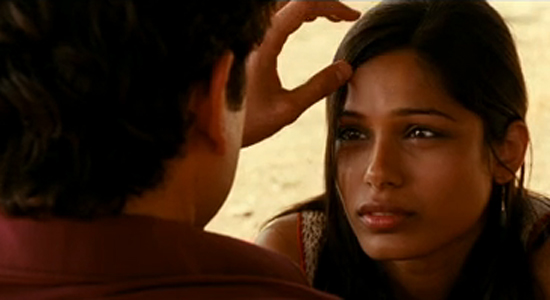
The early stills suggest that Julian Schnabel's latest shares the painterly beauty of his last film, The Diving Bell and the Butterfly. This time Schnabel has turned his focus on a young woman (the titular Miral, played by Freida Pinto) growing up in an orphanage and school for Palestinian children, who finds herself questioning the head's philosophy of non-violence when the intifada gains popularity. This should be provocative and evocative in equal measure.


West is West
DIR:Andy De Emmony

The funny and poignant sequel to East is East, in which the family return to their roots in Pakistan.
This is likely to be the big popular success of the festival, but if it's anything like its predecessor East is East that success will leave me feeling like some sort of alien, and baging my head against a table. I LOATHED East is East, and I'd rather stick pins in my eyes than see a sequel, but if you want it... here it is.


FILM ON THE SQUARE
13 Assassins
DIR: Takashi Miike

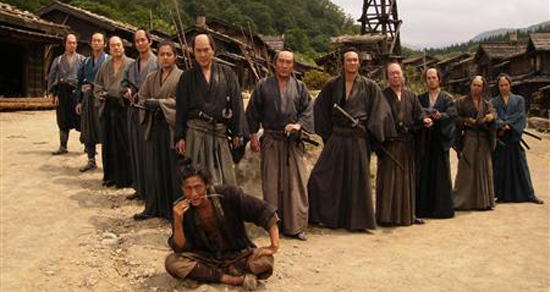
Takashi Miike's slam-bang period drama plays like a cross between Seven Samurai and King Hu's A Touch of Zen and stars Koji Yakusho and Yusuke Iseya.
Miike works fast, two to three films a year fast, and that can make him something of a scattershot talent, but he's remained edgy and interesting over the years, and there is almost always something to enjoy in his films, even if just for the craziness, and the references laid out above, combined with Miike, would seem to promise fun times.


Aurora
DIR: Cristi Puiu

Romanian director Cristi Puiu's study of a day in the life of an embittered, middle-aged divorcee is a disturbing and darkly comic portrait of male angst.
With his first film; The Death of Mr Lazarescu, Cristi Puiu was the filmmaker who really brought the present Romanian new wave to notice. Aurora is his first film since then, it sounds like it might be tough going; a three hour character study of an embittered divorced engineer who may turn violent, but if you've been enjoying what's been coming out of Romania of late then this would seem to be a must see.


Boxing Gym
DIR: Frederick Wiseman

Renowned documentary maker Frederick Wiseman's beautifully observed study of a Texas gym.
Frederick Wiseman's films are about as pure a form of documentary as you can imagine, and Wiseman, the lifelong observer, has now turned his attention to a Texas boxing club. It's an interesting subject to follow his last film, La Danse, about the Paris Opera Ballet, as Boxing Gym too would seem likely to be about people defining themselves through their physicality. Whatever it ends up being about, this should be fascinating because Wiseman is perhaps cinema's foremost people watcher.


Carancho
DIR: Pablo Trapero

Urban thriller and soulful romance collide in this Argentine drama about an ambulance-chasing lawyer who falls for an emergency medic.
Another national cinema that seems to be undergoing something of a renaissance. Argentinian films are suddenly getting exported, and there is evidence of a wave of interesting talent. Pablo Trapero's last film, Lion's Den, was highly acclaimed and Carancho reunites him with that film's star, Martina Gusman, casting her opposite the potential breakout star of Argentinian cinema; Ricardo Darin (XXY, The Secret in Their Eyes). The stills and synopsis suggest a thrilling noir with a romantic undertone, combine that with the cast and Carancho sounds very interesting.


Carlos
DIR: Olivier Assayas

Olivier Assayas takes on the life and crimes of notorious '70s terrorist and headline-grabber Carlos (aka 'the Jackal') in a fast-paced modern epic.
I have been hearing greaat things about this lengthy biopic of the infamous terrorist Carlos the Jackal, and particularly about Edgar Ramirez' leading performance. Perhaps the best reason to see it at LLF though is that it will be showing in its full 325 minute version, something you are very unlkely to see on the big screen otherwise. If nothing else it will be an experience.


It's Kind of a Funny Story
DIR: Anna Boden / Ryan Fleck

A funny, astute and authentic look at the sometimes difficult process of growing up.
I may have hated Boden and Fleck's first film, Half Nelson, but even through that film's barely in focus, 90% close up cinematography it was easy to see that they are able to draw strong performances from their actors. I'm interested to see how they can bring that skill to bear on what seems like a more mainstream project (the festival synopsis references John Hughes) and also to see how Zach Galifianakis does in what is likely to be the most dramatic role he's had to date.


Kaboom
DIR: Gregg Araki

An 'old school Gregg Araki movie', Kaboom is smart, sexy and so much fun.
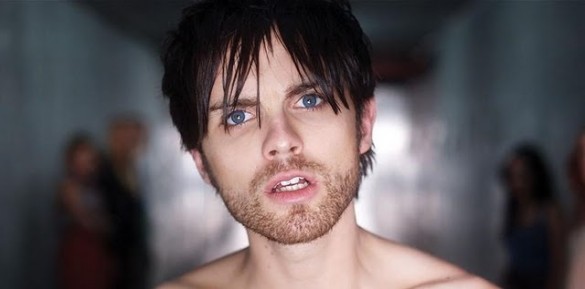
Gregg Araki is a hit and miss filmmaker, but I'm hoping that, though he's conciously revisiting the old ground of his 'Teen Apocalypse Trilogy' here, he can bring some of the weight of Mysterious Skin and perhaps some of the fun of Smiley Face to Kaboom. However, I'm most interested in this because it seem like British actress Juno Temple, who has impressed me in everything I've seen her in, finally has a really juicy role to get her teeth into.


Meek's Cutoff
DIR: Kelly Reichardt

An absorbing and beautifully composed western, set on the Oregon trail in the 1840s.
Kelly Reichardt is a filmmaker whose work I've been meaning to explore for a while, and Meek's Cutoff seems likely to be be a good starting point. The Oregon Trail setting and the narrative hook of three families lost with food and water running low suggest that this film will have a slightly more traditional narrative approach, and be more accessible than her minimalist work to date. Then there's the cast, made up of a selection of great character actors; Michelle Williams, Zoe Kazan, Will Patton, Paul Dano and the wonderful Scottish actress Shirley Henderson, who is always worth watching.


Surprise Film
Place your bets please. Notable absences from the announced programme include Sofia Coppola's Somewhere and the Coen Brothers' True Grit (the former is perhaps more likely, as No Country For Old Men took this slot in 2007). If I had an ultimate outside bet I'd suggest that Tron: Legacy would be PERFECT for this spot, but that's probably dreaming.


Surviving Life
DIR: Jan Švankmajer

Eugene prefers a life of dreams to everyday reality in surrealist animator Jan Švankmajer's witty extension of one of his own dreams.
Jan Švankmajer is a fascinating filmmaker, his work can be both nightmarish and beautiful (often in a single frame) and though his films are often baffling they are always intensely interesting to look at and technically astonishing (forget Aardman, nobody does stop motion better than Švankmajer). You may not eventually understand Surviving Life, but you're likely to be taken aback by it.

Thursday, September 9, 2010

Film review: The Last Exorcism

THE LAST EXORCISM
DIR: Daniel Stamm
CAST: Patrick Fabian, Ashley Bell,
Iris Bahr, Louis Herthum


I honestly can’t believe how badly THE LAST EXORCISM ends. For a good 75 of its scant 87 minutes it’s that rare thing; a genuinely interesting contemporary American horror film, it even ends in a perfectly satisfactory, if slightly anti-climactic, way. But when it ends that first time the movie fails to stop, and in doing so it takes a running jump off a cliff, and proceeds to spend the next ten minutes falling to a messy death. It’s a real shame, because there really is a great deal to like here, but those last ten minutes mean that I can’t recommend the film wholeheartedly.

The story is largely the same one that was told as far back as THE EXORCIST and has been revived recently in films like REQUIEM and THE EXORCISM OF EMILY ROSE. Once again a young girl (Bell) from a religious family begins acting strangely, leading to the belief that she may be possessed, and the film follows the efforts of a priest (Fabian) to exorcise her. However, that premise is given a couple of neat twists here. First of all the priest is a fraud, a man who has lost much of his faith, and secondly he’s doing this one last exorcism in order to expose the industry for the fraud it is, and to demonstrate his point he’s allowed a documentary crew to follow him.

Given the pedigree of its producer Eli Roth (of the HOSTEL films), THE LAST EXORCISM is perhaps surprising in its subtlety. Up until it loses its marbles in the last ten minutes this is a film that deals not in gore but in restraint, in implication, and gets its creep factor more from what you don’t see or hear than from what you do. It’s grounded by two excellent central performances from Patrick Fabian and Ashley Bell. Fabian is effective at drawing us into the faux documentary style of the film, giving a supremely natural performance as a ma whose whole life, it seems, is a performance of some sort (an early highlight comes when, to win a bet with the documentary crew, he inserts a recipe for banana bread into a sermon). There are shades of BEHIND THE MASK: THE RISE OF LESLIE VERNON in the way that he shows us how he fakes his exorcisms, and Fabian’s Reverend Cotton Marcus, though he’s a benevolent presence rather than a psychotic one, is just as genial a host in these early scenes as Vernon is in that film. As the film amps up the script becomes a little more by the numbers, but Fabian’s strong presence helps it retain credibility even as the camerawork and screenplay slip from their verite stylings.

Good though Fabian is, he and everyone else in the film is completely outshone by Ashley Bell. This has been an interesting pattern in these recent exorcism films; they’ve always seen standout performances from the young actress playing the possession victim. Bell’s sweetly naïve Nell Sweetzer is instantly lovable (in a lovely character beat she’s delighted when, after she admires them, the crew’s sound recordist (Bahr) gives her her boots) and her dextrous performance – in both a physical and an emotional sense – carries the film. With her girl next door prettiness and the obvious acting chops on show here, Bell is definitely a name to watch for and like Sandra Huller in REQUIEM she makes the film worth seeing by herself.

I was genuinely involved in THE LAST EXORCISM, because it does take the time to set up credible characters before introducing its horror elements, and that meant that even when, in the last forty minutes or so, Daniel Stamm’s directorial style veered away from faux documentary to something closer to traditional shaky-cam style I didn’t mind all that much, because while the direction serves the film well, this isn’t a film to come to for the pretty pictures, it’s the slow build of the story and characters that really make it work, and frankly that’s what a lot of American horror has missed of late.

I appreciated both the patient pacing (which gives the occasional shock real punch) and the film’s dedication to keeping it unclear just what is happening to Nell (well, until the last ten minutes take a huge shit on that aspect), until that disastrous ending this is more of a psychological than a visceral or supernatural tale, and it’s all the more effective for it because many of the real life possibilities thrown up for Nell’s condition are scarier by far than the supernatural ones.

On the whole I’d definitely recommend that you check out THE LAST EXORCISM, because it is both involving and at times unnerving, and because it boasts a couple of very fine performances from actors you likely haven’t seen before. However, I would suggest that you walk out the first time the film appears to end, believe me, staying for the last ten minutes is a bad idea.

Tuesday, September 7, 2010

The Greatest? Part 3: Leigh – The Big Picture / Huppert – A Story of Women

The next selections in this series find Jennifer Jason Leigh and Isabelle Huppert working in almost opposite circumstances; UNE AFFAIRE DE FEMMES sees Huppert in an acclaimed period piece, with Claude Chabrol, a favourite director with whom she has worked regularly since 1978’s VIOLETTE) at the helm. On the other hand THE BIG PICTURE finds Jennifer Jason Leigh in a small role in an atypical film from director Christopher Guest and working in broad comedy, which really can’t be described as her comfort zone.

THE BIG PICTURE [1989]
DIR: Christopher Guest
CAST: Kevin Bacon, Emily Longstreth, Michael McKean,
J.T. Walsh, Teri Hatcher, Jennifer Jason Leigh


If there is one thing that is evident from THE BIG PICTURE it is that Christopher Guest thrives as a filmmaker when his work is largely improvised. This film, unlike the subsequent BEST IN SHOW and A MIGHTY WIND, feels very closely scripted and thanks to that it also feels very stiff, bereft of the dazzling comic energy of THIS IS SPINAL TAP and Guest’s other directorial work.

There are several big problems with THE BIG PICTURE, but the most pressing, obviously, is that it’s just not very funny. It’s hard to put your finger on the problem, but to me it felt like the film was just too on the nose, the jokes far too obvious. It’s the story of Nick Chapman (Bacon) who wins an award for his student film and finds himself courted by producer JT Walsh, who sets about allowing Nick to make his dream project… with just a few changes. The head slapping obviousness reaches its zenith in a late scene in which Walsh, whose ‘creativity’ has ended up taking Nick’s black and white film about a love triangle between three middle-aged people and turning it into a pitch called Beachnuts, is in a set that’s clearly supposed to be Hell; the studio head as Satan. It’s not just that though, everything feels rote and lazy, from the opening spoof student films and their makers (one, a conceptual artist, played by Jennifer Jason Leigh) to the sub-plot in which a starlet (Hatcher) attempts to seduce the hot young director, right up to the so predictable that you’ve already guessed it closing shot.

The story clanks through the expected moments. Nick gets a whiff of success then cheats on his girlfriend (the lovely Emily Longstreth), leases a Porsche, begins ignoring his best friend and cinematographer (McKean). Then his deal evaporates, which leads to the hugely unconvincing last half hour, in which Nick reforms, and gets another shot thanks to a homemade music video for a band called Pez People. If anything in this movie should have been a home run it’s this, but the song isn’t funny, the video (despite Leigh’s energetic oddness as a dancer) is terrible, and also not funny. This, as much as the awfulness of Nick’s student film, seriously undermines the whole plot of the film. Ultimately it’s marooned in a wilderness between being believable enough for us to be interested in Nick and his journey and crazy enough to work as comedy.

The cast don’t help very much. Kevin Bacon is uncharacteristically bland as Chapman, Martin Short is at his nigh insufferable worst as Nick’s sycophantic agent (a joke that runs far too long to work in the same way that Spinal Tap’s Artie Fufkin did) and Michael McKean seems as ill at ease as Guest with the heavily written dialogue. On the plus side, Emily Longstreth (who, sadly, hasn’t made a film since 1994) is charming as Bacon’s girlfriend, and she’s fun in a sequence in which Bacon fantasises her as a film noir femme fatale and JT Walsh, despite the fact that all of his character’s actions are the most obvious pieces of ‘satire’ you can imagine, is great value as the slimy producer.

If this weren’t part of a series on Jennifer Jason Leigh her participation in THE BIG PICTURE would hardly rate a mention. She’s on screen for perhaps five minutes in total, and has very little to do. That said, she’s clearly having a good time and even with very little to work with she manages to give Lydia a real identity, and a very particular nervous energy; she moves like she’s being repeatedly electrocuted. It’s not much, I’d really like to see what she could do in one of Guest’s improvised films, but here she’s one of the better and funnier things in what is a disappointing film.


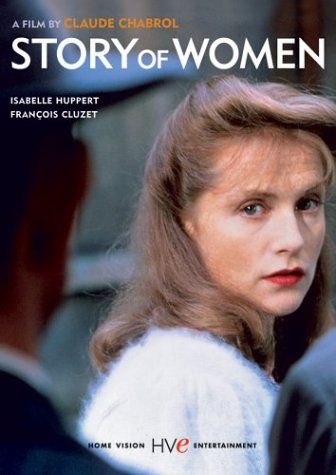
UNE AFFAIRE DE FEMMES
DIR: Claude Chabrol
CAST: Isabelle Huppert, Francois Cluzet, Marie Trintignant


The English language title for this film, A STORY OF WOMEN, may fit it to a certain degree, but what it doesn’t capture is the implication in the original title (explicitly stated in the film) that what its central character, Marie Latour (Huppert) does is essentially a woman’s affair, women’s business.

The film is set in the midst of the second world war, with France occupied and ruled by the Vichy government. As the film begins we find Marie and her two young children living in poverty, but an opportunity comes when Marie’s neighbour asks for help aborting her pregnancy. When the neighbour pays by giving Marie a record player she seems to see the opportunity, and to become determined that she, her children and her wounded husband will begin living better, war or no war. She begins offering further abortions, and letting a room in her house to Lulu (Trintignant), a friend, and one of the local prostitutes. Marie Latour is based on Marie Louise Giraud, who was one of the last women in France to be executed by guillotine.

Though its title is plural A STORY OF WOMEN is overwhelmingly the story of this one woman, of her attempt to keep her family (or at least her children, she shuns her returning husband) in some comfort and, equally, of her intoxication at being able to live well when so many weren’t. Marie isn’t a sympathetic character, Huppert plays her as opportunistic, an emotionally neglectful wife and mother, and not a little manipulative, but while it’s hard to feel for her you do understand her. You see the desperate poverty of the opening (in which she’s raggedly dressed and she and her children pick nettles for a very thin soup) and you can understand why, when she gets a little glimpse of what material goods and money can do, especially in the times she’s living, she becomes somewhat drunk on it, and pursues it greedily.

It’s a challenging balancing act for Huppert (whose performance won her the Best Actress prize at the Venice Film Festival in 1988, and a Cesar nomination). She’s spectacular, she never courts sympathy for Marie and, as ever, she’s extremely effective when her character is at her coldest. She’s especially strong in a scene that draws a contrast between the two sides of her life; coldly and dispassionately handing a client over to her ‘trained assistant’ (actually her housekeeper) before becoming sunny and lively on joining her lover (Nils Tavernier) in the next room. Good as she is throughout, it is in the film’s last half hour that Huppert is truly extraordinary. Once Marie is arrested all her facades slip away, both the coldness with her clients and her husband and the freewheeling, flighty woman we see with her lover and with Lulu are gone. Huppert seems tiny in these late scenes, as if the simple act of stripping her of her makeup and hairdressing has shrunk her. She’s also more delicate than ever, this once hard woman, now seemingly made of porcelain. The sheer emotion that Huppert puts across in the scenes in prison and leading up to Marie’s execution will really stick with you, none more so, surely, than her final prayer; crying, she says “Hail Mary, full of shit”. It’s a moment that resonates long after the credits, as does the performance itself.

This is a slightly atypical effort from Claude Chabrol. It lacks the stylisation that marks much of his work, and though his clear fascination with women (and Huppert in particular) persists, few of his other trademarks make it into this film. However, it’s a lean work, with every scene cut right to the bone (many are played with just a couple of images or a handful of sentences) and an expectation that we are intelligent enough to fill in what isn’t explicitly stated. The great advantage of Chabrol’s choices here, which are much more observational than usual, is that he really lets us in to Marie Latour’s world. The period detail isn’t played up, but it’s convincing, and along with Huppert’s and the rest of the cast’s naturalistic performances (Francois Cluzet is especially good as Marie’s frustrated husband) he allows us to forget that we’re watching a film and instead become invested in this woman’s journey to its bitter end. He does put in a little explicit social commentary, having Marie ask of her ‘crime’ “How could a man understand?” and dedicating the film to the children of the condemned (in a very odd late touch, that completely fails to work, he adds narration from Marie’s son, looking back as an adult at his Mother’s arrest and execution). But these are small things, and only the narration detracts (and then very briefly) from what is, overall, one of Chabrol’s and Huppert’s best efforts. This is a sadly underseen film, and well worth looking out.

Friday, September 3, 2010

Movie of the Week: My Man Godfrey

This week's movie is a real public domain treat, for my money one of the flat out funniest films ever made. MY MAN GODFREY is a screwball comedy classic, with pitch perfect performances from William Powell and the luminous Carole Lombard. I hope you enjoy it as much as I do.

Thursday, September 2, 2010

The Greatest? Part 2: Leigh – Introduction / Georgia

I’ve been an admirer of Jennifer Jason Leigh’s for 15 years or more, almost as long as I’ve been a serious movie lover. I don’t remember what the first film I saw her in was (it may well have been THE HUDSUCKER PROXY), but what I do remember is a book I had back then. It was called Young Hollywood, and profiled a lot of that generation of actors. I remember being surprised by Leigh’s entry, by realising that I’d seen several of her films, and not made the connection that it was the same actress in each of them.

Free image hosting powered by PostImage.org Free image hosting powered by PostImage.org Free image hosting powered by PostImage.org
That’s, for me, Leigh’s greatness. She isn’t so much an actress as she is a changeling. Like DeNiro in his heyday she throws herself body and soul into her parts, she doesn’t so much play a person as she becomes her. She’s changed her body for roles, written extensive in character diaries, worked her characters jobs (including one at the same pizza place her character in FAST TIMES AT RIDGEMONT HIGH worked at). She’s never the same twice, and is perhaps the only actor I can watch and, despite having seen her in more than 40 films and knowing a good deal about her, still catch myself not watching Jennifer Jason Leigh but instead her character.

Genius is not too strong a word, or at least it hasn’t been. Lately Leigh has dropped off the radar somewhat. In 2005 she married Noah Baumbach, and since she’s made fewer and fewer screen appearances, more often than not in small parts (four minutes in SYNECDOCHE, NEW YORK, ten in GREENBERG). Can she still be called the greatest working actress? Taken as a whole does her body of work back that up? I’m going to try and figure that out for myself.


GEORGIA [1995]
DIR: Ulu Grosbard
CAST: Jennifer Jason Leigh, Mare Winningham,
Ted Levine, Max Perlich


I first became aware of GEORGIA through the Oscars. I watched the 1995 ceremony, during which Mare Winningham was up for Best Supporting Actress, and though Winningham didn’t win (Mira Sorvino did) and I wasn’t at that time aware that Jennifer Jason Leigh was in the film, it stuck in my mind. Of course after I discovered that Leigh was in it, and that this is generally rated as perhaps her finest performance, I knew I HAD to see it. Unfortunately I was defeated by the fact that, so far as I can tell, GEORGIA never had any kind of home video release in the UK. If it did ever come out on VHS then it is spectacularly rare; I’ve scoured new and second hand stores for a copy for over a decade, and have never even seen one. It’s taken me the best part of 15 years, but I’ve finally seen GEORGIA and it was more than worth the wait.

The story is pretty basic. Two sisters, both singers. Georgia (Winningham) is a country music star with a loving husband (Levine) and a young family. Younger sister Sadie (Leigh) is an alcoholic and drug addict, scraping by from band to band and gig to gig, she’s got the passion for music, but lacks her sister’s real talent. The film is essentially about Sadie, her ever downward spiral, and the way the people around her (including Georgia and a sweet young man named Axel (Perlich) whom Sadie hastily marries) are affected by her.

What really makes GEORGIA the rather extraordinary piece of work that it is isn’t the story, which is familiar, nor even the screenplay (by Leigh’s mother Barbara Turner). The quality here is in the acting. There are exceptional performances all round, from the colourful character parts in the various bands (filled by people like John Doe and John C. Reilly, both of whom have done distinctive work since) right up to the leading players.

The undervalued Max Perlich (who seems to have dropped off the planet) is great as Sadie’s naïve, gentle, 23 year old husband. He comes into her life, ever so politely, when he delivers her groceries. He’s an easy character to like and to feel for, and in that we take a cue from the other characters, who also warm to him. Ted Levine, as identifiable as ever by his one of a kind drawl, makes for another sympathetic figure as Gerogia’s solid husband Jake. His relationship with Sadie is particularly interesting; there’s real warmth between them, but he seems slightly blind to her problems. The Oscar nominated Winningham is, make no mistake, excellent. Georgia is such a straight character that she could be rather bland, but Winningham finds real depth in her conflicted relationship with Sadie. She also performs all her own vocals, showcasing a very impressive (if appropriately MOR) country voice.

And then… and then there’s Jennifer Jason Leigh. My instinct in discussing this performance is to do an impression of Wayne and Garth meeting Alice Cooper, and simply fall to my knees crying, “We’re not worthy”. Think of your favourite superlative and treble it, Jennifer Jason Leigh is still better than that. She quite simply IS Sadie, it’s not acting, it’s not even that she’s living in this person’s skin, Leigh completely and utterly becomes Sadie in a way so complete that it verges on frightening. She hardly even looks like herself, appearing tinier and more fragile than ever, having dieted her 5’ 3” frame down to just 89 pounds. She seems so breakable, as if the wind could knock her over and break one of her tiny arms, and yet she’s also forceful, almost possessed, full of vitriolic energy that takes the place of any great talent on stage. Sadie could easily have been reduced to a mass of actorly tics, but Leigh never does anything predictable. Or twice. From the first moment you see her, Sadie is a living, breathing person, and as the film’s 113 minutes pass Leigh peels back more and more layers, leaving herself, by the end, completely raw; like an exposed nerve. Like Winningham, Leigh does all her own vocals, and her live performances were staged for real. The most notable takes place at a benefit concert (an appearance granted as a favour from Georgia), at which Sadie performs an almost ten minute cover of Van Morrison’s Take Me Back. She repeats lines endlessly, yelling rather than singing, essentially spitting the song in the faces of the audience. It’s like watching a ten minute car crash, and we see and hear every last excruciating note. It is an extraordinary scene, the total breakdown of a person writ large over the duration of a song, and it may well be the single best thing Jennifer Jason Leigh has ever done.

Towards the end the film becomes a little more conventional, as we see Sadie finally confront the depth of her problems, but even this passage is lifted by the performances. Is the film itself a masterpiece? Perhaps not, but GEORGIA is absolutely required viewing if you have any interest at all in screen acting. Jennifer Jason Leigh’s work here is among the best ever put to film, full stop. How she was passed over (AGAIN) by the Oscars while Winningham, who is great but like everyone else completely overshadowed by Leigh’s virtuoso display, was nominated is one of the great mysteries. Hunt this film down. You won’t regret it.

Wednesday, September 1, 2010

The Greatest? Part 1: Huppert – Introduction / The Bedroom Window

Why Isabelle Huppert? Of all the many hundreds of actresses out there, what makes her one of my two finalists when deciding who the greatest working actress is? Well, here are a few examples of the first thing that comes to mind…
Free image hosting powered by PostImage.org Free image hosting powered by PostImage.org Free image hosting powered by PostImage.org

In cinema, beauty is commonplace, even expected, especially in women. Even if you don’t think Isabelle Huppert is beautiful (for the record, I certainly do, in fact I’d suggest hers is among the most beautiful faces ever to appear on the big screen) one thing you can’t deny is that her face is fascinating. It is fascinating because it shouldn’t work, but the mass of freckles, the angular structure, the slight bump in the nose, the small, slightly tired eyes and the downturned mouth somehow come together to form a face that is at once completely distinctive and striking, and yet plausibly ordinary, able to fit itself to almost any part be it the rural postmistress of LA CEREMONIE, a hooker in LOULOU or an uptight pianist with secret desires in THE PIANO TEACHER.

Her face is also one of the most expressive things in cinema. Actors often speak of training as honing their instrument (a little pretentious, granted, but go with it for a moment). Huppert’s face is her instrument, and like any virtuoso player she can get almost any register from it. She can open up and let us in, she can be completely walled off, she can gives us a glimpse of what’s going on under that façade, and yet plausibly hide it from the people sharing the screen with her or she can explode with emotion, even if the moment is totally silent.

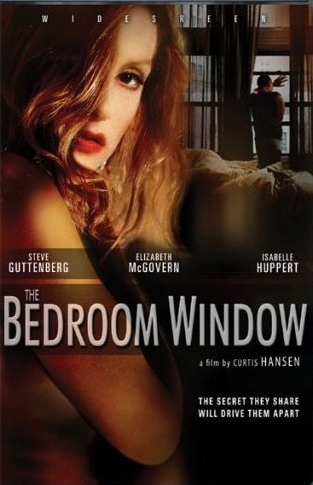
It is certain, proven beyond doubt by a career that spans almost 40 years of theatre and film, that Isabelle Huppert has been and is a great actress, but the greatest contemporary actress? Over the next month I’ll be looking at at least ten films, some I’ve seen before, some for the first time to try and answer that question, and I’m starting in an unlikely place; Curtis Hanson’s 1987 neo-noir THE BEDROOM WINDOW, which finds Huppert working in English, opposite an unexpected co-star… Steve Guttenberg. Yes. Mahoney. Really.


THE BEDROOM WINDOW [1987]
DIR: Curtis Hanson
CAST: Steve Guttenberg, Isabelle Huppert, Elizabeth McGovern


Looking at THE BEDROOM WINDOW as part of Isabelle Huppert’s career is perhaps the most interesting way to see this rather non-descript movie that is otherwise just one more not especially good generic 80’s thriller. The basic plot has Huppert’s character witness an assault while staying with her lover (Guttenberg, hilariously miscast), in order to keep their relationship secret from her husband (his boss) they report the incident to the police, after discovering that it may be connected to a murder, but say that Guttenberg was the witness. When the deception becomes obvious in court Guttenberg finds himself the prime suspect for two murders.

THE BEDROOM WINDOW is an interesting example of just how badly an actor, even one as good as Isabelle Huppert, can be hobbled by circumstance. She’s great casting as the femme fatale, but she’s hamstrung by Curtis Hanson’s very stagy dialogue, by her own still slightly broken English and by the lumpen performance given by Steve Guttenberg (smirk still firmly in place between POLICE ACADEMY movies), which gives her little to play off. Credit to Huppert though, because as the movie runs on, she’s the one aspect that gets better. She gets more and more comfortable in her character’s skin as she becomes harder and colder, and by the hour mark she’s giving a performance a good deal better than the film deserves.

Unfortunately the rest of the film fails to engage. Guttenberg is flat out awful; he looks baffled much of the time (even when he’s not supposed to), clearly completely out of his depth here and imbues his performance with all the charisma of an end table. Elizabeth McGovern, as the assault victim, is better, and probably the most consistent performer here, but her efforts are also undone by the fact that the plot ends up reducing her character to bait in a very flat ending.

Hanson’s direction is uninspired at best and the uneven, often bored seeming, performances suggest a very loose grip on his cast. The visuals aren’t a great deal better; pedestrian outside the early sequence in which Huppert witnesses the key assault and one or two shots that nod rather explicitly to Hitchcock. THE BEDROOM WIMDOW isn’t a good film, but it is an interesting one as an Isabelle Huppert fan, it’s really the only true genre film she’s made, and suggests that she’s ill at ease when boxed in by such conventions.