Showing posts with label bond week. Show all posts

Monday, November 16, 2009

Bond Week: Day 7

You Only Live Twice (1967)
Dir: Lewis Gilbert

At the time of its release You Only Live Twice must have played really well. It boasts a story that was loaded with relevance at the height of the cold war, taking in both the space race and the threat of mutually assured destruction between the US and Russia. In Donald Pleasence’s Blofeld it has an iconic villain. Sean Connery, in his fifth Bond, contributes a vigorous and entertaining performance; one that distils everything that defines Bond, and the action sequences are exciting, varied and well excuted.

The one thing the film really suffers from is the lack of a greatBond girl. Bond meets and hooks up with several Japanese lovelies, but none really contributes anything memorable. Another problem is a long sequence in which Bond is made up as Japanese man. The effect, to quote Blackadder, is as convincing as a giraffe in dark glasses attempting to get into a polar bears only nightclub. And, if not out and out racist, it’s certainly an uncomfortably anachronistic sequence.

The more pressing problem with seeing You Only Live Twice now, for the first time, is that it plays less like a Bond film and more like Austin Powers. It’s so nakedly the template for Mike Myers’ first spoof outing that I found it difficult to take the film seriously. That’s not a fault of the film, but it does mean that You Only Live Twice plays very differently now than it would have in 1967. Still, this is a very solid Bond film, and a highly entertaining piece of hokum.

Sunday, November 15, 2009

Bond Week: Day 6

I've made a few edits, but this is largely the review I wrote on seeing Casino Royale on its cinema release.

Casino Royale (2006)
Dir: Martin Campbell

Newly promoted double 0 agent James Bond (Daniel Craig) is sent by MI6 to play in a high stakes poker game against terrorist banker Le Chiffre (Mads Mikkelsen). He's to make sure Le Chiffre loses all his money so he'll have no chice but to seek asylum from Britain.
Along for the ride is treasury agent Vesper Lynd (Eva Green) whose job is to protect the money Bond is playing with and for whose charms Bond falls fast.

I wasn't optimistic about this one at all. I'm not a big Bond fan and I'm even less of a Daniel Craig fan. The criticsm when he was hired was about Craig's hair... James BLOND yelled the tabloids when, having seen the man 'act' before, I thought James BLAND was much more of a worry.
However reasons for optimism did begin to mount up. The recruitment of such strong talent as Mikkelsen, Giancarlo Giannini and, in a small role, Jeffrey Wright. The breathtakingly beautiful Green as a Bond girl. Most importantly, though, this was not merely to be the next Bond film, it was a complete reboot of the franchise.

Let's get a few things straight. This isn't really a Bond movie. It's got the girls and the action but so many of the trademarks are missing. Gone are the horrible puns about girls names ("I thought Christmas only came once a year"). Bond's drink order is also different ("Shaken or stirred?" "Do I look like I give a damn?"). There's no Q, no megalomaniacal supervillain in a hollowed out volcano. All in all this feels more like Jason Bourne than James Bond.

The script is pared down. For the first half of the film Bond says next to nothing as we the audiences get to gorge ourselves on action sequences. This is where one of the more major changes in the franchise shows itself. While still grandiose and show-offy the action feels more real here than in previous franchise entries. There's no powerboats down the thames, just feet and fists. The free running sequences (executed with panache by Sebastien Foucan) are stunning, injecting pace and danger into the opening of the film where there could merely have been dry setup. There's a lot of setup needed to get us to the titular Casino Royale and this is where the screenplay, by Neal Purvis, Robert Wade and Paul Haggis, comes good. The plot machinations could be slow but they find ways around and get some great scenes out of it, most notably a moment when Bond breaks into M's (Judi Dench) house. What's really well handled though is the immediate build up to the poker game, beginning with the introduction of Eva Green as Vesper Lynd. Most Bond girls have been characterless sex objects, not this one. The script gives her real intelligence and wit and Green sparkles. Witness the lovely scene where she and Bond first meet. The sparks fly around some quick witted flirting, though the two don't really like each other just yet.

So what of the main players? I've never liked Craig, as an actor he's always seemed to me to be robotic and act merely by saying one bit quietly and another bit LOUD, more or less randomly. This is as good as he's been and perhaps it's that he's found a role that fits him. Bond is an all but emotionless killing machine, it's surely not co-incidental that the passages where Craig is found wanting are when we are supposed to be feeling and investing in a genuine emotional connection between him and Green. Better is Mikkelsen, a great actor, who has fun as Le Chiffre but never lets his performance become pantomime, as so many Bond villains have. However this is Director Martin Campbell's show all the way. From the stark black and white opening, to the unrelentingly grim torture sequence and the massive final set piece in Venice he's got a firm grip on the reins and knows that he's going for realism and weight more than ever before in Bond.

All this mountain of praise isn't to say that there aren't problems with the film. The poker game itself is too drawn out, the match ups must take 15 minutes of screentime and though it's spread out the pace can't help but flag. There's also a 15 minute segment of Bond and Vesper's relationship, which not only slows the film to a crawl but, criminally, rings false. Another problem is the lack of an ending. As the credits roll you'll have been entertained but little has been achieved and no sense of closure is felt. It also bears mentioning that the product placement in the film has reached all but unbearable levels. As if visual plugs for Sony phones, Ford cars and Sony laptops weren't enough there's what may as well be an ad for Bond's watch inserted into the dialogue. These are all small things, but all distracting. However, on the whole, as absolutely empty nonsense goes, this is about as entertaining as it gets

Saturday, November 14, 2009

Bond Week: Day 5

For Your Eyes Only (1981)
Dir: John Glen

As far as I can tell, For Your Eyes Only seems to be something of a favourite among the diehard Bond fans. I can’t for the life of me figure out why. It’s not that this is an especially bad film; it’s just not a very good one either. It just sits there on the screen, often seeming as tired and old as its Bond (Roger Moore, looking like a wrinkled leather sack at 54). It is perhaps summed up best by its title song, which isn’t the worst Bond song ever (that, surely for all time, is Madonna’s staggeringly terrible Die Another Day) but Sheena Easton’s somnambulant ditty sets you up brilliantly for what is a rather tedious film.

Though, at two hours, For Your Eyes Only is hardly a marathon, or even one of the longer Bonds, but it moves like a snail on valium. It doesn’t help that Julian Glover’s villain makes little impression, and is not even close to being evil enough to be interesting. It’s also a shame that the very talented Carole Bouquet appears, for much of her performance as dull as dishwater Bond Girl Melina, to be very poorly dubbed. The action isn’t bad, but only one scene - Bond hanging perilously off a cliff as some random thug cuts his rope - really gets the blood pumping. Moore does his usual thing as Bond, and is perfectly alright, but he seems a little bored, perhaps tiring of the role, or even realising that he’s getting rather long in the tooth for it.

For Your Eyes Only is a two hour yawn.

Next Up: Casino Royale (2006)

Thursday, November 12, 2009

Bond Week: Day 4

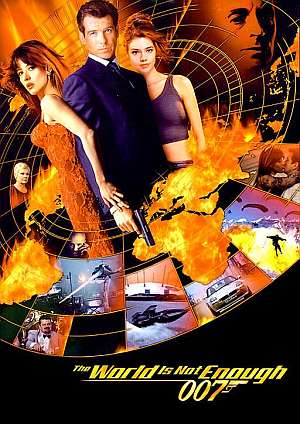
The World Is Not Enough (1999)
Dir: Michael Apted

I was going to watch Die Another Day, the only Pierce Brosnan outing I haven’t yet seen, today but my VCR (yes, VCR) ate the tape and so I went to this film, and I’m glad I did. Every time I look at The World Is Not Enough I enjoy it more. Brosnan’s third crack at the Bond whip isn’t without its faults; Robert Carlyle’s bad guy is poorly defined, and totally unthreatening, Denise Richards is laughably cast as nuclear physicist Dr. Christmas Jones and the one liners are often painful (“I thought Christmas only comes once a year”) but, conspicuous as these faults are, they don’t take much away from what is a hugely engaging and entertaining film.

Michael Apted was brought into the Bond fold in order to punch up the film’s performances, and he’s succeeded admirably. Leaving aside the awful Denise Richards there’s not a bad turn on display here. Brosnan appears much more comfortable in the role than in his first two films, like he has now found a way to make it fit better, it’s evident in his interaction with other actors, notably Judi Dench’s M and in the fact that he’s able, in Bond’s relationship with Sophie Marceau’s Elektra King, to give the character a little more depth. The star attraction though is Sophie Marceau. Quite apart from being mind-blowingly attractive, Marceau is a proper actress; someone with major talent to back up the kind of looks that make her, with the possible exception of Jane Seymour, the single most beautiful Bond girl. Elektra is a strong role; while Richards is stuck with a very basic damsel in distress role, Marceau has layers, complex motivations and an interesting psychology to play. She does it brilliantly, giving a performance that is even richer the second time you see it.

This is not to say that the film skimps on the action. Apted and second unit director Vic Armstrong have crafted some tremendously exciting action sequences, from the opening boat chase down the Thames to the Millennium Dome to the attack on Zukovsky’s (Robbie Coltrane) Caviar factory by two helicopters each wielding several massive circular saws, there’s enough action to sate any fan, a great deal of it very obviously practically realised. Brosnan makes for a solid action hero; outwardly tougher than Moore and Dalton, he’s the most convincing Bond in action scenes since Connery. Like The Spy Who Loved Me, The World Is Not Enough starts to run out of steam in its last fifteen minutes or so, mainly because Robert Carlyle’s Renard isn’t developed or scary enough to make for a credible threat at the end of the film, otherwise, this is an underrated movie, it has plenty of problems, but is never undone by them and so far it’s one of my favourite Bonds.

Next Up: For Your Eyes Only

Bond Week: Day 3

The Spy Who Loved Me (1977)
Dir: Lewis Gilbert

Roger Moore, the longest serving Bond, probably the most divisive, and the one I’ve seen least of - just one film prior to this week. Moore’s films have a reputation for being campy, and though there are certainly flashes of this in The Spy Who Loved Me (“keeping the British end up, sir”) those problems are outweighed by the film’s many virtues.

The film gets off to a roaringly exciting start, with a strong action sequence which culminates in a jaw dropping stunt with Bond skiing off a mountain, freefalling and then opening a parachute. Today you’d probably do that stunt with a CGI Bond; here a stuntman skis off a mountain. It is absolutely astonishing. This leads into a title sequence featuring one of the series’ finest title songs and then a pacy subsequent 75 minutes of high class action and thrills. Moore, at 50, is looking a touch weather-beaten, but he’s still pretty spry and he executes the action scenes, especially those where he faces off against Richard Kiel as the menacing metal-mouthed mute Jaws, with energy. The choreography is also pretty good, and Jaws is made to feel like a real threat, with his blows looking like they connect and hurt.

Barbara Bach, as Russian agent Anya Amasova, isn’t much of an actress, which is a bit of a shame because while she’s very pretty an actress with a little more depth could well have made Anya one of the great Bond girls. As a secret agent herself, and working with Bond only for her own ends, Amasova is an intriguing character, but Bach lacks the resources to play the layers of the relationship between herself and Moore’s Bond and ends up playing more of a decorative role. Curt Jurgens’ Stromberg isn’t the most memorable of villains, but his plot is rather original and intriguing, particularly now, when climate change seems to be beginning to bite.

Overall though The Spy Who Loved Me is a very solid Bond film. Moore is pretty good here, he even scores with several of the one-liners that are usually my least favourite aspect of Bond movies in general, and which marred the otherwise rather entertaining Live and Let Die. He’s by no means the almost psychotic Bond of Dalton and Craig, but there’s a slightly harder edge to Moore than he’s usually credited with, and he does seem more secret agent than playboy here. The action is excellent, and well directed by Lewis Gilbert. Aside from that opening there’s a strong fight with Jaws around an Egyptian ruin and the storming of Stromberg’s control room, from which he’s attempting to destroy the world, results in a lengthy but exciting and, in a touch that has now become rather rare, intelligible, gunfight.

My only major issue with the film is that it runs a little long, and begins to run out of steam in the last twenty minutes or so, at which point the evil plot has already been foiled. That said, a hundred minutes of solid entertainment is pretty good, and I enjoyed this film more than I expected to.

Next Up: The World is Not Enough

Wednesday, November 11, 2009

Bond Week: Day 2

I’m sorry that this post is late. Our local telephone exchange has been down, and for almost 24 hours we’ve had no internet service.

On Her Majesty’s Secret Service (1969)
Dir: Peter Hunt

I have often said that, given a decent budget and a proficient crew, just about anyone can make a technically competent movie. Clearly I had not reckoned with Peter Hunt. Had it been competently made parts of OHMSS might have been fun, but as it is Hunt’s stylistic choices and the hideous botching of several technical issues make the film a real chore to sit through. The first problem is the action. All of the hand to hand fights (and there are many) are abysmally choreographed, with blows that never seem to connect, they are all dubbed with sound effects - both impact noises and Bond and whoever he is fighting breathing heavily, to show how much they are exerting themselves - that would seem outrageously over the top in a Jackie Chan movie, but these are the least of the problem with fights. Every fight scene is sped up. I named this website for the speed at which film runs through a camera to create the illusion of movement, but during the silent era films were often shot at 16 FPS. Some DVD releases fail to take account of this discrepancy, leading to movements seeming sped up and jerky. This is what appears to have been done with most of the action in OHMSS, and it is an unmitigated disaster, not just lessening the impact of the action but rendering it comical.

Other technical elements are also botched. The editing, by Bond director in waiting John Glen, is a complete mess. The first ski chase sequence is particularly terrible, with shots of new Bond George Lazenby and his stunt double not only utterly failing to match, but so disconnected that the sequence makes barely any sense. Then there’s the soundtrack. The music, though John Barry’s score is fine, is obnoxiously used; played so loud it dominates many scenes and used less as score than as instruction. Worst is the looping, oh dear god, the looping. It’s standard practice to re-record dialogue and match it to the pictures after the fact, but never - except perhaps in Lucio Fulci’s House by the Cemetery - have I heard it done worse. At one point during a car chase Diana Rigg ‘speaks’ while on screen she is facing the camera, open mouthed with fear and shock and clearly not speaking. There are several of those moments, but that one is just so blatant that it made my jaw drop to see that it had been left in a professionally made film. I saw better looping at a screening of short films made by the 17 year old students I had film studies with last year.

I wish that On Her Majesty’s Secret Service had merely been a technical failure, but sadly it disappoints on just about every level. The thrills are almost totally mitigated by the appalling editing and action choreography, and in between those sequences the film is both boring and seemingly interminable. The sequences at Blofeld’s (Telly Savalas; less megalomaniac than slightly creepy uncle) are just endless, and provide nothing in the way of thrills and even less in the way of comedy. Add in a totally unconvincing romance with gorgeous Bond girl Diana Rigg (who, to be fair, is the best actor and the best character in the picture; a tough, spunky Bond girl long before that was expected) and the stunning woodenness of Lazenby himself, and you’ve got a horrible, tedious, mess of a movie.


Next Up: The Spy Who Loved Me

Monday, November 9, 2009

Bond Week: Day 1

This will be the first in a series of themed weeks, during which I’ll be watching seven films that are in some way linked, be it that they are part of a series, the work of the same director, actor or actress, or even that they share a theme or genre. I thought I’d start off with a series I have embarrassingly little experience of…

Bond, James Bond

Licence To Kill (1989)
Dir: John Glen

It’s a shame that Timothy Dalton’s stint as James Bond was short and unloved, because his two films in the role are two of the best I’ve seen in the series. Licence To Kill is the only Bond ever to get a 15 certificate. These days it’s pretty mild for that category (indeed the 12 certificate Casino Royale is considerably more brutal) but twenty years ago this must have been a shock to Bond fans. The Roger Moore era of arched eyebrows and awful puns was, clearly, well and truly over. Dalton’s Bond was a tougher, meaner, more mercenary proposition. The quips are largely absent, as are many signature lines and moments and in their place is an unrepentantly violent Bond, gone rogue, seeking revenge on a drug lord (Robert Davi) who, at the beginning of the film, maims Felix Leiter and murders his wife.

Many of the qualities so lauded in Daniel Craig’s Bond are visible here, and Dalton really should get credit (as should director John Glen) for trying to take the series in a new direction with this film. Licence To Kill, despite the fact that it finds Bond working outside MI6, and with his licence to kill revoked (original title Licence Revoked was changed because, apparently, it was feared that Americans wouldn’t know what ‘revoked’ meant) still feels very much like a Bond film. We get the expected exotic locations, we get the girls - notably the stunningly lovely Carey Lowell, whose Pam Bouvier is a Bond Girl more capable than most - and we get Q (Desmond Llewellyn), very well used in an extended role. The difference is that it is all delivered with a harder edge. Robert Davi’s Sanchez is no cat-stroking megalomaniac, he’s a drug dealer, and a perfectly loathsome one at that, and it is his brutality that lands Licence To Kill with its certificate.

This is a lean, mean, focused film; one that matches its James Bond perfectly. It more than delivers the action goods, with a climactic truck chase and several excellent aerial stunts being especially thrilling and the performances (bar that of the robotic, if lovely, Talisa Soto) are generally very strong. Dalton is particularly good, and certainly more convincing as a rogue Bond than Daniel Craig was in Quantum of Solace. I really enjoyed Licence To Kill, and it baffles me that it was so poorly received that Dalton never got to develop this take on the character and the series very nearly died in its wake.