Showing posts with label Remakes. Show all posts

Monday, August 15, 2011

Conan the Barbarian [3D] [15]

DIR: Marcus Nispel
CAST: Jason Momoa, Stephen Lang,
Rachel Nichols, Rose McGowan

Do I really need to tell you that Conan the Barbarian is dumb as a brick? Do I really need to tell you that it has extremely limited character development, a story that is both incredibly simplistic and confusingly told, that the use of the word 'acting' would be to slightly over flatter the cast? Probably not. What I do need to tell you that despite (or, perhaps, because of) this it's actually pretty good fun.

In the interests of full disclosure I should say that I haven't actually seen the 1982 film with Arnie as Robert E. Howard's famous creation, and perhaps that let me have an easier time seeing this Conan as a stand alone piece. The screenplay weaves a simple tale of vengeance; Conan's father (Ron Perlman, genius casting) is murdered by a warlord (Avatar's Stephen Lang), but young Conan escapes. Twenty years later, Conan finally discovers the identity of his Father's killer and seeks his revenge. The details are a little more confusing; there's a mask that apparently makes the wearer invincible, but for some reason it needs the blood of a special girl (Nichols), the magic is never really that well established, but what more do you need than 'evil bastard wants to kill hot girl so he can resurrect his wife'?

The thing is, Conan is stupid, but it is seldom less than entertaining. Jason Momoa isn't someone I suspect we'll be seeing as he lead in an intensely demanding dramatic film anytime soon, but as a mobile wall of muscle with a voice that sounds like a constant low rumble, he's fine casting for Conan. Momoa hadles the copious action scenes well, as does director Marcus Nispel (who I had little faith in, having previously seen only his awful Texas Chainsaw Massacre remake). Several of the set pieces are genuinely exciting to watch. There's a dynamic chase sequence as Rachel Nichols finds herself pursued by Lang's men, and, refreshingly, while Conan does help rescue her, the film also shows her as a capable and instinctive fighter. Another standout sequence starts out as a glaringly obvious tribute to Indiana Jones and the Temple of Doom, but the fight between Momoa and Lang as they and Nichols dangle on a spinning platform above a pit is hugely exciting. The choreography also works well, with the cutting fast, but without obscuring the action.

Sadly, all this good stuff is filtered through a middling 3D conversion. It's not as catastrophic as the conversion of Clash of the Titans, but it does suffer similar problems like a very over dark look, which renders many of the film's later scenes a challenge to follow, and a smeary quality to fast motion which takes away from the film's greatest asset; its action. This is a film that will be much, much better in its original 2D version and that's how I'd advise you to see it.

To my great surprise I would advise you to see Conan. It's got some fun (hammy) performances, especially from Rose McGowan, enjoying herself as Lang's witchy daughter, some entertainingly bloody action sequences, a damsel who, if not exactly developed, is at least not in constant distress and a solid leading turn from Momoa. It's not going to end up in anyone's top 10, but I'd be lying if I said I didn't enjoy it, and didn't think that you'd have fun seeing it with a few mates on a Friday night, in 2D.

Saturday, June 11, 2011

Mother's Day [2011] [18]

DIR: Darren Lynn Bousman
Image and video hosting by TinyPic
It's easy (and often fun, I won't deny it) to be sniffy about the recent trend for horror remakes. Horror may always have been the genre that ate itself, but lately it seems to have chowed down with almost disturbing zeal, and regurgitated a lot of foul smelling rubbish into cinemas. And that makesit all the more puzzling to me that most of the reviews I've seen for Mother's Day have been one star pannings, because this – while no classic – is one of the best remakes to come along in some time, and a pretty entertaining horror film in its own right.

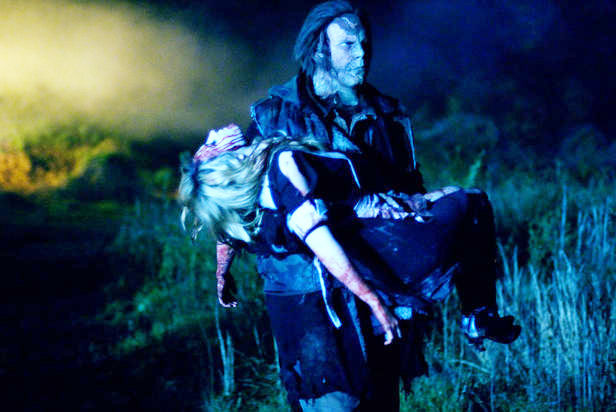
The setup is pretty straightforward home invasion horror. A band of brothers (Patrick Flueger, Warren Kole and Matt O'Leary) who have just robbed a bank, one of them getting shot in the process, roll up to their Mother's house, but soon discover that she has moved, and that the new owners (Jaime King and Frank Grillo) are having a party in the basement. Desperate to find the money they have been sending their mother, so they have a fee to enable themselves to cross into Mexico, they take the party goers hostage, and call their Mother (Rebecca DeMornay) and Sister (Deborah Ann Woll) to the house.

So far, so standard then, but there are a couple of elements at work here that enable Mother's Day to stand out. Chief among them is Rebecca DeMornay's performance as the titular criminal matriarch. It has been years since she did anything of note, and she's little short of revelatory here, ungodly beautiful at 51, and giving a complex and engaging performance that powers every scene she's in. While there is always an undertone of threat in DeMornay's performance it is the outward friendliness with which she greets her son's hostages, and the way she seems to want them to be comfortable – without doing anything to help them – that is most disturbing. In many ways she's like the perverted nightmare vision of a perfect sitcom mom, even making a cake for the hostages. DeMornay takes the character credibly through several stages, from the outwardly friendly parent who just wants to get her boys out of these nice people's way to a brutal monster who will do just about anything if she is crossed, it's chilling and layered work, and makes Mother's Day worth seeing all by itself.

However, that's not the only interesting thing in the film. The rest of the bad guy performances are all pretty good, with Flueger, Cole and O'Leary giving each of the boys their own distinct personalities, and making each of them a different kind of threat, and True Blood's Deborah Ann Woll giving a performance that almost matches DeMornay's in its subtle complexities. The screenplay also works quite well, okay some of the dialogue is rather perfunctory, but the characters are well developed and there is an impressively uncompromising tone, a bleakness that gives the film a bit more punch than your average horror picture. This is especially true of the film's emphasis on punishment, which reaches its ultimate expression in a very tough scene in which two innocents are given the chance to live if they will pick up a knife and stab the other to death.

Darren Lynn Bousman does a solid, if not massively personal feeling, job behind the camera. There's a nice, John Carpenteresque, cold open, and a tendency to keep much of the worst violence just off screen, or just out of focus, which allows the imagination to go to work, but overall it's not as distinctive as the barmy and underrated Repo: The Genetic Opera.

On the downside, 112 minutes is long - too long - for a pretty basic home invasion horror, and outside of Shawn Ashmore as the Doctor trying help the injured bank robber the performances from the films good guys (especially the wooden Jaime King) are less impressive than those of the bad guys. The film does slip into standard slasher silliness towards the end (a moment with a nailgun is laughable), but finds its feet again in the last moments with a great coda. On the whole, Mother's Day isn't perfect, but it's much better than I expected it to be, much better than it really has any right to be, and if you're looking to see a nasty little horror movie, it's well worth a look.

Wednesday, October 13, 2010

LFF 2010 review: Let Me In [15]

LET ME IN
DIR: Matt Reeves
CAST: Chloe Grace Moretz, Kodi Smit-McPhee,
Elias Koteas, Richard Jenkins
Image and video hosting by TinyPic
What puzzles me is this; it should be so easy. Let the Right One In is such a filmable book, it’s all there; a scary, nasty, edgy, different, horror film. All you have to do is shoot it. So why, twice now, has cinema managed to miss that very special mix of horror, first love and pathos that the book gets so right?

My major gripe with the original, Swedish, version of this film was that it really only told one of the three story strands that the book deals with – the one about a bullied 12 year old boy (here called Owen and played by THE ROAD’s Kodi Smit-McPhee) who becomes friends with a vampire who appears to be a 12 year old girl (here Abby, played by Chloe Grace Moretz, destined now and forever to be remembered as Hit Girl) - LET ME IN focuses on this single strand of the book to the near total exclusion of everything else, so much so that when other storylines intrude (like the amazing sequence in which a local woman named Virginia begins to turn into a vampire) they feel like they belong in another film entirely.

It’s not that LET ME IN (which is, by the way, an awful title) is an especially bad film. Indeed there are things to admire here, mainly the two central performances. Chloe Moretz is especially good as Abby. Her character may lack some of the complexities of the original’s Eli, but with what she’s got to work on, Moretz does brilliantly. She’s spoken in interviews about the loneliness she thinks is Abby’s lot as a vampire, and that’s what comes through most strongly in her performance, and her interactions with Kodi Smit-McPhee. An especially nice moment between the two comes when Owen offers Abby a sweet, which she takes, it’s clear, because she can see it means a lot to him. In that one small moment there is much said about both of those characters.

There is so little room for other characters that a couple of gifted actors are given shorter shrift than they deserve. As ever Elias Koteas is effective, but (also as ever) he just doesn’t have enough to do, and is essentially, in the end, a plot device. Richard Jenkins has perhaps three audible lines as the unnamed ‘father’ of Abby, and poor Cara Buono, as Owen’s mother, never even gets her face on screen.

Matt Reeves pulls out one really strong scene of his own; a brilliant set piece in a car, which starts out tense and ends up visceral, and remains thrilling throughout. The POV car crash in that scene is easily the most memorable original shot in the film. Otherwise though, Reeves comes off poorly. Most of his shots are near direct lifts from Tomas Alfredson’s film, and when they aren’t they tend to be less effective. Two things were especially irksome. The first is Reeves’ fondness for lens flare, perhaps learnt from his friend JJ Abrams. There is some flare in almost every other shot of this film, and it is never anything other than distracting. Perhaps more damaging is the way that Reeves chooses to stage Abby’s vampiric attacks. He’s upped the violence of them, which is fine, and in keeping with the book, the problem is that he’s done it through the medium of shockingly poor CGI. All the film’s CGI is awful, though none more so than the fire in what should have been a shocking scene. Honestly, is there nobody left in Hollywood who can do a full body burn?

We’re also treated to one of the most singularly obnoxious horror film scores of recent times. Michael Giacchino’s music isn’t so much score as it is a musical Cliff’s Notes for the film, instructing us in exactly how to interpret every last moment. It grates particularly during the horror scenes, in which it readily embraces every booming cliché of horror film music with great apparent zeal.

Overall, LET ME IN is a pretty pointless exercise, despite its several undoubted strong points. Even those strong points were done better in the Swedish film (itself far more flawed than most critics would have you think). LET ME IN amounts to a photocopy; very similar to its original, but of reduced quality.

Thursday, August 26, 2010

Film Review: Piranha 3D

PIRANHA [3D]
DIR: Alexandre Aja
CAST: Elisabeth Shue, Steven R. McQueen, Jessica Szohr,
Jerry O’Connell, Christopher Lloyd, Kelly Brook


The original PIRANHA wasn’t exactly good; it was a Roger Corman production, which meant it was low budget and not really expected to be intelligent, but thanks to screenwriter John Sayles and Director Joe Dante it actually emerged as a fun movie, paying inventive and witty homage to old B-Movies, while delivering the JAWS aping goods itself. The sequel; PIRANHA 2: FLYING KILLERS is notable only for its awfulness and the fact that it was James Cameron’s first film. This belated third in the series (it sits uneasily somewhere between remake and sequel, though the onscreen title, which is simply PIRANHA, leans to the former) is, to its very limited credit, better than the second film, but that shouldn’t be mistaken as a suggestion that it is any good whatsoever.

You know what to expect with a B-Movie, as Joe Bob Briggs puts it; Blood, boobs and beer. PIRANHA 3D certainly delivers on those promises, but, unlike Dante’s film, it forgets little things like wit and tension. Just to be clear on this… I like tits as much as the next heterosexual guy, but dear God, this film’s focus on them is relentless and dull. If you cut just half of the shots that have no other purpose than to fill the frame with large, bouncing, tits you’d have three minutes that you could fill with a character scene, of course, for that to work you’d have to have characters… but I digress. It’s not that you don’t want tits in an exploitation movie, it’s just that this film’s endless fascination with them, to the exclusion of all else (no less than twice the film stops dead for what amounts to a tit break), makes it feel like the work of a horny 13 year old. This might have been cool if I were still 13, but I’m not, and 13 year olds can’t see this movie.

The gore is better used, certainly it’s more sparing, at least in that Aja makes you wait for it. The physical effects by Greg Nicotero and Howard Berger are exceptional (one especially great, and nasty, moment comes when a girl gets her hair tangled a boat propeller, which tightens until it rips her face off). The major piranha attack set piece is good old fashioned exploitation fare, and the one sequence of the film that largely works; 10 minutes of inventively blood drenched mayhem, with the welcome kicker of watching Eli Roth get killed. What’s missing during the earlier gory moments is any real sense of tension, or any interest in the people who are getting eaten. Some of the effects are good, but it’s just not as much fun as it ought to be.

This is perhaps down to the script and the performances. To be fair, Elisabeth Shue gives her best as the small town sheriff trying to police spring break in her lakeside town, and Christopher Lloyd’s eye-rolling mania is a wonderful little mid-movie treat, but otherwise the cast are either bland (McQueen, Szohr, Brook) or relentlessly irritating (O’Connell). There’s not a single interesting or likeable character in this movie, and so when we get to the ludicrous final few minutes, there’s just nothing worth caring about. I haven’t wanted characters to get eaten so badly since I sat through OPEN WATER.

Even if the film were better, I still wouldn’t be recommending it, because the 3D is the worst I’ve seen in over a year, perhaps ever. The 3D is so unspeakably awful that it rendered the film, for me, all but unwatchable. It’s a conversion job, so every shot has three very distinct layers. The foreground is never in focus, not for one single frame, and so every single effect involving something floating out of the screen (and there are many, all of which the film stops dead for) looks incredibly fake, and then drifts out of focus. The rest of the frame is very soft. This is most prominently seen in the hideously overlit sequence in which a naked Kelly Brook and Riley Steele swim underwater. It’s so bad that the girls look like they are CGI, and any detail of their nudity is largely obscured by Aja’s awful shot selection and the abysmal 3D. There are also huge problems with ghosting, which could cause headaches as well as just being ugly and inept.

I can’t for the life of me understand the generally appreciative reviews that PIRANHA 3D has been collecting, it’s a stupid movie that’s a lot less fun than it thinks it is, and besides that it is technically broken. No film should be released in such a state.

Friday, August 6, 2010

Martial Arts Month: The Karate Kid [2010]

THE KARATE KID [2010]
DIR: Harald Zwart
CAST: Jackie Chan, Jaden Smith,
Wenwen Han, Taraji P. Henson


Let’s get one thing absolutely straight; there is no karate in this movie (well, there is, on TV, in one scene). Jackie Chan doesn’t teach karate, Jaden Smith doesn’t do karate. As is stated over and over again in the dialogue, this movie is about Kung-fu. Aside from that minor detail, and the fact that the titular kid is now just 12, rather than 15 or 16 in the 1984 original, this is a reasonably faithful remake of the beloved (but, whisper it, actually not very good) movie that many of my generation grew up with.

That means that this version shares many of the weaknesses of the original; for instance, the villain is exaggeratedly, inexplicably, and seemingly irredeemably evil. Only if he had a moustache to twirl and punctuated each line with “Muahahaha” could he be more ridiculously evil. There’s also the matter of the ending; different here, but still cheesier than a warehouse full of gorgonzola. Where this remake scores over the original though is in the action stakes.

The biggest hole in the original Karate Kid series was the fact that you never believed that either Pat Morita or Ralph Macchio could do karate (well, that and the utter ridiculousness of that crane pose). Here that’s not a problem, rather than Pat Morita you’ve got Jackie Chan, Asian cinema’s clearly indestructible martial arts star, he’s been doing breathtaking kung-fu on screen for more than 35 years. The action is clearly heavily influenced by the presence of Chan and his stunt team, who worked training Jaden Smith for months before production. It’s punchy, and often times quite surprisingly brutal (the PG certificate that BBFC have allowed this through with is a nonsense, it’s clearly a 12A, and seriously upset a couple of young members of my audience). But it’s also quite thrilling to watch, and crucially, looks like real kung-fu.

The story is very basic, in place of Maachio’s Daniel-san we have Jaden Smith as Dre, who has been moved to China after his mother (Henson) is transferred there for work. On his first day he meets pretty Meiying (Han), but some of the other kids at school don’t approve of Meiying being seen with Dre, so they beat him up. This leads (eventually) to Dre taking up kung-fu training with handyman Mr Han (Chan) so that he can fight the bullies at a climactic kung-fu tournament.

The big problem with the film is twofold; first, it is indulgently overlong, and could easily stand to lose 30 of its 140 minutes. The opening third of the film is incredibly repetitive, and no matter how engagingly some of the chase and fight scenes between Dre and the bullies are staged, there are a great deal more of them than are really required to tell the story. Perhaps the more pressing issue is that of Jaden Smith. Look, I’m sure Jaden Smith is a nice kid, but let’s not pretend that he’d have any sort of film career were he not the son of (executive producers) Will and Jada Pinkett Smith. I think I got a bike for my tenth birthday, it seems that Jaden got a multi-million dollar movie franchise. I don’t like to beat up on a kid, but Smith has all the charisma of the peg he repeatedly hangs his jacket on and the expressiveness of someone slipping into a coma. He has two gears; blank and stroppy (we get much more of blank) and is one of the dullest leading performers in a film this year.

Fortunately there are compensating factors; Wenwen Han gives a nice performance as Smith’s love interest (though the scene where she dances to Lady Gaga’s Pokerface (not THAT song) sexualises her in a rather uncomfortable way), but its Jackie Chan who makes this movie worth the ticket price. Chan’s opera brother Sammo Hung (who, frankly, would have been my first choice for this part) has settled nicely into character roles, but Chan has struggled with his acting, especially in English. Happily he gives his best ever performance as Mr Han, giving his scenes with Smith a real warmth and brining real weight and credibility to the one scene in which he’s got some dramatic heavy lifting to do. That aside, Chan is also in astounding shape for 55, and his one action scene has all the brilliant dexterity fans expect (even if it is a little more heavily cut now). It’s a surprising performance, I didn’t know that Chan had that car scene in him (He may have had little help because, though it’s not credited, I think the pictures he looks at in that scene are of his real wife and son).

Really though it’s the action that you’ll want to see the film for, the training sequences take a while to warm up, but once Mr Han shows Dre what he’s been learning with jacket on, jacket off routine (replacing the original’s wax on, wax off) the film really picks up with a blistering exchange of technique, which appears to have been done in long takes and without doubles, and finally the film kicks into high gear and largely stays there. The tournament is much more fun here than in the original; the fighting so much more varied and dynamic. This new Karate Kid is by no means perfect, but it’s fun, and it’s got some really great action. All in all, it’s a remake that betters its source.

Monday, June 21, 2010

Mini-Reviews: Revanche / Helen / Buried Alive / Wild Target / Please Give

REVANCHE
DIR: Götz Spielmann


Thanks to its very slow burning nature, and lack of a visceral payoff, calling this Austrian film a thriller might be stretching the point a little, but it is strangely riveting. It centres on Alex (Johannes Krisch), an ex-con working in a brothel and, on the sly, romancing one of the prostitutes, Tamara (Irina Potapenko). Wanting to escape from the brothel and from having to hide their relationship Alex plans a bank robbery, so that he and Tamara will be able to run away. Unfortunately it goes wrong. Tamara is shot accidentally shot dead by rookie cop Robert (Andreas Lust). Taking refuge with his grandfather (Johannes Thanheiser), Alex discovers that Robert and his wife (Ursula Strauss) live next door, and begins to plot vengeance.

I loved the opening forty minutes of this film; the slow grind of Alex and Tamara’s day to day life is brilliantly drawn by Spielmann, and the characters are intricate and, despite their obvious flaws, sympathetic. Kirsch and Potapenko give fantastic performances, and create a genuinely interesting relationship. It’s also worth noting an interesting choice with the subtitles here; as the Ukrainian Tamara speaks rather broken German the English subtitles reflect that; “I go car” for example, which really, along with Potapenko’s affecting work, helps paint a full picture of the character for an English speaking audience. I was genuinely saddened by the loss of her character, which does cast a melancholy over the whole of the rest of the film.

It’s not that the second half of the film is bad (though the character of Robert is frustratingly sketchily drawn). Kirsch continues to be excellent, while Ursula Strauss is equally good as Robert’s wife. However, for a long time very little happens besides Alex sawing very large piles of wood for his grandfather and while you’ve got a very real sense that film is building to something you do begin to wish it would get there. And then there’s what I call the Last House on the Left problem. The Last House on the Left problem arises when the entire plot of a film turns on you buying into a coincidence so outlandish that it is self defeating. Believing that Alex would find himself next door to the very man who shot his girlfriend is just that coincidence.

I appreciated the glacial visual style, redolent of Spielmann’s countryman Michael Haneke. I thought most of the performances were excellent and I was very pleased that the film didn’t go uncharacteristically over the top with its ending, but the pacing issue and that huge coincidence were just a bit much for me.


HELEN
DIR: Joe Lawlor / Christine Molloy


Helen (played, in a remarkable debut, by Annie Townsend) is an 18-year-old girl, she’s about to leave care and about to finish college. When another girl, Joy, who attended college with her goes missing in a local park Helen is called on to be her stand in in a police reconstruction for a TV witness appeal. Helen becomes fascinated by Joy; she begins wearing the yellow leather jacket that Joy wore when she vanished, befriends her parents and gets close to her boyfriend.

That’s pretty much all that happens in Helen, and despite a running time of just 72 minutes it often happens very slowly and very quietly. Shots are often held for an inordinately long time, silences often seem to go on forever and yet every frame of the film speaks volumes. This is a remarkable piece of work from first time feature directors Lawlor and Molloy. If they aren’t always best served by some of their supporting cast (all their actors are amateurs) that still doesn’t detract from the simple stark power of their story and images. Helen is obviously a quite carefully designed film, from the composition of individual shots (especially one that has Helen lying in the forest from which Joy disappeared) right down to the selection of a canary yellow jacket for Helen to wear, making her stand out in a way that we see clearly when we first meet her, is unusual for her.

Lawlor and Molloy are also brilliantly served by Annie Townsend, who gives an extraordinary, completely real, completely raw, performance as Helen. She’s so available to the camera, so easy to read, and yet she’s convincingly closed off emotionally to the other characters. I can find n evidence that she’d acted before, and at least on film she hasn’t acted since, in a world where someone as bland as Kristin Stewart is a movie star it would really be terrible if someone so clearly talented as Townsend didn’t act again.

Helen is one of the best character studies I’ve seen in a long time. It’s a genuinely fascinating look at a troubled young woman, and at a troubling event and how it effects the community and the individuals surrounding its happening. I suspect that a lot of people will hate it, many of them for many of the reasons I loved it, but I implore you to give this film 72 minutes of your time, because it will resonate much longer than that.


BURIED ALIVE [1990]
DIR: Frank Darabont

I like Frank Darabont as a filmmaker, but he’s not the reason I’ve spent the best part of 15 years chasing down this TV movie, which appears never to have had any home video release in the UK. I finally got it by getting a friend to record a Sky TV broadcast to DVD for me. Why? Why spend so long chasing a probably not especially brilliant, barely released, TV movie? Jennifer Jason Leigh’s in it.

She plays Tim Matheson’s wife, but she’s having an affair with William Atherton (Walter ‘this man has no dick’ Peck from Ghostbusters), who talks her into poisoning her husband so that she can sell his business and they can run away together. So far so low rent Double Indemnity, but Matheson doesn’t die and, after clawing his way out of his grave he discovers his wife’s affair and sets about crafting a suitable punishment for her and her lover.

There are a few really clever ideas here, the pretty horrifying dénouement being one of them, but it’s wrapped up in uninspired direction from Darabont, lacklustre performances, a lack of chemistry between the leads and a whole pile of quite laughable contrivances. It’s schlock, and to be fair Jennifer Jason Leigh has the ability to lift schlock above its station (just look at Single White Female), but here even she seems a little lost. She’s especially hamstrung by William Atherton, who gives a wooden performance, providing her little to play off and the pair have all the chemistry of a cat and a dog. She does pull out a strong performance in the film’s disturbing last few minutes, but it’s rather little and rather late. Overall it’s a surprisingly uninspired performance.

Among the rest of the cast Hoyt Axton (who I know only from Gremlins) does his avuncular thing as the town Sherriff and Tim Matheson does what he can with a role that essentially degenerates into bogeyman territory. Even by the relatively low standards I had expected of it, Buried Alive disappointed.


WILD TARGET
DIR: Jonathan Lynn


From the sound of the imdb reviews, this film is an incredibly close remake of the 1993 French film Cible Émouvante in all but one respect. The plot has translated exactly, the character names are almost the same, but the British appear to have forgotten to bring the funny. I understand that on any journey, say a cross channel one, you’re liable to lose a couple of things but mislaying the comedy in a remake of a farce seems somewhat beyond careless.

Bill Nighy plays professional killer Victor Maynard, whose latest contract requires him to kill Emily Blunt (according to imdb her character’s name is Rose, but I don’t recall getting that information from the film). Predictably he gets an attack of conscience and so he, Rose and a young man named Tony (Rupert Grint), who accidentally gets caught up in the incident have to hide out from Victor’s employer (Rupert Everett) and the new hitman he’s hired (Martin Freeman).

Wild Target is shockingly unfunny. It’s not as if the people involved in it aren’t funny. Director Jonathan Lynn was one of the creators of Yes Minister, Bill Nighy has been funny even in some pretty dire films and Rupert Grint is reliable comic relief in the Harry Potter series. So what happened? Why when so many jokes are being thrown at the wall do absolutely none stick? One of the major reasons is that Emily Blunt just isn’t a comedienne, she’s certainly very alluring as Rose, but she's more irritating than she is funny (half the time I just wanted Nighy to shoot her in the head so we could all go home).

That said, as noted before, everyone’s comic metronome is here hopelessly off the beat. Nighy just doesn’t seem interested, Grint flails around, desperately searching for either a character or a reason he’s in this movie (it’s lost on me). Martin Freeman underplays to almost the point of invisibility and Rupert Everett has so little screen time and so little to do that he may as well not exist. This film would have been equally amusing had it actually, rather than just figuratively, consisted of 98 minutes of tumbleweed blowing across the screen.


PLEASE GIVE
DIR: Nicole Holofcener


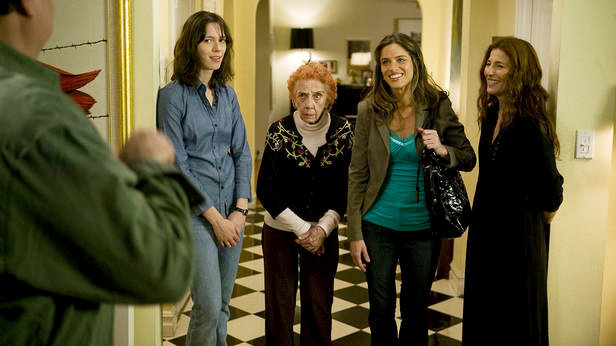
I want to like Nicole Holofcener’s films, and I feel like I should like them. Please Give, for example, has some nicely drawn characters; Catherine Keener and Oliver Platt as a middle aged couple who buy old furniture from the relatives of people who have just died, Sarah Steele as their teenage daughter. There’s also another family; Ann Guilbert as Andra, a 91 year old woman whose home Platt and Keener are planning to buy when she dies and Amanda Peet and British actress Rebecca Hall as Andra’s granddaughters. It’s got some clever dialogue. It’s often pretty funny and the acting is excellent all round. But I didn’t like Please Give because, largely, I just didn’t care.

I didn’t care, for example, about Catherine Keener’s Kate (though Keener, as ever, is flawless) and her mounting guilt about what she does for a living. I certainly didn’t care about her problems with her daughter Abby, who seemed to me in desperate need of a slap (particularly in a sequence where, when Kate gives $20 to a beggar Abby snatches it out of his hand, keeps it, and demands that Kate give him $5 instead). I didn’t much care about Kate and her husband Alex’s marital problems, largely because I didn’t buy the threat to it nor his affair.

I didn’t care about Amanda Peet as Mary, because Holofcener writes her as such a bitch that I had trouble buying her as a character, and certainly I didn’t care about Abby, whose feeling of entitlement to a $200 pair of jeans results in a final scene which sent me out of the cinema fuming. The one character I did care about, probably because she was the only one I warmed to at all, the only one I’d want to spend any time with, was Rebecca Hall’s character, also called Rebecca. Hall is a fast rising talent, and with good reason; she strikingly beautiful and, more importantly, I’ve never seen her be less than excellent in anything. Here she’s the film’s much needed ray of sunshine. Rebecca, who spends most of her time looking after her Grandmother, could just have been played as a saint, but Hall makes her simpler than that; not perfect, just a decent, caring, but very real, person.

There’s nothing notably wrong with Please Give. The story isn’t eventful, but it’s well told and at all levels the writing and acting is strong. It just struck the wrong chord with me, at the end of the day I just struggled to find any interest in well off people who were either struggling with the guilt of being well off in a vague sort of way (Keener), or just bitching about their lives (most of the rest of the cast. I, quite simply, don’t give a fuck.

Saturday, May 8, 2010

Film Review: A Nightmare on Elm Street [2010]

A NIGHTMARE ON ELM STREET [2010]
DIR: Samuel Bayer
CAST: Jackie Earle Haley, Rooney Mara, Kyle Gallner,
Katie Cassidy, Connie Britton, Clancy Brown


Last year I revisited and reviewed the entire Nightmare on Elm Street series as part of my Long Halloween series for the blog. You can see the reviews here and here. As a series it has moments of genius and plumbs astounding depths of awfulness, but even in its worst moments (Freddy’s Dead) I’d rather be watching that series than this remake. I have nothing positive to say about Samuel Bayer’s presumed new franchise launcher, and so there really is only one way I can address it.

Nightmare on Elm Street, how do I hate thee? Let me count the ways.

1: THOU ART NOT SCARY
This isn’t especially new territory for the Nightmare franchise, indeed the only truly frightening entries are the original film and Wes Craven’s New Nightmare, but, like most of Platinum Dunes films to date, A Nightmare on Elm Street is deeply, deeply unscary. The frights in the original come from some distinctly freaky moments, several of which are replicated here, with all the scares sucked out of them. Most notable is the death of the Tina character (here called Kris and played by Katie Cassidy, who is actually a pretty good match for the original’s Amanda Wyss). Here, instead of being slowly dragged up the wall and across the ceiling as the unseen Freddy is cutting her up she’s thrown around the room, slammed into the ceiling and off the walls, in a manner which, if you put the appropriate music under it, would be ideally suited to a Looney Tunes cartoon.

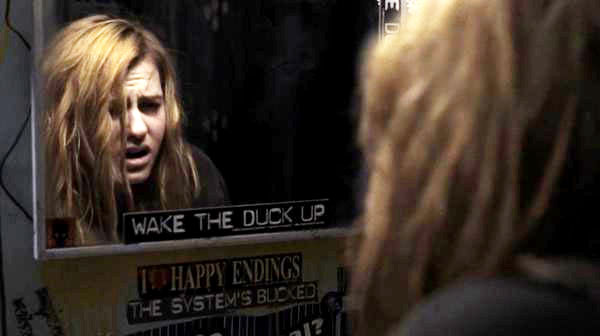
Freddy himself isn’t scary either, but we’ll come to that a little bit later. The reason that the film isn’t scary, beyond its imagery being both uninspired and so visually murky (with that greenish brown tinge that all Platinum Dunes directors seem contractually obliged to use) that it’s often hard to see what’s going on with any great clarity is the simple fact that it has no characters. Filmmakers seem to have forgotten, lately, that having a body in a film isn’t enough, that there has to be some personality imbued in each of them. It’s not like the teenagers in the original Nightmare were the world’s best or most rounded characters but they all, especially the girls; Tina and Nancy, had some semblance of personality. That’s not the case here, indeed, and again, we’ll get to this in more detail later, they seem to have been stripped of personality. The thing is, personality is what induces you to care about characters, and caring about characters is what leads you to be scared. Sure, you might jump a couple of times during Nightmare on Elm Street, if only because, given the sheer amount of cheap boo scares, one or two are bound to get you, but that nailbiting fear, that psychological terror of Freddy? Gone, as much a part of your dreams as the character himself.

2: THOU MAKE’ST NO SENSE
It really shouldn’t be a difficult story to tell. Accused child molester Freddy Krueger (Haley) is burnt to death by the parents of his victims. About 15 years later, Freddy, now a supernatural being with a razor fingered glove, begins stalking and killing those children in their dreams. Nancy Holbrook (Mara, taking over from Heather Langenkamp, whose Nancy Thompson is one of horror cinema’s truly iconic ‘final girls’) attempts to survive by staying awake, but when she can’t attempts to find a way to take Freddy out of the dream world and destroy him. Simple, right? Apparently not. That IS the story of this film, but if you don’t know the original then I’d imagine you’d be hard pressed to tell me that story after seeing this mess of a movie.

There’s no structure to this film, I’m not even sure of the timeline, of how many nights it takes place over. The key to the structure of the first Nightmare was that it stayed with the characters over several full days as they tried to escape Freddy by staying awake, here the narrative is so choppy that any sense of that struggle goes completely out of the window, this is terrible, because the timeline is key to the new plot concept of ‘micronaps’; waking dreams that kick in after about 70 hours without sleep. The film leans heavily on this concept, but we also see the characters sleep quite a lot, so it doesn’t track at all.

The original was also quite careful about giving you context for when and where characters fell asleep, notably by frequently having concerned parents forcing them to do so. Here the dream sequences emerge out of nowhere. The most strikingly illogical is an exposition filled dream that Quentin (Gallner) has after falling asleep in the middle of swimming a length of the school pool, seriously, did anyone give that even a second’s logical thought? If you really want him in his trunks then have him sit down in the showers after swimming and fall asleep there, but honestly, IN THE MIDDLE OF A LENGTH?


3: THOU HAST BETRAYED THINE CHARACTERS
As well as stripping its characters of all discernible personality (Jesse, Thomas Dekker’s character, has literally no trait apart from the fact that he wears more eyeliner than Nancy). This version of A Nightmare on Elm Street betrays them, especially Nancy, the parents and Freddy on a much deeper level. The original Nightmare was a sins of the fathers (and mothers) story; Freddy was a child murderer, released on a technicality and hunted down by the parents when he returned to his old home. The fact that they burned him to death wasn’t exactly positive, but at least you understood it. Here Freddy is an accused child molester. A hideous crime to be sure, and one that should be punished, but these parents apparently go right from ‘my kid said Freddy touched her’ to ‘lets set him on fire’. In the first film they certainly behave in a disgusting fashion, but it is so compounded here that you no longer understand their actions and, like Nancy, question why they didn’t just call the fucking police.

In the original film Nancy is smart and resourceful. She’s proactive, in fact she takes on the traditionally male role of being the fighter while Johnny Depp (making his debut as Nancy’s boyfriend) fills the more traditionally feminine role of simply watching from the sidelines. In this film Nancy is such a blank slate that when she does figure something out about how to bring Freddy into the real world (a LONG time after it should have become painfully obvious) we don’t buy it because the character demonstrates absolutely no intellect and her sudden transformation, in the final scenes, into a fighter is completely risible, first because Rooney Mara is so slight that you don’t buy the idea of her surviving more than three and a half seconds against Haley’s Freddy and secondly because there is, in the rest of the film, so little fight in Nancy. In the original Nancy makes things happen, here she is present when they happen to her.

As for Freddy…

4: THOU HAST NOT DELIVERED ON THY PROMISES
The thing we’ve consistently heard in the film’s pre publicity, right from the first greenlight, was that this film was taking Freddy back to his roots as the ultimate evil bogeyman, and eschewing the comedy stylings of Mr Freddy Krueger which ‘graced’ the sequels. Well, that’s just bollocks. Okay, so there aren’t too many of the cheesy one liners that sequel Freddy followed each kill with, but that’s not to say that his dialogue is either menacing or indeed serious here. About eighty percent of Freddy’s dialogue (all growled by Haley in a voice something like Christian Bale’s Batman gargling with cement) is at least attempting to make us laugh (and some of the subjects for this dialogue are skin crawlingly uncomfortable). Freddy has precisely one menacing line, and that one you’ve heard in the trailers (“What are you screaming for, I haven’t even cut you yet”). The other problem with Freddy’s dialogue is that it is all delivered in a series of non-sequiters, he talks a lot, but there’s no sense that any of the dialogue helps establish a character for him, it’s all just him popping up and saying something almost entirely random. Freddy doesn’t come across as evil here, he doesn’t come across as anything, either he’s trying for unsavoury laughs or he’s vomiting up raw exposition, including one moment in which he essentially lays out how to kill him for Nancy (then again, this Nancy would probably struggle with it even if he showed her a fucking flow chart)

Freddy’s make up is also disappointing, the look of Freddy always changed from film to film, but frankly the new look is distracting and, though arguably more realistic, it detracts from the concept of the character as the bogeyman. Here he looks like a burnt man, fine, but that’s not what Freddy Krueger is any more, he’s a creature not of reality but of dreams, and the realistic look, even after you take away the fact that the CGI giving him holes in his face is pretty distracting, undermines that. The look isn’t strange enough to feel like part of a dream reality. It’s also not scary but that, here, is par for the course.

5: THOU THINK’ST ME A MORON
There is so much exposition in this film, so much explaining, so much clarifying. Of course Freddy’s backstory has to be told for people coming fresh to this film, but that’s not what I’m talking about, the problem is really the incidental stuff, the endless explanation of things that anyone with a brain cell knows. Take the amount of times that Quentin clarifies that Clancy Brown is his father. Every time Brown appears poor Kyle Gallner gets stuck with a line like “Oh, there’s my Dad”. I KNOW. Not only have you told me three previous times that that’s your Dad, but he had his hand on your shoulder at your friend’s funeral earlier, I didn’t assume you were lovers. But my ‘favourite’ piece of exposition for idiots comes when Quentin warns Nancy of the dangers of staying awake for too long and says something like “Then you’ll fall into a coma. A sleep you won’t wake up from”. I almost stood up and yelled “I KNOW WHAT A FUCKING COMA IS” at the screen. Christ, if you’re 18 and don’t know what a coma is then you are probably in one. WHY EXPLAIN IT?


6: THINE PERFORMANCES ART UNIFORMLY AWFUL
Now, clearly I’m not about to argue that the original Nightmare on Elm Street set some gold standard for movie acting. Theere are actually some pretty bad performances in there; notably from Johnny Depp and from Ronee Blakey a Nancy’s mother. But overall most of the acting was pretty solid. Here, wow, I struggle to describe what this cast are doing as acting.
Rooney Mara was decent enough in a small part in Youth in Revolt that I began to have a little hope for this film. That hope was sadly, sadly misplaced. Mara is a pretty girl, and clearly that’s why she’s got this job because throughout the entire 95 minutes that A Nightmare on Elm Street runs she fails to betray a single emotion through facial expression, gesture or vocalisation. Listening to her dialogue is like listening to monotone static for the length of each speech while her pretty face sets itself into a vacant expression that suggests that she’s gazing out of a window and thinking ‘look at the pretty birds’ rather than being chased by a maniac in her dreams. The writing is godawful, so it may not be entirely her fault, but this is still one of the worst leading performances I’ve seen for some time.

As the parents with the most screentime Connie Britton and Clancy Brown aren’t bad (though Britton, a striking redhead, is woefully miscast as the mother of Mara, a rail thin, doe eyed brunette) and they fight valiantly to deliver their exposition heavy dialogue with something resembling feeling, but ultimately they are defeated by the words.

The kids are really the problem. Aside from Mara Kyle Gallner, Katie Cassidy, Thomas Dekker and Kellan Lutz have significant screentime and watching them all act opposite one another is like watching a bland off. Dekker takes an early lead in the utter tediousness stakes, by letting his eyeliner do the acting for him, but he’s overtaken by Gallner’s impressive dedication to not having any expression at all, despite the fact that his character is supposed to be in love with Nancy from afar (an idea utterly destroyed by their kiss, which has all the heat of a canister of liquid nitrogen at the north pole). Cassidy and Lutz aren’t any good either, but they escape the movie early on and so don’t have time to be quite so impressively dull.

7: THOU HAST A DISTURBING ATTITUDE TO CHILD ABUSE
Look, I’m all for exploring dark subject matter, and I’m not, in principal, against the idea of making Freddy Krueger a child molester rather than a killer. The problem with the idea (we’ll get to the attitude in a second) is that it does make Freddy a different animal, and actually undermines the plot of the film. By the time this film takes place his former victims are supposed to be around 17 (actually they are all very obviously at least 23, but I digress) so the problem is that his character, as established here would not be interested in them. He’s a paedophile; these ‘kids’ wouldn’t do anything for him anymore. Furthermore, Freddy is never established as a killer, so why does he kill at all? Surely given his psychology in this movie he’d be using his dream invading abilities for other nefarious purposes, and choosing far younger victims. Leaving that aside. It’s just really offensive when the movie tries to use repressed memories of child abuse for laughs.

As I said above, despite what we were promised, Freddy puns a lot in this movie, and several of his attempts at humour revolve around reminiscing about the abuse he committed when he was alive. It’s really uncomfortable, in all the wrong ways, when he says to Nancy “Your mouth says no but your body says yes”. There’s nothing wrong with discussing child abuse in cinema, or even, providing you do it sensitively, with depicting it, but playing it (and, in that line, a threat of rape) for laughs is just flat out wrong and the filmmakers should be absolutely ashamed of themselves for taking that route.

8: THOU HAST WASTED GOOD IDEAS AND A GOOD ACTOR
The micronaps idea is great. Just a hell of a concept, it means that at any moment we could be plunged into the surreal dreamworld, that Freddy might be lurking at any moment. If only. As I mentioned briefly above though, the concept is utterly fumbled, first by a screenplay so devoid of structure that you’re never sure how much time has passed or, for the most part, which dreams result from micronaps. The other problem with these micronaps is how they are used. There’s never a developed dream sequence, instead Freddy pops up for a quick boo scare and then we carry on with our scene, already in progress. Insultingly, some of the most iconic moments from the original film are dealt with in this way.

More criminal still is the utter wasting of the talents of Jackie Earle Haley. Like most people I was impressed and intrigued when Haley signed on for this film, assuming that it must mean that there was something more here than your usual remake offered. Not the case. I really hope Haley was nicely paid for this film, because he’s getting nothing else out of it. His performance feels strained, as if the make up has shackled him. He works hard, but all he’s been allowed to do is pop up in ‘unexpected’ parts of the frame and say some random line before disappearing again. That’s no work for an actor as talented as Haley. The only really notable thing he brings to Freddy is a neat little twitch with the glove, rubbing two of the knives against each other to create a signature gesture and sound.


9: THOU ART A PALE SHADOW OF THY SOURCE
Wes Craven’s A Nightmare on Elm Street is a fine film, and it deserves a place among the line up of horror classics, but it isn’t impossible to improve upon. Certain moments and performances do clunk and while many of the effects still look great some are a little ragged now. Instead of devoting itself to fixing these problems (most notably the hideously anticlimactic ending) Samuel Bayer’s film adds gloss and sheen (it does look pretty) but strips the film of interest. It removes character and metaphor, abandons subtlety and storytelling and becomes a collection of stuff, some of it quoted from Craven’s film, other bits drawn from parts of at least four separate draft screenplays. It is when Bayer quotes the original film that this film’s failings are most apparent. One notable is the bathroom scene, with Freddy’s glove coming out of the water. We get that image, but follow up to it, the terrifying moment in which Nancy is dragged through the bathtub and nearly drowns, is gone, replaced by a different dream sequence which contains plenty of exposition, but no scares.

The worst moment though, the thing which for me sums up the utter redundancy of this 95 minute train wreck, is the famous moment when Freddy’s face emerges from the wall above Nancy as she sleeps. In the original film (whose total budget was $1.8 million) the effect was achieved by replacing the wall with a sheet of spandex and having FX supervisor Jim Doyle lean into it. If there’s a creepier image in all of 80’s cinema I’m not sure I know it. Here, sub-Frighteners CGI emerges from the wall, looks fake for a few seconds, and then we cut to the next scene. For me, that moment sums up Platinum Dunes entire approach as a company; they’ll update things because they can, not because it will be better. Well, fuck that, fuck Platinum Dunes, fuck Samuel Bayer and fuck this movie. If you care at all about horror cinema don’t see A Nightmare on Elm Street at the cinema this weekend, spend £3 on the DVD of the original, and enjoy a real movie instead.

Tuesday, May 4, 2010

News

Of all the things I would NEVER have thought would get tapped for a remake, Mier Zarchi's infamous video nasty I Spit on Your Grave (a film which, 30 years after its release, remains a genuinely distressing experience) is near the top of the list. Here's the poster for the remake.


You know what? I'm intrigued. Just approaching this film is a hugely ballsy move, and if the people behind this new version can combine the ultra disturbing tone of the original with better performances, especially from the actors playing the men who attack Jennifer Hills, we really could have something here. The poster gives me hope, as it suggests that this movie isn't going to be some watered down PG-13 item. Could this be that rare thing... a worthwhile horror remake?

Saturday, February 27, 2010

Review Post 66: The Crazies [2010] / Crazy Heart

THE CRAZIES
DIR: Breck Eisner
CAST: Timothy Olyphant, Radha Mitchell,
Joe Anderson, Danielle Panabaker


I haven’t seen George A. Romero’s original version of The Crazies (the third of his films, to date, to get an official remake following the first two entries in his Dead series), so I can’t compare Breck Eisner’s unfussily efficient remake to its source, perhaps that’s a good thing though, because it forces me to look at The Crazies purely on its own limited merits.

To give Eisner (son of longtime Disney head Michael) his due, he does pull out several effective moments; a scarily atmospheric shot here (such as that of a woman dwarfed by a running combine harvester, or a garden fork being dragged along the floor), a thrilling scare sequence there (a car wash scene is pretty unnerving, and beautifully paced) and even a genuinely creepy downbeat ending that runs against the established Hollywood grain, but for each of these directorial hits there are half a dozen misses.

The biggest is simply that Eisner never stamps any identity on this film; any one of the directors who have been tasked to churn out the endless amount of horror remakes that Hollywood has been producing over the past five years could have made The Crazies. It’s a shiny, glossy, and ultimately rather soulless film, even Eisner’s best shots don’t feel like they could only belong to this story, or this filmmaker, it’s all just there.

Most of the other problems with this film begin not with the direction but with the screenplay by Scott Kosar and Ray Wright. There is a gaping hole at the centre of this film where its characters ought to be. The Crazies has no characters, just shells that walk around talking occasionally. Radha Mitchell suffers most, she’s a capable actress, but here she’s reduced to merely looking pretty (which she does well) and waiting to be saved. I hope she bought something nice with her wages. Her character is a doctor, and pregnant, but neither of these things has any real purpose in the film; instead the sense is that the character needed a job and the screenwriters’ dart happened to hit the card saying Doctor.

Timothy Olyphant has just as little to do, despite being the lead as Mitchell’s small town sheriff husband, who, along with his wife, his deputy (Anderson) and his wife’s teenage receptionist (Panabaker) attempts to escape when a mysterious disease outbreak results in their small town being wiped off the map by the Government. However, Olyphant is effective, giving a charismatic, Bill Paxton-ish, performance that suggests that if his character had anything resembling a personality he might prove a solid actor. In support, British actor Joe Anderson does a creditable American accent, and gives a decent performance despite a one note character, but Danielle Panabaker all but vanishes into the background, giving a performance that is as much a non-entity as her character.

It is, perhaps, churlish, to complain about lapses of logic in what is, in essence and feel if not in fact, a zombie movie, but there are holes here that one could drive a truck through. The most glaring are to do with the infection, and how it spreads (hmmm, might this have been a good use of the doctor character, do you think?) We’re never really sure how it spreads, how infectious it is, and the incubation period, though defined late in the day, seems motivated by dramatic requirements. The glaring error would seem to be that, at one point, Olyphant is clearly exposed to infected blood, essentially pouring it into a cut on his body, a fact that goes curiously unacknowledged (even by the DOCTOR).

The perfunctory screenplay, the mixed performances, the unimaginative and resolutely adequate direction, the fact that nobody has any character to speak of, these are all problems, but they are all amplified by the fact that The Crazies is just no fun. In fact it’s dull, a tedious collection of workaday horror clichés that never knit together into a satisfying story. There are no stakes here, because we don’t care about the ciphers at the centre of the film, and more than once, even during some of the film’s more action packed moments, I felt myself begin to nod off. Three or four effective moments, and a couple of better than deserved performances are all well and good, but they can’t lift The Crazies beyond being future bargain bin fodder for the most undiscerning horror fans.


CRAZY HEART
DIR: Scott Cooper
CAST: Jeff Bridges, Maggie Gyllenhaal,
Robert Duvall, Colin Farrell


I was always likely to like Crazy Heart, after all, it features three things of which I’m extremely fond; Jeff Bridges, Maggie Gyllenhaal and great music. In many ways Crazy Heart is, as a film, much as its main character; alcoholic, washed up country singer Bad Blake (Bridges) is as a person. It’s a little baggy, carrying some extra weight, it’s rough around the edges and sometimes a little caustic and it does some hopelessly cliché things along the way. However, it also possesses passion and a great deal of charm, which provide just enough smooth to take the rough with.

Jeff Bridges is nominated for an Oscar for the fifth time for his work here, and he’s going to win. It’s not an undeserved honour, and yet, this isn’t his best work. As Bad Blake, Bridges is brilliant; he really sucks us into this guy and makes him likeable against all the odds. He’s perhaps especially good in the scenes with Maggie Gyllenhaal’s single mother Jean and her four-year-old son Buddy. In these scenes we see Blake come to life, and perhaps for a moment we see the man who lies behind that alcoholic fug he’s spent most his life in. The only thing is that, occasionally, usually when Blake is at his most inebriated, Bridges’ performance smacks of effort. Just every now and then Blake goes away and is replaced by Jeff Bridges giving a really good performance. It’s strong work, but not quite as complete a creation as, say, The Dude.

Certainly Bridges is one of the things that lifts Crazy Heart out of the ordinary, which is where the rather hackneyed and signposted screenplay by director Scott Cooper would otherwise have landed it. The writing is strictly by the numbers redemptive stuff, it’s fine as far as it goes, and the dialogue is nicely written, but we’ve seen this movie a hundred times before (though it’s usually a biopic).

Maggie Gyllenhaal is one of the warmest and most enjoyable actresses out there at the moment, but what’s striking is how organic her work is. There’s none of the forced perkiness that can mark the performances of some actresses who are striving for warmth, and there also seems to be a total lack of vanity. She’s absolutely convincing as a single mother trying to hold her life together, and do it with good humour. She’s also got good chemistry with Bridges, which allows them to get over the implausibility of this sweet, attractive, woman in her early 30’s taking up with the alcoholic, slightly overweight and almost three decades older Blake.

In a smaller part, as a protégé who has now overtaken Blake, Colin Farrell does some nicely understated work, and reveals an unexpectedly strong singing voice. The music, by T Bone Burnett, is the heart and soul of this film, and if it had fallen flat it would have taken the whole movie with it. At one point Blake observes of songs “that’s how it is with the good ones, you feel like you know them, even if you don’t”. That’s sentiment that applies to all of this film’s songs. Bad’s music is stirring, and brilliantly performed by Bridges, whose voice may not have widest range, but is full of expression, in which you can hear the last twenty years of Bad’s life inform his performances.

Without Bridges, without Gyllenhaal and without its songs, Crazy Heart would be a deeply ordinary movie, and in some ways it remains so, but there is enough of quality here to overcome the overfamiliarity of the writing and to make the film well worth recommending as a whole.

Saturday, January 30, 2010

Review Post 63: The Princess and the Frog / Precious / Broters

THE PRINCESS AND THE FROG
DIR: Ron Clements / John Musker
VOICES: Anika Noni Rose, Bruno Campos, Keith David,
Jim Cummings, Michael-Leon Wooley


The path that John Lassetter’s career has taken is more ironic than most. Lassetter is the driving creative voice at Pixar, he directed Toy Story and, along with his company, brought CG animation to such prominence that it all but destroyed hand drawn animation, certainly in the US. Walt Disney did what was previously unthinkable; they closed their hand drawn animation department, effectively laying off animators who had spent their whole careers at the studio. Then Disney bought Pixar, and Lassetter became Chief Creative Officer of both companies. His first act was to re-open feature animation, and re-hire Ron Clements and John Musker, who had directed The Little Mermaid and The Lion King, among others.

The Princess and the Frog is Disney’s first hand drawn film in seven years, but it’s got a vibrancy and a classic feel that had been missing for rather longer. I grew up with the second golden age of Disney; The Little Mermaid, Aladdin, and the peerless Beauty and the Beast, and The Princess and the Frog was like a door opening, letting me back into my childhood for 90 minutes. The story, like many told in Disney’s animated films, is a twist on a famous fairy tale. In 1920’s New Orleans the vain and lazy Prince Naveen (Campos) is turned into a frog by voodoo practitioner Dr. Facilier (David). At a party Naveen mistakes poor, working class Tiana (Rose) for a princess, and asks him to kiss her, and lift his curse. When they kiss Tiana also becomes a frog, and then their quest to become human once more begins. It’s nice and simple, very traditional in a lot of ways, but this is also a notably different Disney film.

It is notable that Tiana is Disney’s first African-American ‘princess’, but that’s not what’s most interesting, or most different, about this character. All Disney films have a moral message at their heart, and The Princess and the Frog’s is that nothing worth having is obtained without hard work. Tiana is no vapid dreamer waiting for a man to come and rescue her (though there is one of those in this film, hilariously played by Jennifer Cody), she’s working two jobs and has spent her whole life scrambling to save money to open a restaurant. The rich layabout Prince would previously have been tolerated, but here Tiana berates him for his lack of drive, it’s an interesting reversal, and a much more meaningful change to the character of Disney princess than a mere choice of the colour that she’s painted.

For the most part Clements and Musker cleave close to classical Disney style with the look of this film; the jazz playing crocodile Louis (Wooley) wouldn’t seem out of place in the earlier classics, and neither would Tiana, Naveen or Naveen’s scheming valet Lawrence (Peter Bartlett, who seems to be doing an impression of Timothy Spall in Enchanted). A few characters, however, do stretch the imagination of the designers a bit further. Dr. Facilier is the film’s most stylised character, with his thin, spindly legs giving way to an imposing torso and face. He and his ‘friends from the other side’, who appear as shadow monsters, may be a little scary for the very young, but they are perhaps the most striking characters in the film in both their design and their animation. There is also a beautifully stylised, deco look, sequence for Tiana’s ‘I want’ song (which, in keeping with the film’s theme, is about how her hard work had got her “Almost There”). On the whole though, traditional or stylised, the film fits together beautifully, its look all very much of a piece and the animation is stunningly fluid.

The screenplay, by Clements, Musker and Rob Edwards is full of memorably eccentric characters who are destined to become beloved Disney classic. This is most obviously the case with Ray; a Cajun firefly voiced by Jim Cummings, he starts off as (very successful) comic relief, but his love for a ‘girl’ named Evangeline ends up providing the film with some of its most moving moments and Cummings balances these two sides of Ray beautifully. Another riotously entertaining turn is served up by animator Andreas Deja and Jennifer Lewis, when Tiana, Naveen, Louis and Ray visit voodoo woman Mama Odie, who is 197 and blind. Deja is a past master of character animation, and he gives Mama Odie (and her guide snake) such life that you want more than just the one hilarious scene with her. I always knew I was going to be in for some fun with The Princess and the Frog, but what I didn’t expect was to be so moved, one late twist may upset the kids a great deal, but it will likely get to the adults too and the love story between Tiana and Naveen is well told, and genuinely involving.

There are only a few downsides to the film. The biggest is that the reason that Dr. Facilier wants to turn Naveen into a frog to begin with is never really very clear, and second tier villain Lawrence is never very effective. There are some toe tapping tunes from Randy Newman too, but also a few that fall flat, and sometimes a song swells on the soundtrack just a little too often, breaking up what is an involving story a little more than is necessary. On the whole though this is about as good a return as Disney’s classic style could have hoped for. It modernises where required, but still has the feel and form that are so beloved of Disney, it’s a treat for kids and adults alike and I can’t imagine anything better to do with the children over half term.


Precious
DIR: Lee Daniels
CAST: Gabourey Sidibe, Mo’Nique,
Paula Patton, Mariah Carey


Lee Daniels’ acclaimed film has been doing the rounds since Sundance 2009, and even the worst reviews have generally breathlessly praised the performances. Some critics have decried the film’s depiction of black family life, but given that one of the more notable of those reviews from a man who singled out Norbit as a positive depiction of the black experience you can ignore much of that fuss. Precious isn’t a film about a community as a whole, it’s about one hideously abusive family, and anyway, it’s not as if it doesn’t also have positive (angelic, even) black role models. This is perhaps the big problem with the film; it’s very black and white, not in racial but in moral terms. People are either saintly (Patton’s teacher, Carey’s social worker, Lenny Kravitz’ male nurse) or they are essentially evil incarnate (Mo’Nique as Precious’ mother). The only really shaded character is Precious herself, and even she is generally depicted as a shining force of goodness.

Despite the limitations that such thin writing places on the actors there are some genuinely brilliant, searing and hugely surprising performances in the film. Mo’Nique is someone I’d barely heard of previously, aside from having seen a review of her ‘comedy’ Phat Girlz. It seems that somewhere behind that apparently deeply unfunny persona there lie deep reserves of dramatic acting talent. Her performance is likely to win her an Oscar, and it will be absolutely deserved if it happens. The character is basically a monster, but Mo’Nique finds so much more in there, it’s a deeply chilling performance, never more so, perversely, than when a social worker visits the family and Mary has to play nice. It’s so forced, so fake, so obvious that the monster is just itching to come out. It’s an incredibly compelling and scary scene, because for once you don’t know what to expect of the character.

Another shock is the performance of Mariah Carey, her last notable film, the star vehicle Glitter, was just about laughed out of cinemas. Here she’s utterly unrecognisable, she's got no make up (save for to give her the appearance of a small moustache), wears a shapeless muddy brown wig and baggy clothes. If I hadn’t known it was her ahead of time I’d never have spotted Carey. She gives a skilful performance, very down to earth, as a woman used to keeping her emotions back, and when she can’t anymore, at the film’s climax, it’s done in a beautifully small and subtle way.

Next to these two unexpectedly brilliant turns Paula Patton comes off poorly, but that’s likely more to do with the fact that her character is so poorly written - she really couldn’t be any more saintly if she wore a halo and had a choir of angels accompanying her every appearance. Patton does what she can with this one note, but there’s nothing there for her. Gabourey Sidibe has been attracting plaudits since Sundance, and she too is likely to be Oscar nominated for this, her film debut. Certainly she has presence, and gives a fine performance, but again she just rather pales next to, in particular, Mo’Nique and again, despite attempts to fill in some of her hopes and dreams though (embarrassingly poor) dream sequences, she comes off as a rather thin and ultimately rather passive character, seeming at times more a vehicle for the story than anything else.

However, the big problem at the centre of the film isn’t the screenplay or the acting, it’s Lee Daniels’ often howlingly terrible direction. The dream sequences are just a total miscalculation; a filmic device that utterly breaks the flow and verisimilitude of the film’s Harlem setting and late 80’s period. His handling of Precious' education is also poor, with a class straight out of the Dangerous Minds handbook, but what’s most troubling is the way that Daniels shoots the violence and the rape scenes. Precious has been called poverty porn, and when, in the film’s first five minutes, we get slow motion shots of the abuse being meted out to Precious, I can see where that criticism comes from. Often the film dwells in its most extreme moments of degradation to a slightly troubling degree. It may boast some brilliant performances, but I found Precious an ugly and depressing, as well as a cinematically flawed, experience.


Brothers
DIR: Jim Sheridan
CAST: Natalie Portman, Tobey Maguire, Jake Gyllenhaal,
Bailee Madison, Taylor Geare


I went into Brothers (a remake of the Susanne Bier's Brødre, which I haven't seen) somewhat reluctantly, having seen an appalling clip from it on Film 2010, but I went expecting that I’d get to have some fun ripping it apart in a review. 104 minutes later I came out, largely pleasantly surprised.  I wish I could give the film as a whole a better review, because there are lot of really good things in it. Jake Gyllenhaal and Tobey Maguire play the titular brothers, Tommy and Sam Cahill. Tommy has just come out of prison and Sam is shipping off to Afghanistan again. When Sam’s helicopter crashes his wife Grace (Portman) and daughters (Madison and Geare) are told that he’s dead. Actually Sam has been captured, and while he’s struggling to survive his brother is growing closer to his wife and kids, meaning that everything comes to a head when Sam returns home.

One of the more obvious potential problems with Brothers is the casting. Sam and Grace are clearly supposed to have been married for some time (their eldest daughter is nine), but the cast seem quite young for their roles (okay, Maguire is 34, but he still looks a lot younger). However, this doesn’t actually become as much of an issue as it might have, because for the most part the cast give mature performances that help to overcome their youthful looks. Natalie Portman, a variable actress who clearly needs a strong directorial hand, gives her best performance in some time as Grace, both the love she feels for her husband and the way she grieves for him are subtly played, but both seem deeply felt. She’s also a plausible parent, working well with the young actresses playing her daughters and finding a lot of real little moments in the way she behaves with them.

Jake Gyllenhaal is also strong, making the way his character grows; stepping up to the plate when his brother is thought dead, feel organic, and his strong chemistry with Portman makes their attraction play well as an undertone in quite a few scenes before it becomes something stronger. Perhaps the best performances in the film come from nine year old Bailee Madison and seven year old Taylor Geare, who are both wonderful as Maguire and Portman’s daughters. Jim Sheridan showed with In America (a terribly underseen film) that he was able to get great work from kids, and he does it again here with the help of David Benioff’s script, which gives the children some deep emotional places to go to, but always remembers that they are children, not small adults. Among the support there’s also good work from Sam Shepherd, Mare Winningham and Clifton Collins, Jr.

Sadly the weak link among the cast, and the one who at times threatens to bring the film tumbling down, is Tobey Maguire. First off, I just don’t buy him as a hardass marine, despite the jarhead haircut and the fact that he’s in great shape he just doesn’t give off that toughness. He’s not bad in the scenes before he ships out, building a nice connection with Portman and the kids, but in Afghanistan and when he comes home Maguire is way over the top, and unbalances the otherwise rather low key tone of the film. In what should be the film’s big emotional climax, Maguire goes completely off the deep end, giving a performance so risibly bad that I couldn’t help laughing. In the end I think the whole would be better had Gyllenhaal and Maguire swapped parts, because Tommy’s part lacks the operatic notes that Maguire so catastrophically misses.

It’s a shame that there’s such a gaping hole in Brothers, because aside from that performance the film is excellent. Sheridan’s direction isn’t flashy, but it gets the job done and a strong cast give the best of themselves despite a slightly implausible story. This isn’t a great film, which is a pity, because it could have been, but it is certainly worth seeing and persevering with.

Tuesday, October 13, 2009

The Long Halloween: Fuck you, Rob Zombie

HALLOWEEN II (2009)
DIR: Rob Zombie
CAST: Tyler Mane, Scout Taylor-Compton,
Malcolm McDowell, Brad Dourif


Rob Zombie’s remake of Halloween was, make no mistake, awful, bad enough that to call it his ‘best’ film would be to insult things that are actually good, it was his least worst film though. He’s regressed.

There are, of course, plenty of horror films worse than Halloween II, endless amounts of shitty horror films made on a camcorder in someone’s back yard have inexplicably found their way to a video release, but that’s not what Halloween II is. This film cost $15 million, it has a writer/director who has made three successful horror films before, it is produced by a major Hollywood studio. It may not be worst horror film ever made, but Halloween II is certainly one of the worst studio horror films in a very long time.

Zombie’s story sees Michael Myers returning to Haddonfield (why? Because, that’s why) after apparently wandering around America knifing people for a year, while growing a mountain man beard that makes him look like a 7-foot, dirt encrusted, member of ZZ Top. Anyway, he comes back and sticks his knife in a bunch of teenagers and other minor characters. It’s the same ‘story’ as every other bad slasher. To be fair Zombie does try to inject a little depth into the film, unfortunately what he comes up with a series of jaw-droppingly pretentious dream sequences involving Young Michael (now played by a slightly less freaky, but still completely charisma and talent deficient child actor) his Mother (The beautiful, but entirely wooden Sheri Moon-Zombie) and, for some reason, explained on an opening title card and yet still utterly obscure, a white horse. He also tries to establish a connection between Myers and Scout Taylor Compton’s Laurie Strode, but does so using little more than graphics and editing techniques that look like they were lifted from a bad music video by a terrible metal band in 1995.

The story is one thing, but what is truly abominable is the screenplay. If you counted every ‘fuck’ in this film I believe the total would be higher than the total amount of words that aren’t ‘fuck’. I mention this not because I’m offended by bad language (I actually don’t believe in bad language), but because it demonstrates beautifully just how tedious Zombie’s writing is. He has an absolute inability to create individual voices for his characters, so they all spout the exact same profanity riddled invective. The characterisation of Laurie Strode is a particular problem. In the original films she is a perfectly average, even slightly mild-mannered, teenager. Here every second word out of her mouth is fuck, she’s hostile and unlikable, and there’s a toughness about her, which undermines the sequences where she’s supposed to be threatened because, little though she is, there’s a sense that this girl can really look after herself. Even this is inconsistent though, given that Laurie is also prone to nightmares and endless fits of crying. In a better film this would pass for layered characterisation, a character hiding her vulnerability behind outward toughness. Unforunately neither Zombie nor Taylor-Compton have the ability to pull this off, and so it just seems confused and inconsistent. This seriously undermines what are supposed to be the scares, because not only do you not get the sense that there is any real threat but you also don’t care if there is. Personally I would have liked Michael to put a knife straight through Laurie’s head and have done with it.

The same problem exists with all the characters. I could believe that Zombie just wrote a few lines and then had the actors pick their dialogue out of a hat, in fact I have trouble believing that such personality free, identical sounding, cardboard cut outs could be created any other way. Perhaps Zombie’s worst offence when it comes to the characters is in his depiction of Loomis. Loomis was always brittle, but here he’s just an utter prick, the kind of man you want to punch in the face the second he speaks. When he was Donald Pleasance Loomis at least exuded some expertise and insight into Michael, there’s none of that here. Indeed the character is completely pointless in the context of the film, serving only to swan around like an arsehole, being rude to all and sundry, before yelling some useless psych 101 crap at Michael to no real purpose.


So we’ve established that writer/director Rob Zombie can’t write. He also can’t direct. He certainly can’t direct actors. When I say that Brad Dourif gives the ‘best’ performance in Halloween II I mean it much the same way as when I said that Halloween was Rob Zombie’s ‘best’ film. It’s not good (check out the hilariously poor scene in which Doruif’s Sheriff Brackett brings home a pizza for his, Annie’s (Danielle Harris) and Laurie’s supper) it is, however, slightly preferable to spending the same amount of time stabbing yourself in the leg with a pair of compasses. The same cannot be said of the rest of the… I hesitate to call it acting, but for want of a better word. Scout Taylor-Compton, for example, baffles me. She’s got a girl next door prettiness in real life, which would work for Laurie, but here Zombie has her looking raddled and ugly, and however good a physical fit she may or may not be, Compton lacks any sort of acting ability. If Zombie had cast a Speak n’ Spell machine as Laurie he couldn’t have got a performance that was any less expressive and emotional. How, when there are huge amounts of talent out there, does someone as staggeringly awful as Taylor-Compton get even extra work, let alone a lead in a studio film? Malcolm McDowell should also be in contention for next year’s Razzies for his scenery chomping work as Loomis. However, nobody really had much of a shot at being good in this movie, given the material.

In previous films Rob Zombie has demonstrated that he’s a bit of a magpie, stealing shots left, right and centre from other films, but he’s usually managed to make a film that looked at least okay. Until now; Halloween II is a horrible, horrible mess to look at. First of all most of the film takes place in near total darkness, meaning that during a great deal of the film we can’t see what’s going on (ah, small mercies), and are essentially sitting squinting at a black screen for minutes on end. At other times there is light, and it is as ineptly handled as the darkness. During one scene on a deserted road there is a brilliant white light throughout the scene, which serves to silhouette Michael. Where’s the light coming from? Who cares, it looks ‘cool’, right? In fact it looks more like a UFO from The X-Files is about to land behind Michael and is amateurish in the extreme. Then there are the music video moments, in which Zombie tries to pummel us into submission with cuts upon cuts upon cuts of ‘symbolism’ that only a 12 year old could see as profound or cool. The biggest fuck you though, is reserved for the film’s very last shot, which is a direct steal of the last shot of Psycho. I swear, even over the music, I could hear Hitchcock begin to rotate in his grave. If I ever meet Rob Zombie I’m going to punch him in the face for that shot.

I’ve now written 1200 words about a Halloween movie without discussing Michael Myers. Part of that is down to how unimportant Michael is to this film, and part of it to how unlike Michael he seems. I was always against Tyler Mane as Michael, because it makes the threat he poses so different. The original Michael was a threat mainly through tenacity (and, yes, a supernatural inability to die, but why split hairs), rather than power. Mane’s Michael is just a hulk. Yet by demystifying Michael, Zombie has also removed another of the things that made him truly scary, the point behind that blank mask is that who Michael is doesn’t matter, what his name is doesn’t even matter (remember that in John Carpenter’s original he was ‘The Shape’), Michael isn’t a person, he’s living, breathing evil. That’s scary, a big tramp with a mask isn’t. Michael’s kills are extremely boring, and all executed in a very similar manner. Zombie loves to dwell on overkill (another thing that Michael never really engaged in), and so we get scenes where Michael stabs a victim repeatedly for about 20 seconds, pauses, then keeps right on stabbing. Annoyingly for gorehounds, though Halloween II is very bloody, we actually get to see very little of the violence. Blows usually land off screen, or in such pitch darkness that we can’t make them out, and the violent scenes appear to have been shot and cut by an epileptic on crack.

The dream sequences that recur throughout the film are absolutely awful. The imagery is so cliché that it’s just hilarious, and the acting by Sheri Moon-Zombie and new Young Michael Chase Vanek is torturously stilted. They are also hugely pretentious, it makes me laugh that people have lately accused films like Antichrist and Martyrs of being pretentious. Those people clearly haven’t seen this movie. Oh, how I envy them. Perhaps the thing that most irritated me in this film though is the reveal of the first dream sequence, at which I actually sat up in my seat and said, “you’ve got to be fucking kidding”.

I really hate the trend for remakes in mainstream horror. Hopefully this staggeringly inept entry in the cycle brings us at least close to its absolute nadir (though Zombie’s next is a version of The Blob, God help us). Halloween II is an inexcusably awful film, by a filmmaker who has said that this excremental production represents his vision. That being the case he should get his eyes tested and have his DGA card taken away. If you have even a passing interest in good horror movies, skip this one and get your fix with Thirst on October 16th.