I'm not the guy who talks to the characters in the cinema (you know the guy, the one who yells "Don't go in there" at the Nightmare on Elm Street remake), in fact I think there should be severe punishment for that guy. However, I did shout at Julia's Eyes. Let me explain myself... For the better pert of two hours I had watched Julia's Eyes lurch from being a deeply uninspired noises off horror, with unconvincing supernatural overtones, to become a dull, stupid and derivative serial killer film. Then came the final shot, which managed at once to be head slappingly obvious, mawkishly sentimental and insultingly stupid, and I could not contain myself, the words just sort of rolled out at the screen "Oh, do fuck off".
This is a terrible shame, because Belen Rueda, who took the lead in earlier Spanish horror hit The Orphanage and here returns to the genre, deserves considerably better. Her performance exceeds the film at every turn, and if you believe in a single frame of Julia's Eyes it will be entirely thanks to her nuanced performance, remarkable in a film so hackneyed.
The fault lies, unquestionably, with director Guillem Morales, who makes a series of irritating, film hobbling, choices. First of all there are the many threads which Morales sets up, but never pays off (a group of blind women who seem to have almost supernatural senses, a creepy neighbor for Rueda's Julia, why the hell nobody thinks to tell Julia that a: Her twin sister (whose suicide opens the film) had an operation to correct her blindness and b: That that operation failed), these are just some of the half complete threads. The screenplay also gives us little sense of most of the characters motivations, notably those of its ultimate villain, which are 'explained' in a garbled and hilariously nonsensical speech.
However, the big issue is Morales' consistently awkward direction, which knows only three qualities; cliche, theft and pathetically obvious metaphor. At times Julia's Eyes resembles a horror cliche museum; you've got the creaking floorboards, the lights going on or off suddenly, loud inappropriate music, the obvious dream sequence, the chase through a thunderstorm (complete with thunder as a score track cueing the scares), a score that essentially bellows 'are you scared yet? HUH?' at you for two hours, and even a 'CAT!' moment, and that's, again, an incomplete list. Theft is also prevalent, horror films like The Eye and The Orphanage loom large, one sequence is an all but direct lift from The Silence of the Lambs (but not scary) and the last shot may as well be from Contact.
The visual metaphor was what got to me most though, especially during a roughly twenty minute sequence after Julia (who has gone blind) has had a cornea transplant and has to wear a bandage over her eyes. During this sequence we never see anyone's face except Julia's. Several problems here; first it's just awkward, and forces Morales into a lot of odd compositions and unnatural lighting, second WE GET IT, she doesn't know what people look like, stop punching us in the face with the visual metaphor and thirdly, most problematically, it makes it screamingly obvious who the villain is, it's basically a Scooby Doo technique,and frankly Hanna Barbera got more surprises out of it.
This is an irritating film, as it went on I had an ever deepening desire to slap the director, and it can't be rescued either by the best efforts of Belen Rueda or by the occasional creepy image. I've got no idea what someone as talented and as original as Guillermo Del Toro is doing putting his name to this boring, derivative, amateur night tosh.
DIR: Michael Caton Jones CAST: Michael J. Fox, Julie Warner, David Ogden Stiers, Woody Harrelson, Bridget Fonda
It's a strange film to have an attachment to, but I will always have a bit of a soft spot for Doc Hollywood, if only because it was where I first saw breasts. Thanks, Julie Warner. Memorable moments for an eleven year old aside, however, the film does have other things going for it.
This is a Capraesque tale of a young surgeon (Fox) who is waylaid on his way to a big plastic surgery job interview in LA when he crashes his car, demolishing the fence of a small town judge. He's sentenced to community service as the town's doctor, and immediately all the residents begin working to try and ensure that he stays there. There's romance with the local ambulance driver (Warner) and a flirtation with the Mayor's daughter (Fonda) makes one of the locals (Harrelson) very jealous.
Doc Hollywood is gently funny, and doesn't lack for charm, but it's hard to shake the feeling that it's a little empty. Michael J. Fox was never the world's best actor, but he can be magnetic, unfortunately he's not great here, he's a little miscast as a soon to be high flying doctor who is more than a bit of an asshole, but worse he just seems to be coasting here, and the growing relationship between him and Julie Warner - who is perfectly good as Lou the ambulance driver, but is outshone by another performance we'll come to - never really convinces.
What works better is the depiction of this bible belt town and its inhabitants. The script and direction poke gentle fun, never pretending that this depiction of Grady is of a real place as much as it is of a romantic cinematic vision of a small town. Though the characterisations are broad, outside of the rather drippy main story, everyone is having fun. David Ogden Stiers is blustery and funny as the mayor desperate to keep this new doctor in town, while Woody Harrelson does his patented 'amusingly dim, while a side of menace' thing to perfection.
Bridget Fonda reunites with director Michael Caton-Jones, who gave her a big break in Scandal two years before. Here she plays the mayor's flirty and oversexed daughter, who wants Fox to take her away from the provincial life to the bright lights of LA (and this, for me, is where the story strains credulity, because really, who could resist?) It would have been easy for this role to have been played as no more than a punchline, but as ever Fonda invests her character with a real spark, she's effortlessly likable, and that as much as her beauty makes her a much more interesting potential match than Warner. Saddled with a thankless role, Fonda makes much more of it than was likely on the page, it's both one the film's greater qualities and eventually one of its greater failings.
You'd be hard pressed to dislike Doc Hollywood, it's too amiable for that, and for all its problem it is frequently funny, and its gentle charm does end up rubbing off on you, even if, at the end of the day, you know it's not especially brilliant.
DIR: Daniel Zirilli CAST: Tony Schiena, Heath Herring, Louis Herthum, Bai Ling, Dean Cain I love martial arts movies. Sometimes I just want to switch off my brain for 90 minutes and engage with a movie at a visceral level. That's what films like Circle of Pain are designed for. If you're looking for something to pass a friday night with some friends, some beer and some pizza, then this ought to go over perfectly well. That's not, however, to say that it's an especially good movie.
The story couldn't be more formulaic if it tried. It's that tired old tale of the fighter (in this case karate champ Schiena) with a dark past pulled out of retirement for one last bout against a younger up and comer (UFC fighter Herring). Schiena has a roommate (Cain) who has been confined to a wheelchair since they had an accident in the ring, and this haunts him so much he's never fought since, so he trains with the eccentric Willy (Herthum, last seen in The Last Exorcism) to get over this block.
And then, oh then there's Bai Ling. Ling plays the owner of the Multiple Martial Arts franchise putting this bout on and does so in the riotously terrible way we've come to expect from her. She's an appalling actress, never for a second convincing as anything but the utterly insane Bai Ling, but her broken English and apparently equally broken mind are hilariously entertaining.
Next to Ling's lunatic display (watch for the scene where she shouts "shut fuck up" at her own crowd) the rest of the performances come off dull, but the cast aren't bad, considering that they are largely fighters rather than actors. Tony Schiena is flat, but Heath Herring has some charisma. The worst performance comes from Shannon Leppard, making an embarrassing debut as Schiena's ex wife.
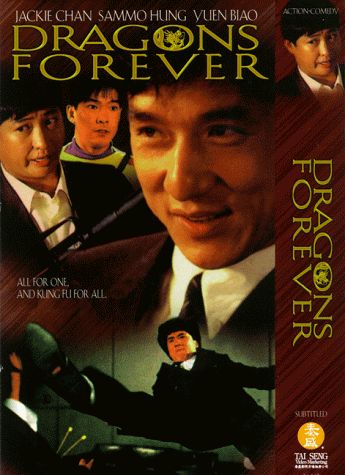
But the story and performances aren't really the point. What people really want to know about when it comes to films like this is the fighting. If you're a fan of MMA then you'll likely love this film. The fights are plentiful and the pairings varied. For me, I can't quite get into MMA as a cinematic style. It seems to stake out a no man's land between the brutality of a style like Muay Thai or Hung Gar and the grace of Wushu or Wing Chun. The choreography does a good job of putting across the power of these fighters but personally I missed the lightning speed of a Yuen Biao, the humour of Jackie Chan and the groundbreaking choreography of their best work.
Ultimately Circle of Pain wasn't really for me, but if you like this sort of thing then you'll like this. It's an acceptable way to kill 86 minutes, but personally when I next reach for a martial arts film it will probably have Sammo Hung in it rather than Tony Schiena.
After seeing London Boulevard I sat down with Ray Winstone's character, Mr Gant, to discuss the film. This was our conversation. It was very, VERY sweary.
DIR: William Monahan
24FPS: Hi Mr Gant. Fancy a beer?
Gant: Yeah. So what did you make of the movie, you facking c**t?
24FPS: To be honest Mr Gant, I thought it was largely bollocks.
Gant: The dog's bollocks?
24FPS: Afraid not, just regular bog standard bollocks.
Gant: You think you can do better, c**t?
24FPS: That's really not the point, it's more that hundreds of directors before William Monahan have already done better, that this movie plays like the cutting room floor scrapings from every sub-average British gangster movie ever made.
Gant: Give me some facking specifics.
24FPS: Well, let's start with you, and with the actors playing your criminal gang.
Gant: You want to watch yerself sunshine.
24FPS: You're fictional Mr Gant, I'm really not scared of you. Anyway, you're all cartoons, spouting out the mouldiest of cliche gangester lines, all of them liberally festooned with obsceneities.
Gant: Like fack, and c**t?
24FPS: Like, as you - repeatedly - say, fack and c**t. Frankly it's a bit boring, and the fact that neither the plot nor the characters were keeping my interest meant that I ended up wondering what the exact ratio of swear words to other words was in the script. It's not as though THE DEPARTED, which William Monahan also wrote, was lacking in swearing, but the dialogue was intersting, so you didn't end up counting fucks, here it just sounds like Monahan, whenever he couldn't think of anything else for a character to say, just threw in a c**t.
Gant: Didn't you fink the plotting was clever, like how I made Colin Farrell my facking bitch?
24FPS: No. I've seen it all before, especially that car park scene where you try to induct him into your organisation, a scene which comes complete with dialogue so cliche I wonder if Monahan got it from an examplar passage in screenwriting for the near brain dead.
Gant: Alright you facking smart arse c**t, was there anything you did like?
24FPS: They're both underused, but the two lead actresses; Kiera Knightley (as a movie star who shuts herself away in her home to escape the papparazzi) and Anna Friel (as Farrell's alcoholic sister) are both good. They each feel like they're in a completely different movie to the impoverished man's GET CARTER that you and Mr Farrell (who is not bad here so much as he's just bland) are participating in, and while Friel's storyline is also familliar, Knightley's was actually the more furstrating, because I didn't feel like I'd seen that movie before, and yet it kept cutting back to you and Ben Chaplin doing your boring mockney villain thing.
Gant: Awright, what about the tech side, not going to tell me it looks shit too are ya? ARE YA?
24FPS: No, actually it's often gorgeous, and that's what happens when you hire Chris Menges to photograph your film, and cast such fabulously beautiful people as Farrell, Knightley and Friel.
Gant: And me.
24FPS: Well. Anyway, it's something, but it's not much compensation, because it doesn't stop the storytelling from being plodding and the plot being depressingly telegraphed (the 'surprise' ending is anything but). Nor does it keep the dialogue from clunking, especially Knightley's speech about the role of women in cinema, which couldn't have landed with a more resounding thud if it had been wearing concrete boots.
Gant: So you saying my facking movie's shit, ya c**t?
24FPS: Yes, bluntly. LONDON BOULEVARD is so predictable that if you've ever seen a British gangster film before you'll know exactly where it's headed right from the start. It's a shame, because there are some interesting ideas here (who, for example, is the photographer outside Knightley's flat who isn't among the press corp) but Monahan's flat refusal to explore these ideas, in favour of a story we've all seen, done better, fifty times already, is really irritating. Also, it's annoyingly sweary, I may have mentioned that.
The mid to late 1970's is generally seen as something of a golden age for porn, that time when even people making X Rated movies were at least attempting to make real films, even if they weren't especially artful. ALICE IN WONDERLAND has fascinated me since I first heard about it; a porno musical? How could that not be at least interesting? It's by no means a great film, but ALICE IN WONDERLAND certainly is interesting.
The thing that is perhaps most intriguing about the film is just how much of it doesn't revolve around sex. There is a long establishing sequence in which Alice (played by the sweetly pretty Kristine DeBell, who had several mainstream roles after this film) makes it clear to her boyfriend that she isn't ready to have sex with him (the film is careful to establish that, despite this stance, Alice is 18), then the White Rabbit shows up in the library where Alice works and leads her into Wonderland. Even in Wonderland, where events become more sexual with each passing scene, there is at least an attempt to tell a story, and to allow DeBell to act. Alice wants to grow up, but she's a little reluctant to join in the various sexual games in Wonderland, and to the filmmaker's and DeBell's credit, they do attempt to carry this through even in Alice's approach to the sex scenes.
The songs are pretty awful, and so is the bawdy comedy, but there is something about this movie. Even though, at the tea party, Alice doesn't so much have tea with the Mad Hatter as, well, blow him, there is a strange innocence about the whole thing. It has a playfulness that makes it, for all its rough edges, bad acting, silliness and shagging, feel like something that a group of friends - pardon the pun - tossed off for a bit of fun. I can't exactly recommend it, because it's not actually any good, but I certainly enjoyed watching it.
I haven’t had the time (or, quite frankly, the energy) to cover everything I’ve seen from this year’s London Film Festival so, in the hope of clearing the backlog, here are some (very) brief thoughts on some of the titles I didn’t get to cover in more detail.
LIVING ON LOVE ALONE DIR: Isabelle Czajka This look at the life of a 23 year old woman (played by an excellent Anaïs Demoustier) drifting from job to soul destroying job and partner to casual partner until she meets a cool, handsome guy (Pio Marmaï) who says he’s an actor starts off really well. It’s slowly paced, but patiently builds two very compelling characters whose relationship is always interesting and believable. It also has some witty and true things to say about the experience of the day to day 9 to 5 grind of the job market.
Isabelle Czajka gets very strong, unaffected, performances from her leads, but unfortunately her script runs off the rails in the third act, when, with one key moment, LIVING ON LOVE ALONE seems to become another film, charging off in an unexpected direction that never really convinces. Still, the strong performances and Czajka’s naturalistic approach make this worth a look.
IT’S KIND OF A FUNNY STORY DIR: Anna Boden / Ryan Fleck This is definitely a tilt at the mainstream from the writing/directing team behind HALF NELSON and SUGAR, and it’s a pretty good one. It follows five days in the life of 16-year-old Craig (Kier Gilchrist) after he checks into a psychiatric ward when he’s feeling suicidal. It’s more fun than you’d think, given the subject, and what it ends up feeling most like is THE BREAKFAST CLUB in a psych ward. Boden and Fleck inject plenty of energy and variety into the film with animated sequences (very reminiscent of Michel Gondry’s work), escapes from the ward and fantasy sequences (Craig’s performance of Under Pressure is a highlight).
Most of the performances are strong, but in the lead Kier Gilchrist is a little bland. He’s not terrible, but he is shown up by the other actors around him. Best is Zach Galifianakis, who acquits himself very well in a largely dramatic role as another patient who takes Craig under his wing, while Emma Roberts makes for an effective love interest and gives her character enough depth to suggest that she’s already a better actress than her aunt Julia. Some may find this a little quirky for their taste, but I had fun with it.
THE TAQWACORES DIR: Eyad Zahra For better or worse, Muslims and the Muslim experience have been much more represented in media of all sorts since September 2001, but most of those depictions have tended to focus on one particular issue, whatever the angle. Perhaps the most refreshing aspect of THE TAQWACORES is that it almost entirely ignores questions of radical Islam, terrorism or the victimization of the Muslim community. Instead the focus is on the underground Muslim punk scene in Boulder, Colorado.
Director Eyad Zahra gives the film a washed out look, giving the impression that Boulder really needs this energizing music, but it is the script as much as the images that makes the film interesting. Without being heavy handed about it, and with a real sense of humour, the film looks at the way its characters sometimes struggle to reconcile their beliefs with the punk scene. This leads to a lot of thought provoking moments, especially in the prayer meeting led by Jehangir (a brilliant, charismatic performance by Dominic Rains), and to some big laughs (almost everything that Noureen DeWulf says as burqua clad Rabeya is hilarious). This is an energetic, refreshing, daring film that really throws you into a culture you probably didn’t know existed.
The only real downside to THE TAQWACORES is that the ending doesn’t quite satisfy, it feels cheap and stock, and therefore lacks the emotional punch it’s looking for, but it doesn’t undermine the film as a whole, and I really hope someone will pick it up for UK distribution so you get a chance to see it.
THE ARBOR DIR: Clio Barnard I don’t for the life of me understand why this film exists. It’s not that he story of the short life of playwright Andrea Dunbar (who wrote the titular play and RITA, SUE AND BOB TOO, before dying of a brain hemorrhage at just 29) and of what happened to her daughters - especially her mixed race first born Lorraine - after her death isn’t interesting, in fact it is fascinating and absolutely heartbreaking, it’s just that the way Clio Barnard tells it is so strange that it just doesn’t function as a film.
Barnard recorded audio interviews with Dunbar’s family, and other people connected to this awful story. That audio is what we hear in the film, but what we see are actors playing each role, lip-syncing to the recorded interviews. It is incredibly distracting. Barnard says that she wants to call attention to the fact that you’re watching a film, well… well done, I suppose. I never got away from the fact that this was a construct, never stopped being distracted by the fact that the lip-syncing was often a little off, and thus I never entirely engaged with the story.
My best friend isn’t a great cinephile, in fact he’s often described cinema as radio with pictures, usually I’ll argue with him until I’m blue in the face about that, but here he’s a hundred percent right. This is radio, it’s audio interviews, put them on the radio where they belong, where the impact of the story won’t be distracted from by the self consciously artsy manner of its telling. This is a story that should be told, just not this way.
IN YOUR HANDS DIR: Lola Doillon Britain and America seem to struggle finding roles worthy of the talents of Kristin Scott-Thomas. Happily that’s not the case for French filmmakers, who have helped this exceptional actress to a real career renaissance in her late forties. Unfortunately Lola Doillon’s latest, while it offers Scott-Thomas another emotionally intense role, doesn’t match up to the likes of I’VE LOVED YOU SO LONG or last year’s LEAVING as a whole.
The problem is perhaps that the film is stripped down, so simple, that it feels like something that belongs not on film but on the stage. It’s largely a two hander, with Scott-Thomas as a doctor who is kidnapped and held captive by a younger man (Pio Marmaï) who wants revenge, but won’t tell her what for. As he holds her for longer they begin to talk and form a connection.
The scenes between Scott-Thomas and Marmaï are great extended exercises in expressive, largely silent, and very subtle acting, but Doillon doesn’t make the most of them. The film is static, not very imaginatively shot, and never really comes to life visually. There are also problems with her script, notably the confusing psychology of Scott-Thomas’ character, whose relationship to her captor seems to change from scene to scene with little explanation, and no sense of a continuous arc. Kristin Scott-Thomas is a good enough actress to sell each individual moment, but when you step back and look at the whole, her character makes little sense.
This should have been intense and claustrophobic; instead it’s stagy and frustrating. It is worth a look if, like me, you’re a big fan of Kristin Scott-Thomas, otherwise this is very missable.
MEMORY LANE DIR: Mikhaël Hers There is a nice, freewheeling, feel to this Rhomeresque film about a groups of twenty and thirtysomething friends hanging out in Paris over a summer. There are few big events, narrative structure is minimal, instead what we get is a sense of being invited into this group.
The performances are naturalistic and understated all round, with everyone good individually but, perhaps more importantly, also gelling believably as a group of old friends. Standouts include Louis-Ronan Choisy, who builds on his debut in Francois Ozon’s LE REFUGE with a nicely played turn as a bandleader whose unstated but obvious mutual attraction to their keyboard player (Dounia Sichov, also excellent) forms the closest thing this film has to a narrative through line. Also standing out among the ensemble is Lolita Chammah, whose part here, along with her very different turn in COPACABANA, suggests that she’s inherited quite a bit of her mother Isabelle Huppert’s talent.
MEMORY LANE strikes some very identifiable notes as it passes through the day to day dramas of real life, dealing with some big issues; love, sex, depression and death among them without becoming overdramatic or depressing itself. Indeed this is a very light and easily enjoyed film, largely because it is so easy to spend time in the company of these people. If you don’t mind a film that meanders a little then MEMORY LANE is definitely worth seeking out.
DIR: Catherine Breillat In my review of her last film, BLUEBEARD, I mentioned that I haven’t, until recently, got on with Catherine Breillat’s work. This is her second adaptation of a fairytale, and though it marks something of a return to her often pretentious ways of old, THE SLEEPING BEAUTY also has a great deal to recommend it.
Like BLUEBEARD before it, this film has a sumptuous visual style, which makes it seem as though the movie has been torn from the pages of a beautifully illuminated storybook. It seems too that Breillat has become more comfortable with this new aesthetic; she’s moving the camera much more, with shots being more dynamic, less like artistic tableaux.
This being Catherine Breillat, THE SLEEPING BEAUTY is little like the classic fairytale. It begins traditionally enough, with three fairies (who are delayed in attending the birth because they are bathing topless in a stream), each conferring gifts on a princess named Anastasia after she is cursed by a witch. From there it becomes very odd, with the film following the six year old princess (Carla Besnainou) as she wanders the world in her dreams (while sleeping for a century, after which she’ll wake up aged 16). She stays with a family for a while, but when her older adopted brother Peter is seduced by the snow queen she leaves to look for him, encountering strange kingdoms, creatures, and people along the way. A century later Anastasia wakes up as a beautiful 16 year old (Julia Artamanov), and begins a romance with Peter’s great grandson.
At times THE SLEEPING BEAUTY has glimpses of the Breillat of old; pretentious, boring, obsessed with sex, but for the most part it’s engagingly strange, and has a rather hypnotic quality thanks to the very particular and beautiful visual style, which betrays the rather unlikely influence of Terry Gilliam. The sheer visual beauty extends to the cast as well, especially the older versions of Anastasia and Peter, whose handsomeness as a couple actually aids the otherworldly feel of the film. The performances aren’t exactly brilliant, but the rather mannered acting does actually suit the film.
I’ll have to see this film again to be sure exactly how much I like it, there is a frustrating sense that the entire film is an 80 minute digression, gorgeous though it may be, but it is diverting in both the strange alternate reality it creates and in its visuals. I’m looking forward to giving it another look, and that’s not something I’m used to saying about Breillat’s work.
SCHASTYE MOE [MY JOY] DIR: Sergei Loznitsa Guess what? The title’s ironic. For me it was ironic on two levels; not only is there absolutely no joy depicted in MY JOY, but I got very little joy from it. It starts off as little more than a series of vignettes, tenuously linked by the presence of a truck driver (Viktor Nemets). He has a run in with some corrupt traffic cops, he’s told a story by an old man, he walks through a town, he has a run in with three men who want to steal what he’s transporting. And then, about an hour in, he’s gone from the film, at which juncture the film flies off on several random tangents, mostly focused on a mute bearded man. It does slowly (very, very slowly) draw together the various strands, but by that point I was a long way past caring.
The problem really is that we never learn anything about any of these characters or their lives, the whole film is just a series of ugly events, and for that to have any meaning for me I really have to be able to care about the people to whom those events are happening, and that was never the case with these near mute ciphers.
The only vignette that I really engaged with was a brief episode in which the truck driver, stalled by a long traffic jam, meets a young prostitute touting for business. I thought I recognised the actress, and the end credits confirmed that she is Olga Shuvalova, who I last saw in the exceptional EVERYBODY DIES BUT ME. Shuvalova is so forceful, and at the same time so vulnerable, as this nameless girl that in just five minutes she’s more interesting than anything else in the film.
MY JOY does look very good, especially in a menacing nighttime scene in the middle of the film, but the punishingly slow pace and the utter lack of interest I had in the characters made that scant compensation in a film from which I would like to claim back all but about five minutes of my time.
DES FILLES EN NOIR [YOUNG GIRLS IN BLACK] DIR: Jean Paul Civeyrac They’re known as Emos now, apparently. They were Goths when I was growing up, and there was probably some other name for them when you were a kid, but the one thing that hasn’t changed from generation to generation is that those kids who wore black, thought everything – including life – was crap and romanticised dead rock stars were really bloody annoying. On that level, I suppose, YOUNG GIRLS IN BLACK is just about an unqualified success. On all other levels, however…
The bulk of the film unfolds over a single day; the day on which friends Noemie (Elise Lhomeau) and Priscilla (Lea Tissier) have decided to enact a suicide pact together. I can’t really fault Lhomeau and Tissier’s performances, it’s just that the characters are so irritating, and their problems so prosaic, that you just want to slap a bit of sense into them and tell them both to grow up. The other problem is that the film is just so predictable. The minute any pact is mentioned it seems obvious how it is going to end, and end it does, sadly the film refuses to follow suit.
The last twenty of the mere 85 minutes that YOUNG GIRLS IN BLACK runs are barely explicable, the film is so obviously over, and yet it continues, introducing new characters and ever more clichéd and corny moments, before ending with a shot which is simultaneously cheap and pretentious (something of a feat, to be fair).
Ultimately, YOUNG GIRLS IN BLACK is a demonstration of the fact that while strong acting is always welcome in a movie, it can’t always rescue one that isn’t working.
DIR: Fred Wiseman Strange as it may sound, BOXING GYM is an ideal companion piece to veteran documentarian Fred Wiseman’s last film; LA DANSE: THE PARIS OPERA BALLET. The worlds could scarcely be more different – the rarefied world of professional ballet as opposed to a Texas boxing gym frequented by amateurs and professionals alike, aged from about 6 to 68 – but the films both end up being largely about two things. The first of these is the physical feats the human body is capable of; the second the social structure that grows out of participation in each sport.
Wiseman is, arguably, the last true documentarian working. He deals not in imposed structure (BOXING GYM lack even the loose structure of LA DANSE) but the recording of moments of lives that interest him. This can be a little frustrating, and there are moments where you wish that BOXING GYM would at least build towards a defined event, but what Wiseman captures is so compelling in its raw honesty, and its visual beauty, that those concerns don’t detract from the experience of the film.
The only character we get to spend any great amount of time with is gym owner Richard Lord, who is shown in a great light as a teacher who is able to fit his approach to any sort of student. Aside from Lord though, most of the people in the film pass through the gym and the film. We see many in the background of multiple scenes, but most only get the focus turned on them briefly, be it the semi-pro female fighter whose baby sits in a car safety seat at the side of the ring as she spars, the three young men discussing the Virginia Tech shooting as they lace their gloves or the 19 year old with a black eye who assures Lord he’s not joining the gym so he can get in trouble.
Wiseman intercuts these snatches of conversation, these little pieces of people’s lives, with the almost ritualistic repetition of their training. It could be boring, but as in LA DANSE it becomes hypnotic, at times almost poetic. Wiseman is a brilliant director and cinematographer, and while never sacrificing the lived in reality of this film, he finds countless beautiful, artistic images with which to show us this world. BOXING GYM couldn’t be further from the likes of SUPER SIZE ME and SPELLBOUND if it tried, and while that will mean that it’s not for everyone I found it enthralling.
WOMB DIR: Benedek Filegauf For me, this is one of the most disappointing films of the festival so far. It’s disappointing because the synopsis promised so much, but most of all it’s disappointing because even as you watch it you can see the great film that it should have been and isn’t.
WOMB is about Rebecca (played as an adult by Eva Green), as a child on holiday she meets Tommy (played as an adult by current Dr. Who, Matt Smith) but soon after they meet she moves with her Mother to Tokyo. 12 years later Rebecca returns, finds Tommy, and falls for him. When Tommy is killed in an accident Rebecca decides to have him cloned, and to give birth to him herself. As her ‘son’ grows up, Rebecca’s feelings for him become ever more complex.
The problem isn’t the premise. It’s the execution. You can tell that this is Hungarian writer/director Filegauf’s first English language film, because the problems with WOMB are all in the performances. The visuals are astounding. There is barely a frame of this film that isn’t beautiful enough to hang on the wall of an art gallery, everything in each shot; the colour, the geometry, the movement of the camera and the actors, is beautifully designed. Sadly these exquisite visuals are wrapped around performances that simply don’t work.
You have to blame Filegauf for the performances, because the flat, emotionless, line readings are given by every actor young and old, which means that they must have been directed into them. WOMB deals with controversial issues, powerful feelings challenging emotions, and none of it comes through in the dialogue because everyone delivers it as if they were reading their shopping lists to one another.
The only performer to rise above this is Eva Green, who suffers from the same issues as far as line reading goes, but is a good enough actor to bring a great deal of depth to Rebecca through her physical acting. There is more going on behind her eyes than in the whole of all the other performances (Matt Smith’s terrible display in particular) combined.
I’d like to recommend WOMB, it’s beautiful and it’s got such an interesting, provocative, premise, but it just doesn’t work. If Benedek Filegauf takes some English lessons though, his next film might be very interesting indeed.
AU FOND DES BOIS[ DEEP IN THE WOODS] DIR: Benoit Jaquot I like Isild LeBesco, since having seen her first in Cedric Kahn’s great serial killer movie ROBERTO SUCCO I’ve always enjoyed her work, but by God she comes unstuck in this giant exploitative mess from Benoit Jaquot, with whom she has worked several times before.
The central problem is perhaps that the film seems to exist, for at least an hour, purely as an excuse to get LeBesco to take her clothes off. Let me be clear; Isild LeBesco is a gorgeous woman, and I’m perfectly happy to look at her naked, but the problem is that that’s pretty much the only interesting thing in the first hour of DEEP IN THE WOODS, and her performance is so awful that she’s upstaged by her own nipples.
The film is set in rural France in the mid 19th century, and casts LeBesco as Josephine; the young daughter of what seems to be a relatively rich family. One day her Father invites a deaf mute boy (Nahuel Perez Biscayart) to dinner. The next day the boy returns, hypnotises and rapes Josephine and then hypnotises her into leaving with him. For what may be some weeks he holds her under his power, or does he?
After an hour consisting largely of laughably acted scenes of hypnotism (or ‘magnetism’) and rape – lots of rape – Jaquot suddenly decides that there should be some psychological depth here. He tries to inject this depth with a third act in which the film turns into a courtroom drama and examines the question of why Josephine never ran away from her captor. It’s completely unconvincing, reaching for a depth that just isn’t there in the first two acts, because the characters are so badly played, and defined only within very narrow parameters.
If you want to see Isild LeBesco naked (and trust me, you do) then might I recommend Google? It will take much less time than watching DEEP IN THE WOODS.
CARANCHO DIR: Pablo Trapero Film noir had its heyday in the 1940’s and 50’s, but while it’s not so dominant it remains a vibrant genre of filmmaking worldwide, and this is the first example I’ve seen from Argentina. It’s the new film by Pablo Trapero, which made me just a little wary, because I wasn’t as convinced by his earlier LION’S DEN as most critics. However, CARANCHO is a much more complete and confident film for Trapero.
CARANCHO explores the dark underbelly of what is apparently a lucrative industry in Buenos Aries; compensation for injury in traffic accidents. It follows disenchanted injury lawyer Sosa (the Argentinean film industry’s MVP, Ricardo Darin) and paramedic Lujan (LION’S DEN star Martina Gusman). But when the two begin a romance, and Sosa’s conscience begins to bite, his employers let him get away without a fight.
The overall thrust of the story is familiar from years of noir, but the specifics are well drawn and quite different. This is especially true of the first half of the film, which eschews the later thriller elements for a dark romantic drama, with Trapero taking his time in setting up the characters of Sosa and Lujan. It’s a tactic that pays off on several levels. First it gives the turns that the story takes in the second half all the more punch, second – and arguably more important – it spotlights the excellent performances of Darin and Gusman, and, despite the fact that both characters are coloured in notably dark shades of grey, allows you to sympathise with and root for them. Happily there is a great deal of chemistry between Darin and Gusman, both as romantic partners onscreen (which overcomes the age gap between them) and as actors, playing off one another to great effect.
CARANCHO is an energetic, dynamic, film. Even when it’s more concerned with building character it is still full of incident, and moves at a fast, stylish, clip with Trapero’s fluent camerawork powering it along. While the camera is almost always on the move; keeping action dynamic, it doesn’t often fall victim to that horribly semi-epileptic style that has afflicted much cinema lately.
The only disappointing thing about CARANCHO for me was the final shot. For over 100 minutes the film had avoided the expected, had been content to be messy rather than taking things down expected tracks. And then, right at the last hurdle, I felt that it fell, because the final incident is just too neat, too obvious, too poetic, for a film like this. That, though, doesn’t detract hugely from what is an excellent film, one that really puts Pablo Trapero on the map.
HOWL DIR: Robert Epsitein / Jeffrey Friedman This biopic of Allen Ginsberg doesn’t, unlike most biographical films, attempt to tell the story of its subject’s whole life. Instead, the film adopts a very specific focus on Ginsberg’s most famous work; the titular, four part, poem Howl. It focuses on Ginsberg (James Franco) as he writes and performs Howl in 1955, and documents events in 1957, as Ginsberg is interviewed while Howl is being tried for obscenity. The dialogue is, apparently, entirely drawn from interviews and trial transcripts. Despite the fact that HOWL is unusually specific in the time period it focuses on, the film can still feel rather scattershot at times, as if it is trying to explore this undoubtedly important piece of work from too many angles all at once.
The film largely falls into three parts, which are intercut throughout. The first is a (presumably complete) reading of Howl itself. This was probably my least favourite part of the film, not because Howl is obscene or offensive, more because I found it rather pretentious and self-indulgent. However, that’s mitigated by the way the reading is presented, in that it is rendered with some genuinely beautiful animation, which illustrates, in a slightly abstract manner, Ginsberg’s words. The second major part of the film is the obscenity trial, at which Ginsberg was not present, and it is here that the starry cast make their presence felt. Most of the roles are cameos, but everyone makes an impression, especially Mary Louise Parker, in an atypical role as a very prim high school English teacher and Jeff Daniels as a pompous poetry professor. The trial scenes are, however, dominated by the two attorneys, played by David Strathairn (prosecution) and Jon Hamm (defence). Good though the acting is here, there can’t help but be a slight stiffness to the sequence, shackled as it is to the transcript, and it becomes overtly preachy towards the end of the film.
The one thing you really can’t fault about HOWL is James Franco’s performance, which dominates the film despite the interview sequences in which he’s on screen being relatively short. He reads Howl brilliantly, accentuating the percussive language, and completely disappears as Ginsberg. If the film as a whole doesn’t come up to the level of Franco’s performance (and it doesn’t) then it’s not for lack of effort. HOWL throws a lot of things at the screen, not all of them stick, but it’s far more interesting than watching one more run of the mill biopic.
UPSIDE DOWN: THE CREATION RECORDS STORY DIR: Danny O'Connor Creation Records, in many ways, defined what my teens sounded like. Oasis were so inescapable in the mid 1990’s that not only did Creation reap truly huge record sales, but every other label began to sign bands who sounded like they should have been on Creation (and, let’s be frank, were in many cases far better than Oasis). That period forms part of the story in Danny O’Connor’s hugely enjoyable documentary about Creation (and, to a large extent, its founder Alan McGee) but what the film is more interested in is the journey to that point.
We discover that that journey was mostly undertaken in haze of drugs and parties, that Creation was always just a half step from bankruptcy, and that it was run not so much by businessmen as by insanely devoted music fans who were simply desperate to help bands release albums and singles they loved.
The story is told in great detail, with warmth and humour, by the people who lived it, notably Alan McGee, co-founder Dick Green, Primal Scream’s Bobby Gillespie (a longtime friend of McGee’s, even before they were playing and releasing music), My Bloody Valentine’s Kevin Shields and Oasis’ unfailingly entertaining Noel Gallagher.
The Creation Records story could easily have been told on television, but director Danny O’Connor’s treatment, though it’s largely just talking heads and clips of bands, feels cinematic. That’s largely thanks to the beautiful black and white cinematography employed for the interviews and to the well designed and dynamic graphics. Archive footage of the bands is used intelligently throughout, adding context to the story rather than stopping it dead for musical interludes (though, it has to be said, I’m still of the opinion that ANY use of The Boo Radleys Wake Up Boo, whatever the context and however brief, should be punishable in law).
Of course music is the heart and soul of the film, and the love of it bleeds through almost every interview, especially McGee’s. The soundtrack is, obviously, stunning, showcasing bands I’d never heard of, bands I need to discover, bands I’d forgotten I liked… and Oasis. At 101 minutes, UPSIDE DOWN does start to feel a little baggy towards the end, at which point it also seems to rush through the last few years, leading to a few potentially interesting avenues going unexplored (in a film so in thrall to the effects of drugs on music, why is there nothing about the making of Oasis’ coke hazed Be Here Now?).
For the most part though this is a fascinating story, well told, and packed to the gills with great music and well worth seeing for anyone with a passing interest in the indie music scene of the 80’s and 90’s. Beware though, seeing this film may mean that you’ll be spending obscene amounts on albums.
BLESSED EVENTS DIR: Isabelle Stever It’s not often, you may have noticed by now, that I’m lost for an opinion, but five days after seeing it, and having thought about it a lot, I still don’t know whether BLESSED EVENTS is a good film or not.
The film is about Simone (Annika Kuhl) a German woman in her mid thirties who becomes pregnant after a one night stand. When she tells the father to be (Stefan Rudolf) he’s very happy. They start a relationship, buy a house, and begin preparing for the baby. However, Simone doesn’t seem so excited, and as the pregnancy goes on she seems to grow ever more disenchanted with it.
Very little actually happens in BLESSED EVENTS, but what keeps it intriguing is the fact that the whole film has an atmosphere of tension and threat about it. It’s acutely felt in Annika Kuhl’s performance, despite the fact that she gives little away outwardly there is an ever present fear that Simone’s detachment is just a few seconds from making her do something terrible to herself and her unborn child. The problem is perhaps that the film explains nothing. Simone’s feelings about the pregnancy are never vocalized, her relationship with a mysterious bearded man who we assume to be an ex (Arno Frisch) is never addressed in any detail and for all the sense of impending horror nothing ever actually happens. As an exercise in extended tension, BLESSED EVENTS is interesting, but there’s no payoff.
The performances are strong, especially given the constraints of the often rather banal script, and I suspect that Annika Kuhl, though she doesn’t really have a lot to do here, is a fine actress, but it’s hard to judge when the atmosphere of the film feels so strange and surreal. Isabelle Stever maintains a chilly distance with her direction, and there are some striking visuals here, but there are also some inexplicably odd recurring choices. Why, for instance, are there so many shots in which characters heads are outside the frame? However, Stever does pull out one great moment, with an enigmatic final image, which will have anyone who sees this movie engaged in a raging debate about what happens in the minutes after the credits roll.
BLESSED EVENTS definitely isn’t uninteresting, but as to whether it’s any good? I’ll have to see it again and let you know.
HAPPY FEW DIR: Antony Cordier It’s not that HAPPY FEW is a bad film, I just feel like I’ve seen it before. This French film about two couples (Marina Fois and Roschdy Zem and Elodie Bouchez and Nicolas Duvachelle) who begin swapping partners on a ‘no rules’ basis just feels so familiar throughout, even down to the fact that it is very easy to see who among the group will be the first to raise a problem with the arrangement, and who will start developing some real feelings. Because of this familiarity and predictability, HAPPY FEW feels pretty long. It’s notable in the film’s last twenty minutes or so, during which I expected the credits at the end of every scene.
The thing is though; this is not a badly made film. Antony Cordier and Julie Peyer’s screenplay establishes four very individual characters, gives them each a personality and has a few witty exchanges (one about sexual feng shui is notable). Cordier’s direction isn’t bad either; as even in the many, many sex scenes he finds a lot of variety in his shots.
Best are the performances, all of which are pretty solid. Zem and Bouchez are well matched; both darkly charismatic, but it is Nicolas Duvachelle and Marina Fois who walk away with the acting honours. Fois is especially good, visibly hiding real hurt beneath a façade of disinterest in what her husband and his lover do and real feelings for her lover beneath a detached pursuit of pleasure. The sex scenes are frequent and exposing (and in one case extremely convincing), and the cast deserve some recognition for their fearless performances.
I want to like HAPPY FEW more, but at the end of the day, good as many of its parts are in and of themselves, the film as a whole is not the sum of them. It just never quite engages you in the drama as it should, largely because it’s always obvious where it is going.
CONVICTION DIR: Tony Goldwyn The story of Betty Ann Waters (played here by Hilary ‘please can I have an Oscar?’ Swank) is amazing. Originally a high school dropout she got a degree and went to law school in her spare time over more than a decade, so that she could attempt to free her brother Kenny (Sam Rockwell) from a life without parole prison sentence for a crime she believed he didn’t commit. It’s an incredible story, and it deserves much more than this overgrown TV movie to tell it.
CONVICTION (the clanging double meaning of that title really tells you everything you need to know) isn’t ever bad, the problem is that it’s never good either. It’s like a Big Mac; sure it might be satisfying in the moment, but it’s got no nutritional value and it looks, smells and tastes like every other Big Mac you’ve ever had (and it comes with a slice of processed cheese).
The performances are all resolutely average. Hilary Swank acts her hardest as Betty Ann, but she’s never convincing in the slightest, the incredible actor who vanished into Teena Brandon’s skin in BOYS DON’T CRY appears to be gone and what we have here is a grandstanding 90 minute pitch to the academy, not once did I stop thinking ‘oh look, Hilary Swank sitting the bar exam; oh look, Hilary Swank cooking; oh look, Hilary Swank failing to look like she’s 22’ and variations on that theme. Sam Rockwell is a little better, but again there’s just that sense that you’re watching someone act the whole time, he’s usually such a subtle actor but here, from his accent on down, he’s often cartoonish. It’s nice to see Minnie Driver in a movie again, and she doesn’t seem to have aged at all, which is odd, but appealing as she is she doesn’t have a lot to do, or much of a character beyond ‘supportive friend’.
As a director, Tony Goldwyn doesn’t do anything particularly inventive. He presents the film in a straightforward, evenly lit, personality free way that any Hollywood hack could manage. Unfortunately there are a few areas where he drops the ball quite spectacularly. The biggest of them is the issue of the timeline. The film covers at least 20 years of Betty Ann Waters’ adulthood (it took her 18 to free Kenny) and in that time the sole concession to the passage of time on Hillary Swank’s face is the fact that in the scene in which she’s meant to be in her early 20’s she wears a lot of make up and has big hair. It’s a small issue, but a distracting one because, at a certain point, you begin to wonder where Betty Ann has hidden that picture of Dorian Gray. The age issue and lack of aging make up also results in some other (pretty hilarious) problems, notably Clea DuVall looking about five years older than her screen daughter Ari Graynor and the fact that Betty Ann’s teenage sons don’t age for about six years.
A few of the cameos work well, with Melissa Leo, Karen Young and Juliette Lewis all briefly enlivening this very middle of the road movie, but none of them having enough screen time to make much of an impression on CONVICTION’s utter, overwhelming averageness. You’ll have seen worse movies than CONVICTION, but even in a bad week and certainly at a London Film Festival gala, you can do better.
DIR: Gillian Wearing Turner Prize winning artist Gillian Wearing’s first feature began, as many of her video art projects seem to have, with an advert. “Want to be in a film? You can play a character or yourself. Call Gillian.” From that advert comes this mix of drama and documentary in which members of the public take method acting classes, resulting in their each making a short film.
On the one hand, SELF MADE is a relatively interesting insight into The Method (even if the acting teacher can be insufferably pretentious in his interpretation of his students feelings). The results are often plain to see. Many of the participants get in touch with deep seated emotion (especially charity worker Ash) and several get real results as actors, turning in credible performances in their filmed scenes. On the other hand, this also a frequently disturbing and uncomfortable work.
The best final result is perhaps achieved by 25 year old Lian, who gives a good account of herself in a scene from King Lear, which then inspires her to get back in contact with her estranged father. Not all the outcomes seem so positive, in fact some of the participants final films are downright disturbing, and lead one to question whether therapy would be better for them than The Method.
There is also the question of whether it is entirely moral to allow some of these people to indulge their fantasies as seen in the final films. This is especially true of the fatalistic Dave, whose final film casts him as Mussolini and whose rehearsals for that role and statements about the man imply frankly disturbing things about him. Violence figures heavily in some of these lives and in some of the films. Sometimes you expect it (the bullied Jason has a violent confrontation in his film) and other times not.
In the film’s most disquieting sequence we see Ash’s film, in which he wants to do the worst thing he can think of… kick a pregnant woman in the belly. I’ve seen a lot of nasty exploitation films, but that sequence shocked me in way that even parts of IRREVERSIBLE might struggle to. While SELF MADE is generally pretty interesting I struggle to see the point. On my way out I said to the person I had sat with…”That was fucked up”. That’s still about all I can say; that was fucked up, I guess you can interpret that statement as you like.
DIR: Dan Rush CAST: Will Ferrell, Christopher CJ Wallace, Rebecca Hall, Michael Pena, Laura Dern Will Ferrell may have become famous, and indeed rich, as a comedic actor, but in that part of his career he has lately seemed lazy, bored, and disengaged. This is only his second straight dramatic role, and like STRANGER THAN FICTION, it demonstrates that, despite his larger than life persona, Ferrell is an interesting and subtle dramatic actor when given the chance.
Here he plays Nick Halsey, a salesman whose troubles all pile up on a single day; he's fired from his job because of his alcoholism and his wife (who we never see) has left him. On top of that, all the locks at his home have been changed, and all his possessions left out on the lawn. Nick ends up living on the lawn, drinking. With the help of a local kid (Wallace) Nick has a yard sale, largely so he can remain on his lawn for five days. He also begins to strike up a tentative friendship with a new neighbour (Hall).
There are some strong performances in EVERYTHING MUST GO, notably Ferrell’s. He’s credible as a man who, for most of the film’s running time, is right on the verge of a nervous breakdown. He’s especially strong in a scene in which he imparts what he sees as some home truths to Rebecca Hall (as a young, pregnant, woman whose husband has not yet joined her in their cross country move) and in the one scene he shares with Laura Dern (who is, as ever, a ray of sunshine) as an old high school acquaintance. There is also another good performance from Christopher CJ Wallace, who made his debut playing his father, the Notorious BIG, in last year’s NOTORIOUS and is good here in a role that is very different.
The issue with EVERYTHING MUST GO is really that it feels very obvious; it’s just a standard issue dramedy. You’ll know where the characters will end up, and most of the beats they’ll go through to get there, early on. Dan Rush directs serviceably, but there’s nothing very individual here, nothing that stamps an identity on the film. At the end of the day EVERYTHING MUST GO is probably worth seeing for its cast, but as a whole it’s all just a little over familiar.
The London Film Festival 2010 gets going on October 13th (from which point onwards I’ll have LOADS of coverage for you), but the press screenings have already started, so I can bring you some early reviews.
To start us off, here’s a batch of mini-reviews, all, unfortunately, of films I didn't really warm to.
I'll have full length reviews of some really good films later today.
SENSATION DIR: Tom Hall CAST: Domhnall Gleeson, Luanne Gordon, Patrick Ryan
A low budget, small scale, rather black sex comedy from Ireland. SENSATION isn’t bad, or even unoriginal, but though I didn’t dislike the film I never truly engaged with it, largely because I didn’t especially care about any of the characters.
At the film’s centre is Donal (Gleeson); a lonely man in his mid to late twenties living alone on a sheep farm in the Irish countryside after the death of his father. From that death Donal inherits both money and the land. Things get interesting when he uses some of the money to hire an escort. Kim (Gordon) and Donal soon move beyond an escort/client relationship when she hears of his inheritance and they set up a new escort agency together.
You have to give writer/director Tom Hall credit, because SENSATION doesn’t deal in the expected. There are obvious beats to this story; Donal as the pure sap, being taken by this alluring woman, Kim changing Donal’s look, but his remaining the bumbling farm boy and so on. Happily, Hall doesn’t indulge in these predictable moments. The writing of Donal’s character is especially sharp, as Hall moves him credibly from near mute (or on occasion over talkative; his first attempt to pick up local beauty Melanie (Kelly Campbell) is skin crawlingly uncomfortable and very funny) farm boy to snappily styled, smoother talking, small time pimp. The relationship between Donal and Kim is nicely drawn too, and Hall never quite shows his hand in regards to how genuine it is, whether there is feeling there or Donal is just being – pardon the pun – taken for a ride.
The leading performances are strong, with Domhnall Gleeson (son of Brendan) making an especially strong impression as Donal. He makes the character’s transformation credible, while always retaining the impression that, underneath, he’s the same insecure farm boy he always was. Luanne Gordon does a nice job of keeping Kim’s motivations just a little mysterious, and she’s good when Kim is in character as escort “Courtney”.
The problem is that, for me, all these good parts didn’t add up to a great deal. The bottom line was that I didn’t really care how genuine Kim and Donal’s relationship was, because I never really liked or sympathised with either of them, and since that is the central thread of the film it left the whole feeling a little flat for me. That said, there’s enough here that is good to suggest that the cast and director will do better work in the future.
AÑO BISIESTO [LEAP YEAR] DIR: Michael Rowe CAST: Monica Del Carmen, Gustavo Sanchez Parra
LEAP YEAR focuses on a month (a 29 day February) in the life of Laura (Del Carmen), a journalist living in Mexico. The film takes place almost entirely in her small apartment, where during this month, she conducts an S and M fuelled affair with older man Arturo (Parra). It begins with a few slaps, and over the course of the relationship escalates to real violence and humiliation. Laura crosses off the days on her calendar, leading up to the 29th, which is coloured in red.
I first heard of Australian director Michael Rowe’s film when it played at Cannes, and won the prestigious Camera D’or prize, and since seeing it at the press screening I’ve heard many other critics speak of it in slightly awed tones. I don’t get it. LEAP YEAR is explicit and disturbing, but to what purpose? I never felt that I knew anything much about either of its characters (there is an implied sexual trauma in Laura’s past, but it is referred to only once, tangentially, and may be made up anyway, since other scenes paint her as a liar) nor that their many totally unerotic sex scenes told me anything meaningful about them, except to set up the film’s rather obvious ending.
The technical elements of the film are largely strong. Rowe finds a great variety of shots in Laura’s apartment, and his repeated technique of shooting each sex scene in a single static take is interesting, as it establishes a visual identity for the film and forces you to dwell in each increasingly nasty scene.
The performances, given the limitations placed on them by the script, which refuses to put much meat on the bones of these characters (especially Arturo), are excellent. Del Carmen gives a brave and exposing performance which hints at deep seated reasons for her need for this relationship, while Gustavo Sanchez Parra does what he can with a character so thin he’s barely there, drawing a strong distinction between Arturo’s violent and tender sides. There is one especially strong scene towards the end of the film, in which Laura asks Arturo to take their relationship to an even more extreme level. Del Carmen is outstanding in this scene, really bringing across the depth of Laura’s sadness.
Despite the surprisingly strong acting, I found LEAP YEAR boring. After fifteen minutes or so it settles into a rhythm; dry conversation / S and M / dry conversation / S and M. Even as the sex scenes become more extreme their frequency renders them dull, which is a real problem when the film is trying to be shocking. I was also bored because I barely knew who these people were, they are so sketchily defined that there’s little to invest in and even as Laura’s motivation became clear, dramatic as it was, I just didn’t much care, because the film never made her real and rounded enough.
THE AMERICAN DIR: Anton Corbijn CAST: George Clooney, Violante Placido, Thekla Reuten, Paolo Bonacelli
THE AMERICAN is directed by photographer and music video director Anton Corbijn (making his second film following the slightly overpraised CONTROL), so of course it looks stunning. Everything is beautiful; the Italian countryside, the light, the framing, the women and yet this film is almost painful to sit through, a punishingly boring, predictable, event and investment free 90 minutes of very pretty tedium.
Based on a novel by Martin Booth, the film tells the story of a professional killer (Clooney), who gives his name as Jack to some people, Edward to others. There is an attempt on his life in Switzerland, but he escapes and agrees to do one last job for his handler; making a special gun for a female assassin (Reuten). While hiding out in a small rural village in Italy ‘Edward’ falls for a prostitute (Placido, who is the daughter of Simonetta Stefanelli; Pacino’s ill fated Italian wife in THE GODFATHER), but can he trust her… or anyone?
I try not to give spoilers, but I’d be surprised if, from that brief summary, you don’t know who the surprise villain of the piece is. If not, don’t worry, you will, about 75 minutes before ‘Edward’. That’s the problem here, every little beat of this film is predictable, every plot point, every character interaction, every twist is so hackneyed that nothing is a surprise. Long before it played out I had predicted, in some detail, the final set piece.
Characterisation is thin to the point of non-existence. Placido, who isn’t bad, is simply asked to play one more variation on the practically antique character of the hooker with a heart of gold, Paolo Bonacelli’s priest speaks almost entirely in significance laden clichés and Thekla Reuten is a complete cipher. Sadly this is also true of Clooney. ‘Jack’ or ‘Edward’ or ‘Mr Butterfly’ has more names than character traits and, unable to find anything to play, Clooney coasts on his charisma. The effect is not to wrap us up in the story of an assassin doing his last job, but rather to give the impression of looking at George and Anton’s holiday video, because there is never any sense that you’re watching anyone but George Clooney.
Investment in a film’s characters is hugely important, if you don’t have that everything else falls away. Had it been there I might have had some interest in Clooney’s fate, and some level of interest in what happened between Jack and the hooker. As it is the film tries to give this relationship weight, but fails miserably because neither the characters nor the story are interesting. For all its interesting qualities THE AMERICAN may just as well be a film for the Italian tourist board.
This directorial effeort from Chaing (more frequently a cinematographer) probably has more weight if you know some Chinese history. It's set during World War 2 and has a small group of resistance fighters opposing the Japanese army, who want to set up a poison gas factory in a small, newly occupied, town. The performances are broad; shining heroes vs eeevil Japanese baddies, but MAGNIFICENT WARRIORS has quite a bit going for it.
Chaing keeps the pace up, close to frantic at times, and in 88 minutes doles out a lot of action both violent and comedic. Despite the rather perfunctory story and performances, the cast are also quite engaging, getting by more on charm and charisma than any real acting ability. Richard Ng is fun as a drunk who gets swept up in the action, the beautiful Cindy Lau has some great moments to show off her martial arts, and makes for a sweet, if not helpless, ingenue and Derek Yee is solid and charming as the hero.
However, it's Michelle Yeoh, in an early starring vehicle, who holds the attention. She's very young here, but already the charisma that she'd bring to films like WING CHUN and CROUCHING TIGER, HIDDEN DRAGON shines through. Though she's not a trained martial artist Yeoh's on screen fighting is fluent and hard hitting (her prop use is especially brilliant), her years as a dancer and talent for physical mimicry (as well as a willingness to do her own stunt work) serving her well.
MAGNIFICENT WARRIORS isn't quite a classic, but it's an enjoyable movie. There are some technical failings (even in the Cantonese version the dubbing is appalling, and some of the editing isn't great) but the action is great and the film as a whole is always engaging.
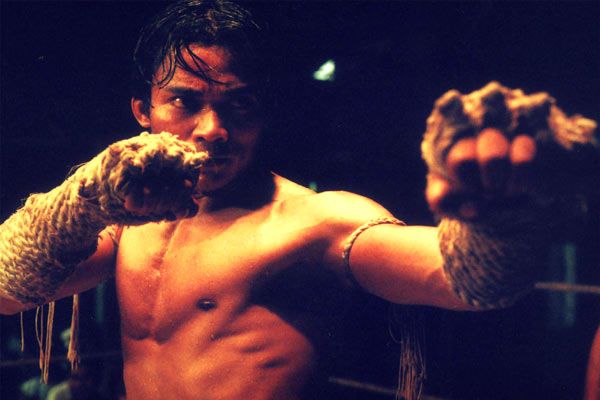
ONG BAK DIR: Prachya Pinkaew
Martial arts films have often been laughed aat for the thinness of their stories, but Tony Jaa's movies really deserve those giggles. Okay, ONG BAK (village boy goes to Bangkok when his village's idol is stolen, retrieves it through kicking people) has a more complex story than TOM YUM GOONG ("Give me back my elephants!"), but not by much.
The thing is, to denigarte ONG BAK for its lack of little things like a well thought out story, compelling performances, or any sort of dramatic weight would be to completely miss the point. This isn't so much a story as it is a breathtaking showreel for tsar Tony Jaa, his stunt team, action director Panna Rittikrai and director Prachya Pinkaew. After 30 minutes or so of exposition and scene setting, ONG BAK explodes into life, and though it becomes little more than a series of tenuously linked fight and stunt sequences the invention, style, skill, and power on display is such that the story could involve the reading of the Thai phone book and it this would still be thrilling cinema.
The action is among the best ever filmed. An early chase sequence shows off Jaa's amazing agility and timing (catch the awesome flip he does between two sheets of glass), but it's the raw power of the Muay Thai fighting style, perhaps best seen in what has been called the Fight Club sequence that was really new and excting when this film was first released.
As an actor, Jaa's flatness can be forgiven, but sadly he lacks the presence of a Jackie Chan or a Bruce Lee, and much of the time you do feel that you're watching a stuntman rather than a star. The support is better; Petchai Wongkamlao and Pumwaree Yodkamol are both funny and charming as the city slickers along for the ride with Jaa, and that keeps the downtime between the action scenes bearable, if never especially engaging. Fortunately the film is chock full of action, so it never slows down long enough to get really dull.
For me, ONG BAK has since been bettered by the same team's vehicles for Jeeja Yanin, especially the jaw dropping CHOCOLATE, but this was the west's introduction to Thai martial arts cinema, the film from which the rest have flowed, and as well as bringing us alot of quality films since, ONG BAK holds up as a genuinely astonishing showcase for thai martial arts, if not a great film.
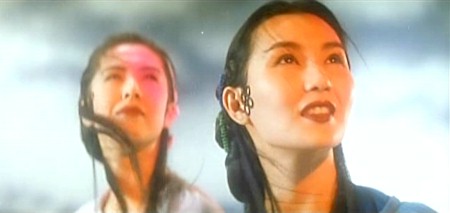
Less a martial arts film than... oh God only knows what this film is... God, or perhaps Tsui Hark, but I wouldn't put money on Tsui Hark. It seems to tell the story of two snake spirits who take human forms (the heart stoppingly beautiful forms of Maggie Cheung and Joey Wong). Wong's White Snake is older than Cheung's Green, and thus she's more able to appear human, and even manages to forge a relationship with a young scholar (Wu Xing-Guo). Theere's also something about a powerful monk (Zhao Wen-Zhou) who has taken it upon himself to destroy these two 'snake evils', this involves a lot of wire assisted leaping around and much use of the incantation "Bo ye ba la hung", which you will know as well as the sound of your own name by the time these 93 minutes are up.
Green Snake is like eating a three course meal consisting purely of LSD. It makes very little sense, you're never sure what's going on, but some of it sure is beautiful. Wong and Cheung both give fine performances under the circumstances, and Cheung is especially effective as the impetuous Green, but the film's pleasures are largely visual, and centred on its female stars.
Many scenes revolve around the scantily clad, frequently wet, Cheung and Wong almost making out. Honestly, if you can think of something better to hang a movie on I'll be happy to help you get it made. It's never explicit, and there's not a frame of nudity from either Cheung or Wong, but dear God it's sexy.
So, if you're not too concerned about little things like a coherent narrative, and you've got a thing for Chinese girls Green Snake comes highly recommended. Otherwise, this one's not really for you.
A highly entertaining, if pretty silly, remake of King Hu's 1967 film. The plot is a tad confusing but let me try. Maggie Cheung (sigh) owns the Dragon Gate inn, in the middle of the desert. For some reason both bandits (led by Tony Leung Ka Fai and Brigitte Lin) and government agents who are hunting them end up there. There's lots of fighting. At the end Donnie Yen shows up (as a eunuch, of course) and the big final fight ensues. So, yes, it's all a bit mystifying and it's certainly not for newcomers to the wuxia genre but there's plenty to recommend here.
Maggie Cheung's performance is infectious, she overplays the comedy to the hilt but the sillier she is the more fun her performance (and, I know I say this whenever I review one of her films but, she's SO beautiful that just watching her is a joy). Brigitte Lin is also terrific in a much more steely and more action oriented part than I’m used to seeing her in and Donnie Yen, sadly not in the film enough, shows up and struts his stuff impeccably.
As far as the fighting goes it's all well worth watching but there's a couple of sequences that really stand out. First a fight between Lin and (a heavily doubled) Cheung in which Lin, having just had a bath, strips Cheung of her clothing one item at a time as they fight. Neither is ever exposed but it's hugely sexy as well as being a solid fight. The final fight is also magnificent with some stunning shots of the cast fighting in what is almost a sandstorm and some awe inspiring physicality from Donnie Yen. It ends in a touch so ludicrous that it's laugh out loud funny but that's the tone of the movie and doesn't hurt a great sequence.
Sadly there's not quite enough action as the tension at the inn seldom boils over and another downside is that Tony Leung Ka Fai is rather bland (perhaps if he and Donnie Yen had traded roles there'd have been a better film here). At the end of the day, as is the case with most wuxia films, if you like the genre you'll find things to enjoy here and if you don't, well, you aren't reading this are you?
REDBELT DIR: David Mamet
When I first heard about Redbelt I did a double take. It seemed like such an odd fit: David Mamet’s martial arts movie, really? While it’s neither the best martial arts movie I’ve seen, nor the best David Mamet movie I’ve seen it is an interesting, and occasionally outstanding, example of each.
Mamet’s name, and his reputation and history as a writer, is enough to attract a stellar cast to play alongside members of his stock company whenever he makes a film, and Redbelt has a truly outstanding cast. Chiwetel Ejiofor impresses in the leading role of Mike Terry, a Jiu-Jitsu instructor who, for reasons I won’t reveal, finds himself having to break his cardinal rule as a fighter, and fight in a competition. Ejiofor seems to be doing the vast majority of the fighting himself and while moves seem quite basic the choreography is well put together and the length of the takes and the combinations of moves are pretty impressive, but Ejiofor’s strength is the drama and he plays it flawlessly, from an American accent so good that you’d barely believe he’s British to hitting every beat of Mamet’s always intricate dialogue just right. Another British actor, again playing an American, also impresses in a smaller role. Emily Mortimer is quickly growing into one of the most reliable character actresses around and here she plays a complex role, with a lot of different facets and an extreme arc absolutely convincingly with only a few rather brief scenes to do it.
Among the rest of the supporting cast there are (too) small parts for Mamet regulars Rebecca Pidgeon, Ricky Jay and David Paymer and excellent turns from Brazillian actress Alice Braga as Ejiofor’s wife and Max Martini as his star pupil. The real surprise, though, is Tim Allen. Allen is usually found slumming, but has previously shown that with a good script (the Toy Story films, Galaxy Quest) he’s an effective comic lead. Here, though, he’s got an entirely dramatic role as action movie star Chet Frank, and he absolutely eats it up, grabbing it with a zeal that suggests he knows exactly how good a chance this is to prove that he really can act. Now if he’d only stop making crap like The Santa Clause and seek out more roles like this.
Mamet’s screenplay is talkier than you’d expect for a martial arts movie, but truly it’s the talk that is the film’s most compelling aspect. As ever with Mamet it overflows with quotable dialogue (“We got a deal”. “What good's a deal if no one's making any money”?) and in typical fashion things that seem incidental end up paying off in ways you don’t expect, as in a beautiful second act sequence here, which draws a morass of dangling threads together to set up the final conflict.
It is, sadly, that final conflict that ends up making Redbelt somewhat less than the sum of its parts. The last act is very familiar, and it’s done with little panache, particularly when Mamet, the master of dialogue, wraps proceedings up with a (hopelessly cliché) silent sequence. Worse is that the final fight isn’t very dynamic or exciting and that several moments that promise rather more drama are thrown away, never to be seen. Still, for three quarters of its running time Redbelt is vintage Mamet, with a nice side order of kicking.
HEART OF THE DRAGON DIR: Sammo Hung
Fung Tat (Jackie Chan) is a cop. He's always wanted to get a job on a ship and sail round the world but can't as he has to care for his elder brother Dodo (Sammo Hung) who is mentally handicapped. Tat is in the process of trying to marry his girlfriend (Emily Chu) so he can leave Dodo in her care and go off sailing but when his brother falls in with a gang of thieves he must save him and clear his name with the police.
Heart of the Dragon is far removed from a typical Sammo Hung / Jackie Chan film. The first thing that audiences will notice is that Sammo doesn't fight, though he does a couple of stunts, the other most notable thing is that Heart of the Dragon is overwhelmingly a drama, allowing Jackie and Sammo both to play far against type for perhaps the first time in their careers.
As Dodo Sammo really gets to create a character and he shows that actually he's a pretty versatile and talented actor, given the chance to stretch. We never get specifics on what is wrong with Dodo but Sammo's childlike performance is charming and never condescends to the audience or becomes so broad as to be insulting to the mentally handicapped as so many films have.
Jackie is also effective as Tat. In one particularly excellent scene he rails against his uncomprehending brother about how he's not been able to go away because he's had to devote his life to caring for him. Jackie always gets to be more adult when Sammo is directing him (perhaps it's because, as his big brother, he trusts Sammo to stretch him) and that's certainly true here. Even outside of the dramatic scenes his fighting is more brutal, more outwardly violent and his relationship with Emily Chu both cynical and suggestive of a more adult side to the character, particularly in a couple of kissing scenes which from anyone else would be mild but are probably as sexual as Jackie has ever allowed himself to be on screen.
This is very much a drama. After an opening action beat (which includes a rare and sadly brief smackdown between Jackie and the late, great Lam Ching Ying) it settles down into being a very serious piece which lets the acting rather than fists and feet do the work and it works better than you'd ever expect because Sammo and Jackie hold it together (though supporting cast members like Mang Hoi are sometimes found wanting). So committed was Sammo to this tone that he actually cut action scenes from the main body f the film, holding off on the action until the traditional end fight which, it has to be said, is a beautiful thing. I love Jackie Chan's films and he's created some of the greatest action ever put on film but he never looks better, or more dangerous, than when he's directed by Sammo and this is no exception, fast, furious and violent it's a great release after a long wait for some action.
Heart of the Dragon is not a film for people new to Hong Kong martial arts movies as it's far from a traditional entry in the CVs of Sammo Hung and Jackie Chan but it's well executed in all respects and a recommended watch for fans who want to see Sammo and Jackie trying something new and doing well at it.
ARMOUR OF GOD DIR: Jackie Chan
Asian Hawk (Jackie Chan) used to be a pop singer along with friend Alan (Alan Tam) but now he's an Indiana Jones style fortune hunter. When Alan's girlfriend (Rosamund Kwan), also Hawk's ex, is kidnapped he and Alan must retrieve all three pieces of the Armour of God as a ransom for the corrupt group of monks who hold her.
Every time he does a film Jackie Chan does things that could quite easily kill him. He fell off a clocktower in Project A (actually he did three takes of that one), he slid down a long pole lined with lightbulbs in Police Story and he's been injured countless times, dislocating bones you never thought you could dislocate (the sternum). He's only come close to dying in one stunt though, a rather simple one on this film. Jumping out of a tree from about 15 feet up Chan missed his target, the cameraman rolled out of the way to avoid being landed on and Chan landed on a rock, cracking his skull. Fortunately he was able to get emergency brain surgery, though he still has a plastic plug stopping the hole in his head.
Armour of God did get finished though and there's little in it to suggest that its star and director had nearly lost his life early in the schedule as Chan still executes some truly breathtaking stunts. It's not, sadly, one of Chan's best but Armour of God does have some real standout sequences. The opening sequence isn't so much inspired by Indiana Jones as it is a direct lift but it's strong with some great stunts and the same exuberant action feel as the Indy films captured. Sadly after this the film settles into a largely action free midsection which throws too much focus on a bland Alan Tam (whose introduction, with an entire canto-pop song, is truly a test of endurance). The ending set piece does, as ever, liven things up with Jackie fighting four female opponents as well as some monks before diving off a cliff onto a hot air balloon and sliding down the balloon into the basket (something he did for real, mere months after his operation).
Aside from the action this isn't a great film but there's enough decent action and endearing performances from Jackie and Spanish model Lola Forner to recommend it.
THE TUXEDO DIR: Kevin Donovan
Jimmy Tong (Jackie Chan) works as a cab driver until one day a passenger offers him a job as driver to super spy Clark Devlin (Jason Isaccs). When Devlin is injured in a bombing Jimmy takes his place, using a tuxedo of Devlin's that confers superpowers on the wearer.
Suited up Jimmy and partner Del Blaine (Jennifer Love Hewitt) (who, being on her first assignment, thinks he's Devlin) go up against an eeevil bottled water manufacturer (Ritchie Coster) who is planning to poison the world's water supply, leaving only his mineral water safe to drink (muahahahaha).
It's not an easy time to be a Jackie Chan fan. His Hong Kong output has been slipping in quality (he's been trying to act, God help us) and his Hollywood films lurch from one embarrassment to the next. This might be the best of his US work to date, I realise of course that that's like saying 'Whaddya know, this sewage smells better than that sewage', but still, small mercies.
The Tuxedo is certainly beset with problems. First among them is the prevalence of wire work (not great wire work at that) in the action and stunt sequences. Time was Jackie lived by the words: I am the special effect. But time marches on and this can be put down to age and injury rather than laziness or a lack of ideas on the part of Jackie and his stunt team. The smaller moments are the best, true they've been slightly aided by effects but still the displays of agility, particularly when Jackie has to fight while trying to put his tux back on, are as amazing as ever.
Debuting Director Donovan isn't the man for the job. Too often he botches the action particularly in a sequence with the most obvious fake leg ever put to film and his leering fascination with Hewitt's cleavage, magnificent as it may be, makes you wonder if it was an adult or a 13 year old boy behind the camera. However there are bright spots. Chan's having fun, which often seems not to be the case lately, clearly he enjoys the slapstick comedy and, for all the frustrations of working in English, his comic timing and screen presence still win through. Hewitt may be utterly miscast but she makes the best of things and actually puts in a sparky performance that serves the film perfectly well.
So it's dumber than you can possibly imagine but there's also fun to be had. There's some hammy cameos from Whose Line Is It Anyway's Colin Mochorie and from Peter Stormare as a mad scientist and just enough of Jackie's trademark action to make it fun. Clearly no masterpiece then, but hardly as mortifying as Shanghai Noon or The Medallion
DRAGONS FOREVER DIR: Sammo Hung
Jackie Lung (Jackie Chan) is a lawyer hired by a chemical processing factory to make opposition to their polluting ways, which are threatening the fish farm run by Miss Yip (Deannie Yip), disappear. However Lung discovers he is working for gangsters (led by Yuen Wah) and with the help of friends Fei-Hung (Sammo Hung) and Tung (Yuen Biao) sets out to destroy the drug refining and smuggling operation really operating through the factory.
The legendary 'Seven Little Fortunes' opera troupe of Sifu Yu Jim Yuen included many of the great stars of Hong Kong martial arts cinema but the three that made the greatest impression on the industry were Jackie Chan, Sammo Hung and Yuen Biao. The three made numerous films together but only in three of those did they all have starring roles. Project A, Wheels on Meals and Dragons Forever. Being a Sammo Hung film it is darker than Project A and lacks the exuberant fun of that film but Dragons Forever, like many of Sammo's films, not only shows off his cast's astonishing abilities to their best effect but allows them to stretch them selves in areas they usually wouldn't.
All three of the stars play against type. Jackie, normally the moral underdog hero, is cast as a shyster, skirt chasing lawyer and when we first see him is defending a rapist in court (though he does give him a hell of a punch after the acquittal). Sammo gets to be a bit of a ladies man, something that his build would usually preclude and Yuen Biao plays a very odd character, an old friend who appears to have gone mad. It is perhaps this deviation from their usual personas that meant Dragons Forever was something of a box office disappointment on its release. For me though the changes to the familiar personas are a welcome way of providing some variety in a genre that too often only distinguishes itself in the choreography of the fighting.
There's quite a lot of plot in Dragons Forever and that allows for not just a lot of fighting but quite a bit of comedy and even a few more dramatic interludes. These vary in their success. For example there's a charming sequence with Sammo and Deanie Yip night fishing while sharing some food (this, apparently, is based on how Sammo and his first wife passed the time when he was broke) which works beautifully but a broader scene when he pursues Yip down the street with a megaphone trying to get her to go on a date with him pushes the boat out a bit far.
A lot of the comedy involves physicality and never is this better executed than in a scene at Jackie's apartment as first Yuen Biao and then Sammo gatecrash as he tries to woo Pauline Yeung and the tries to hide their presence from her. If the Three Stooges did kung fu it would probably look like this ludicrously entertaining sequence.
Though the comedic action is hugely entertaining it really has nothing on the true action beats. There's an excellent early scene for Jackie, which takes place on a boat (the venue for his second date with Pauline Yeung) and again shows off his absolute mastery of fighting with props. The three brothers all fight together in a stunning scene in a club, which uses a real disco as a standing set in ways that look astoundingly painful. There's a one time only occurrence for fans too, as Dragons Forever is the only film in which you can see a three way fight between Jackie, Sammo and Yuen Biao.
The plot wraps up (with, sadly, just about the worst scene in the movie) at the end of act two to set up the final few reels for the traditional showdown. It's here that Yuen Wah, reprising the robotic bad guy he played to such effect in Eastern Condors, comes into force and Benny Urquidez arrives in the film. Urquidez (who Bey Logan, who should know, describes as pound for pound the greatest martial artist alive) fought Jackie in Wheels on Meals (and it's that fight that Jackie named his favourite he's ever taken part in) and was brought back as the formidable last reel opponent here.
Their confrontation is quite simply one of the finest ever filmed. It starts out slow and over about ten minutes amps up to a frenzy of punches and kicks, all of it executed brilliantly. The timing is spot on, the use of props inventive, adding to the scene and Sammo even lets the action pause for a quick comic beat and let the audience catch a breath. Even if it's not the best martial arts sequence ever filmed (for me that's the Sammo directed duel between Frankie Chan and Lam Ching Ying in The Prodigal Son) it's still right up there and a truly fitting finale to the last of the three brothers films together.
SHANGHAI NOON DIR: Tom Dey
China 1881: When the Princess Pei-Pei (Lucy Liu) is kidnapped from the Forbidden City and held for ransom Chon Wang (Jackie Chan) begs to be included in the party sent to rescue her. When the train they are travelling on is robbed by Roy O'Bannon (Owen Wilson) and his gang and his uncle is killed Chon Wang goes after Roy. Eventually they team up and ride off to save the princess.
When even the outtakes at the end of a Jackie Chan film are less entertaining than spending the same amount of time slapping yourself in the face you know it's been a really bad day at the office for the clown prince of Kung Fu movies. Shanghai Noon is an embarrassment. The comedy, from both Chan and sidekick Owen Wilson is thuddingly unfunny (and, in one extended sequence with some indians, more than a little bit racist). The physical comedy for which Chan is justly famous is here reduced to such tired gags as him getting off his horse the wrong way and then walking funny; oh my sides, how they ache.
The most serious crime though is that the action is not only rather dull (shocking, what with Jackie, his stunt team and Yuen Biao working on the film) but ineptly shot. Dey forgets to let us see Jackie in several of the big sequences, including a long fall which is the best stunt in the film (an embarrassing standard).
Chan, Wilson and Liu are fine, doing what little is asked of them perfectly well but there's little to love here. There are no moments to rewind gasping 'how'd he do THAT?' None of the fights really get the blood pumping and the comedy is a laugh desert the fact it's not the worst of Jackie's American films speaks only to how catastrophically awful The Medallion really was.
SHANGHAI KNIGHTS DIR: David Dobkin
Chon Wang (Jackie Chan) and Roy O'Bannon (Owen Wilson) are reunited after Chon enlists Roy's help in avenging his Father's murder and getting back the imperial seal that he was killed for. This involves going to England to meet up with Chon's insanely hot sister (Fann Wong) and pursue the killer; evil Lord Rathbone (Aiden Gillen)
I hated Shanghai Noon but clearly I'm a glutton for punishment so here we are. There's good news and bad: the good news; this sequel is better than Shanghai Noon, the bad news; barely, and by default.
Alfred Gough and Miles Millar clearly decided that they'd run out of cliché jokes about Native Americans and how out of place Jackie Chan was in the wild west so they've moved the story to England. What that results in is some of the worst xenophobic English jokes and clichés since the despicably unfunny Three Men and a Baby. There are only two accents in this England; an incredibly overplayed 'aristocratic' one, which reaches its most ludicrous point with the monumentally terrible performance of Aidan Gillen and the world's most cliché 'apples and pears' cockernee, which contributes to the mortifyingly dreadful performance of young Aaron Johnson.
A constant annoyance is that the film has absolutely no regard for historical context. Set in 1887 it takes place in a London where Jack the Ripper is already terrorising the streets (those murders took place in 1888), motion pictures (first demonstrated in the 1890's) exist and Charlie Chaplin (1889-1977) is already 10 or so. Obviously we don't come to films like this looking for historical accuracy but when these jokes are such a big part of the script shouldn't they at least have a basis in fact?
At least the cast is game. Chan and Wilson work hard but they can't mine laughs from the mirthless abomination that is the screenplay and Gillen certainly puts forth effort (even doing some creditable sword fighting) but has been misdirected; his cliché villain lacking only a moustache to twirl. Fann Wong lights up the screen with her beauty but her character is so thin as to be anorexic and few of her actions have any motivation (notably her character's attraction to Roy). However, untrained as a martial artist though she may be, she looks great in her action sequences.
The action sequences are better than last time out. Unlike Tom Dey, Dobkin makes sure we can see Jackie in the action set pieces, makes sure we know it's him, the choreography is better too, a sequence involving a ladder recalls some of Jackie's best work and harks back to the mastery of props he showed in films like Project A. Sadly the fight between Jackie and Donnie Yen, long awaited by fans, is something of a letdown. The tussle is grounded for much of the time and lacks any real drama (though the pay off, provided by Wong, is good).
For the action, the outtakes (always a highlight of Jackie's films) and for Fann Wong this is worth a look but what surrounds it is, at times, torturously poor.