Showing posts with label Early Review. Show all posts

Saturday, August 27, 2011

Blu Ray Review: Heavenly Creatures [18]

DIR: Peter Jackson
The Film
Today, Peter Jackson is one of the major names in world cinema, and one of the most commercially and critically successful directors in the world, but it was not always so. In 1994, when Heavenly Creatures came out, Jackson was the mad maverick behind splattery black comedies like Bad Taste, Braindead and his 'Muppets from Hell' movie Meet the Feebles. It was, then, something of a surprise that he should be the filmmaker to tackle one of his native New Zealand's most infamous and shocking murder cases.

Heavenly Creatures tells the story of the intense friendship between fifteen year old Juliet Hulme (Kate Winslet) and Pauline Parker (Melanie Lynskey), which ended up, when the girls were to be separated, in the brutal murder of Pauline's Mother (Sarah Pierse). The girls, from opposite ends of the economic scale, bond over their shared history of medical problems ("All the best people have bad chests and bone diseases") and their creativity. This creativity bleeds into a fantasy world and the girls become increasingly obsessed with and dependent on it and on each other.

In many ways Heavenly Creatures is very different to Peter Jackson's previous films; it's set - largely - in the real world, deals with real people and events and is notably less extreme than the likes of Braindead, but it also shares DNA with those films, and is clearly the product of the same directorial mind. Jackson starts the film, after a shocking opening flash forward, by grounding us in the real world, we get footage from a promotional film for Christchurch, New Zealand, where the film is set, and a rather conventional looking (if beautifully shot) first couple of reels, however, as Juliet and Pauline become closer, and as their shared fantasy world develops further, Jackson allows his camerawork to become more and more extreme. As the film goes on it slips more and more frequently and freely into fantasy, and Jackson, even in the real world, plays up the oddness of his characters visually with offbeat, off centre angle choices. This, however, ceases for the climactic murder, which is rendered in brutal and disturbing detail.

What Jackson achieves by this is not just a film with a very individual feel, but one that draws us into the world and the psyche of its leading characters. The people that Juliet and Pauline dislike are seen almost as caricatures, and are shot in a larger than life way, often looming into frame (see the doctor who diagnoses Pauline as a lesbian, or the priest who comes to see a convalescing Juliet when she's hospitalised with TB), and their fantasies are rendered in stark contrast to the world around them, which is often drab. In the fantasy sequences even dowdy Pauline is transformed into a beautiful princess, colours are sharper and more saturated and everything is heightened.

The film is packed with memorable sequences and images in both the real and the fantasy worlds; an idyllic sequence early in the film in which the girls run through the woods, stripped to their underwear, singing and dancing makes for a sharp contrast with the almost nightmarish (and brilliantly cine literate) scene after they have seen a screening of The Third Man, and find themselves chased by "the most hideous man in the world", Orson Welles.

This contrast between the way the girls see the world as opposed to those around them is also drawn with a set of very strong performances. Sarah Pierse is particularly notable as Honora Parker; a mother who gets angry with her daughter through love and worry. Pauline sees her as the villain, but the film is very matter of fact about her, painting her neither as saint nor sinner and Pierse gives a very grounded performance which makes the march to the end (which, even if you don't know everything from the opening, is explicitly revealed as Pauline and Juliet plan the killing) absolutely bone chilling and deeply sad. The cafe scene at the end of the film (shot in the real location) is a great showcase for both Pierse and Melanie Lynskey, whose exhortation to her Mother to "treat yourself" to the last cream cake takes on a cold menace in context. There are also fine performances from the other actors playing the Hulme and Parker parents; Clive Merrison and Diana Kent as Juliet's upper class Mother and Father and Simon O'Connor as Pauline's fishmonger Father.

In the end though, the film rests on the shoulder of its two young stars, then sixteen (Lynskey) and seventeen (Winslet) and both making their film debut. Both are outstanding. Winslet is, at first glance, perhaps a bit over dramatic, but this is Juliet; she's a person of extremes, everything is either wonderful or ghastly, people are saints (James Mason, Mario Lanza and more) or 'the most hideous man alive' (the aforementioned Orson Welles), and her stories are packed with beautiful kings and queens, psychotic children and gorgeous gypsy girls. She's a drama queen, and Winslet plays that side of her perfectly. This - along with her distant relationship with her parents - also gives us an insight into why Juliet, clearly much more intelligent than Pauline, forms such an obsessive attachment to her young friend. Melanie Lynskey is also brilliant here. Her performance got less notice than Winslet's and, seventeen years later, she remains an undervalued talent. This is probably because Pauline, outside of her diary entries (all of which are real, and brilliantly read by Lynskey), she is a much more held in character. It's tough to understand a relationship like this, and a character like Pauline, but Lynskey plays her, seemingly without judgement, as just one more troubled, taciturn, teenager. By taking that starting point and moving the character credibly on through this growing obsession we get to understand how things end up as they do, because we see how Pauline, in contrast to the very open and expressive Juliet, holds her resentment in a tight ball until it explodes. These are two very contrasting and equally excellent performances.

I first saw Heavenly Creatures about fifteen years ago, and it has a special place in my heart. It was one of the first films that really interested me in cinema that was more offbeat and made beyond the US, and it was one of the first films that me and my best friend bonded over (yes, I realise that sounds odd, but honestly we're perfectly normal). For my money it remains as brilliant now as it ever was, it stands out in the distinguished filmographies of both Jackson and Winslet, and is a fascinating film about obsession and about murder. This, amazingly, is its first DVD release in the UK, and I'm really happy that a new generation of cinephiles, who may not have seen any of Jackson's pre Lord of the Rings work will now, at last, get a chance to discover this masterpiece.


The Disc

I received a screener copy of Heavenly Creatures, which did not include the extras. The release copy will boast a 'Looking Back' featurette with Kim Newman, Alan Jones and Rosie Fletcher and four postcards. I can't help but wish there was more; a Jackson commentary, a proper retrospective with the cast and the alternate cut, which is ten minutes or so longer, would all have been welcome.

That said, what we do have is a beautiful looking Blu Ray transfer. The film has been remastered, and looks like it was shot yesterday; the print has some grain structure, but is free of speckles and damage. The edges are sharp without seeming over enhanced, the colours pop brilliantly and there is a good deal of depth in the image (which is also, for the first time in the UK, in the film's original 2.35:1 ratio). This transfer perhaps doesn't have the jaw dropping appearance of a Terminator 2 or the 'wow, look how nicely that cleaned up' impact of some of Arrow's video nasty releases, but it's still a great job, and as good as this film is ever likely to look.


Thanks to Peccadillo Pictures and Rabbit Publicity for the screener. Heavenly Creatures comes to UK DVD and Blu Ray on September 12th.

If you'd like to buy Heavenly Creatures (and trust me, you would) and help 24FPS out at the same time then please use the links below. Thanks.


Monday, August 15, 2011

Conan the Barbarian [3D] [15]

DIR: Marcus Nispel
CAST: Jason Momoa, Stephen Lang,
Rachel Nichols, Rose McGowan

Do I really need to tell you that Conan the Barbarian is dumb as a brick? Do I really need to tell you that it has extremely limited character development, a story that is both incredibly simplistic and confusingly told, that the use of the word 'acting' would be to slightly over flatter the cast? Probably not. What I do need to tell you that despite (or, perhaps, because of) this it's actually pretty good fun.

In the interests of full disclosure I should say that I haven't actually seen the 1982 film with Arnie as Robert E. Howard's famous creation, and perhaps that let me have an easier time seeing this Conan as a stand alone piece. The screenplay weaves a simple tale of vengeance; Conan's father (Ron Perlman, genius casting) is murdered by a warlord (Avatar's Stephen Lang), but young Conan escapes. Twenty years later, Conan finally discovers the identity of his Father's killer and seeks his revenge. The details are a little more confusing; there's a mask that apparently makes the wearer invincible, but for some reason it needs the blood of a special girl (Nichols), the magic is never really that well established, but what more do you need than 'evil bastard wants to kill hot girl so he can resurrect his wife'?

The thing is, Conan is stupid, but it is seldom less than entertaining. Jason Momoa isn't someone I suspect we'll be seeing as he lead in an intensely demanding dramatic film anytime soon, but as a mobile wall of muscle with a voice that sounds like a constant low rumble, he's fine casting for Conan. Momoa hadles the copious action scenes well, as does director Marcus Nispel (who I had little faith in, having previously seen only his awful Texas Chainsaw Massacre remake). Several of the set pieces are genuinely exciting to watch. There's a dynamic chase sequence as Rachel Nichols finds herself pursued by Lang's men, and, refreshingly, while Conan does help rescue her, the film also shows her as a capable and instinctive fighter. Another standout sequence starts out as a glaringly obvious tribute to Indiana Jones and the Temple of Doom, but the fight between Momoa and Lang as they and Nichols dangle on a spinning platform above a pit is hugely exciting. The choreography also works well, with the cutting fast, but without obscuring the action.

Sadly, all this good stuff is filtered through a middling 3D conversion. It's not as catastrophic as the conversion of Clash of the Titans, but it does suffer similar problems like a very over dark look, which renders many of the film's later scenes a challenge to follow, and a smeary quality to fast motion which takes away from the film's greatest asset; its action. This is a film that will be much, much better in its original 2D version and that's how I'd advise you to see it.

To my great surprise I would advise you to see Conan. It's got some fun (hammy) performances, especially from Rose McGowan, enjoying herself as Lang's witchy daughter, some entertainingly bloody action sequences, a damsel who, if not exactly developed, is at least not in constant distress and a solid leading turn from Momoa. It's not going to end up in anyone's top 10, but I'd be lying if I said I didn't enjoy it, and didn't think that you'd have fun seeing it with a few mates on a Friday night, in 2D.

Thursday, June 23, 2011

Early Review: Tomboy

DIR: Celine Sciamma
CAST: Zoe Heran, Malon Levana, Jeanne Disson,
Sophie Cattani, Mathieu Demy

Celine Sciamma made a huge impression on me back in 2008, with her outstanding feature debut Water Lilies (see my Top 100 entry in the sidebar). Ever since I came out of seeing that movie I've been cautiously anticipating her follow up. Whenever a new director makes something as good as Water Lilies there's always going to be a question mark over their ability to follow it with something equally impressive. Thankfully Tomboy is a confident and convincing answer to that question, and a film that really puts its director on the map.

Like Water Lilies, Tomboy concerns itself with girls coming of age. Here Sciamma follows Laure (Heran), a tomboyish ten year old who, on being asked her name by her new neighbour Lisa (Disson), introduces herself as Mikael. 'Mikael' and Lisa become friends, and even share a first kiss, but Laure struggles to keep her secret from her new friend and from her family.

It's refreshing to see a movie these days which, while its focus is on young people, is truly adult, not in terms of having loads of swearing, sex and violence, but in that it deals with complex and challenging issues of identity, sexuality and the process of growing up in a way that never talks down to the audience or moralises about its characters thoughts, feelings or choices. Sciamma approaches Laure/Mikael's gender identity with sensitivity, other viewers might feel differently, but to me it felt like she never quite made an absolute determination about whether Laure is engaging in youthful experimentation here (tied with the confusion that comes with the first engagement with a sexual identity) or is truly transsexual, and for me the film's openness on this issue is a key strength, as it keeps it from being anything as trite as a cry for acceptance. Tomboy doesn't feel, to me, like a film with a heavy political message, rather its strength is as an intimate and insightful drama about a young person trying to define themselves.

As befits a film so focused on issues of the body and identity, Tomboy often lingers in close ups. Shooting on an adapted digital stills camera, with a very shallow depth of field, Sciamma gets right in to the personal space of her characters, especially that of Laure, her six year old sister Jeanne, and her, entirely male, bar Lisa, new group of friends (cast from Zoe Hernan's own real life group of friends). This brings us right in to the characters and experiences being portrayed here, and makes the film feel at times almost voyeuristic in its intimacy and reality. At the same time it's an intelligently composed and often rather beautiful film. It's a difficult circle that Sciamma squares here; making a film that feels designed and directed, without allowing any of it to ring false.

As in Water Lilies, Sciamma's insight into her characters is spot on, now 30, she nevertheless knows how to write kids who seem like kids. Even Laure's intelligent and somewhat wily sister (she exploits Laure's lie so that she can hang out with older kids) is written as a smart six year old, not as the miniature adult we saw in films like (500) Days of Summer. This carries through into the performances. There is never any sense of acting here, especially from the outstanding Zoe Hernan and Malon Levana. Hernan deals assuredly with a complex role, it would be interesting to discover how Sciamma told her about the character, and how she understood Laure/Mikael's identity but what's really impressive here is the ease with which she shifts gears, going from unselfconciously playing with her little sister and her parents, to being more outwardly controlled when she has to fit in with a group of boys. There is a great ease to the way the actors relate, a very real sense of family created between Hernan, Levana and Sophie Cattani and Mathieu Demy as their parents, and this also applies to the scenes between the children, be it the innocent first stirrings of attraction between Lisa and Mikael, or the games that the larger group of kids play, there is just a sense here of Sciamma observing children being children.

Tomboy is full of memorable scenes and moments, from the way that Jeanne visibly considers the decision of whether to expose her Sister's lie when Lisa comes looking for Mikael, to the lovely scene when Jeanne cuts her sister's hair. There is also much to admire in the way the relationship between Mikael and Lisa is drawn, the friendship grows very organically, and there is both charm and thematic interest in a scene in which Lisa puts make up on Mikael. Of course the course of the film can not run entirely smooth, and for me Celine Sciamma's sole - minor - stumble, is having the only confrontational scene with the children, after they discover Mikael's true identity, be an almost line by line quote of a notable sequene in the similarly themed Boys Don't Cry. Is it Sciamma's homage? Is it just that there aren't many other ways to deal with that moment, especially considering the age and level of maturity of the characters? It's hard to say, but it works as a scene in and of itself, even if it is over familliar.

There is real emotional punch to Tomboy. Like Water Lilies it deals in real and raw emotion, and though the performances are never overly demonstrative, you feel it all. I may like Water Lilies a bit more, but this film, for me, confirms Celine Sciamma as a major, major talent to watch and is one of the best of 2011 to date. I'd like to see Sciamma branch out a bit more next time, but if she keeps making coming of age movies this insightful, and this well acted, then that's just fine by me.

TOMBOY is due to open in the UK in September.

Friday, April 29, 2011

13 Assassins [15]

DIR: Takashi Miike
CAST: Koji Yakusho, Masachika Ichimura, Goro Inagaki
13 Assassins is a stunningly simple film. It is the dying days of Japan's samurai era, and local warlord Naritsugu (Inagaki) is carrying out a reign of terror, indiscriminately raping and murdering as he pleases. Despite the fact that is supposed to be off limits samurai warrior Shinzaemon (Koji Yakusho) decides that he must be stopped, and recruits another 11 elite warriors to the cause, which is clearly a suicide mission. Along the way they are joined by a 13th, a bandit with impressive fighting skills and little left to live for, before taking over a village to prepare for the showdown with the warlord's private army of samurai.

Director Takashi Miike is known in the West largely for his extreme works; gangster films, gore movies and thrillers, but he's a more versatile talent than that, his 80 plus films covering all sorts of genres (even the odd kids movie). I've often found Miike a little indulgent and his films a touch unfocused (which can perhaps be blamed on his astonishing work rate), but 13 Assassins is neither of those things; it's a single minded and tightly constructed work in which tension and action complement one another beautifully, and which treats the samurai era and the samurai characters with seriousness and respect. It builds up the main characters well (though some of the 13 Assassins do become little more than sword waving props), and the film builds effectively to both a large scale battle and a personal conflict between Shinzaemon and Naritsugu's bodyguard Hanbei (Ichimura).

13 Assassins divides quite neatly into two halves; the first establishes Naritsugu's credentials as a legendary murderous bastard and charts the building of the team of 13, while the second half consists entirely of the awe inspiring battle between the 13 and the samurai army. The first half does, despite the twenty minutes that have been cut since the film's festival showings, occasionally feel like it needs speeding up, but equally it is packed with standout scenes be it the opening images of a samurai committing hara kiri, or the shockingly violent backstory of why one of the 13 so desperately wants to take down Naritsugu.

The second half; the battle, is astounding. It could easily be dull, it's basically close to an hour of swordfights, but Miike finds little dramas in many of the individual encounters, as well as keeping both camera style and choreography inventive throughout. Happily the violence isn't given the shakycam treatment often, and when it is the stylistic choice has purpose, putting us inside the viewpoint of a defeated samurai, rather than just being employed to disguise the shabby efforts of yet another director who can't shoot action. The restrained camera style (though that's all that is restrained here, despite the 15 certificate the claret flows in rivers) also means that despite the frenetic nature of the battle the action is always intelligible; I knew where people were and who they were at all times - which has not been so commonplace as you might think in recent action cinema. All this adds up to make the battle scenes involving, exciting, dramatic and fun, if you can't get swept up in the last hour of this movie you may as well give up on cinema; it's not for you.

The performances are perhaps best described as fit for purpose. The actors making up the ranks of the 13 may not have tremendous depth, but they are individual enough for you to know who they all are, and to care when they are imperiled during the battle. The leads are excellent though, with Koji Yakusho and Masachika Ichimura impressing as the two respectful but equally ruthless warriors with a history, and again this lends weight to what could easily just have been a bit of splashily violent fun.

I haven't seen as much of Takashi Miike's work as I should have, but this is easily the best I've seen from him thus far; a muscular, beautifully shot, exciting and entertaining film, but one that has enough depth to engage on levels beyond the visceral. Go and see it.

13 Assassins opens on May 6th (Previews May 3rd and 5th)

Sunday, April 3, 2011

Cold Fish [18]

DIR: Sion Sono
CAST: Denden, Mitsuru Kukikoshi, Asuka Kurosawa,
Megumi Kagurazaka, Hikari Kajiwara
I haven't seen his earlier works, Suicide Club and Noriko's Dinner Table, but Japanese director Sion Sono's two most recent films; this one and the four hour epic Love Exposure, mark him out as one of the most original, daring, and downright odd filmmakers in the world.

Cold Fish is very loosely based on a real case in which a rare dog breeder and his wife were hanged for at least four murders by poisoning, and one of their employees was jailed for three years for helping them dispose of the bodies. From this starting point Sono weaves an operatically over the top (and appropriately lengthy) tale of milqetoast rare fish breeder Shamoto (Kukikoshi) who is befriended and then made an accomplice by psychotic competitor Murata (Denden) who, along with his pretty young wife Aiko (Kurosawa) turns out to be a serial murderer (by the end of the film he has ammassed something like 60 victims, taking into account those he boasts of killing before meeting Shamoto). Murata uses threats against Shamoto's own young wife (Kaguazaka) and teenage daughter (Kajiwara) to make him help in making his victims bodies 'invisible'.

Cold Fish is not a reserved or a subtle film. The performances are loud and demonstrative, dialogue is often bellowed, violence is gross and bloody and humour is slapsticky. In short you have to make a decision to surrender to the film, to sink into this heightened and extreme world. I highly recommend that you do so, because once you do you're likely to find, as I did, that Cold Fish is tremendously entertaining as it mixes horror and humour, often in a single moment.

The central performances of Denden and Mitsuru Kukikoshi work for most of the film as yin and yang. Denden is all gleeful malice, doing exactly what he wants with near manic energy from one moment to the next. To begin with he comes across as the fun uncle (certainly that's how Shamoto's daughter Mitsuko is encouraged to see him), but his true colours emerge in a disturbing and well performed single take scene in which he molests Shamoto's wife Taeko with the cool detachment of somebody completely corrupt. Though he's in his late 50's, Denden plays Murata almost as a sugar high ten year old, only rather than candy his pleasure is murder. It's a creepy turn, and a paradoxically amusing one. If Murata is the rampaging id, Shamoto is the terrified part of the brain that processes consequence. He's shown as emasculated at home, repressed and fawning in his interaction with others, a weak man. However, Kukikoshi does demonstrate how Shamoto's association with Murata pushes him closer and closer to the very edge of sanity. When, in the film's deliriously overblown and spectacularly violent last half hour, he finally snaps, Kukikoshi does a spectacular 180, turning Shamoto into a more outwardly cruel version of his recent mentor, with none of the humour or pretence.

Another tremendously entertaining performance comes from Asuka Kurosawa, provocative and sexy at first glance as Murata's young wife, but emerging as probably the most dangerous character when the film shows its hand. Murata seems to kill largely for money or revenge. Aiko kills because, it seems, it turns her on. In fact the whole process of murder seems to turn her on, in one notable scene she makes out with a female co-worker just before going into a meeting where her husband and Shamoto are attempting to cover up a recent killing. Kurosawa convinces on all the levels the film asks of her; she's seductive, and can play the sweet, dutiful wife, but she's also mercenary, and incredibly dangerous (see the moment when she beats another character to death with a TV).

Sono clearly has a dark sense of humour, and one that tends towards the absurd. It's best summed up in an image from the final scenes, as one character hugs the disembowelled corpse of another in a moment of truly perverse (and rather belated) tenderness. The sheer level of blood and violence on display can also be funny, often taking on the feel of an insanely brutal Looney Tunes cartoon (aided by a bombastic, drum driven, score). And yet, Sono also attempts to ground the action in reality, making use of a grainy aesthetic which gives a slightly dirty, homemade, feel to the film, emphasising even more the extremities it indulges in.

What I found so thrilling about Love Exposure was the dizzying invention on display, and that hasn't changed with Cold Fish. Sono keeps you on your toes for the whole of the film's 146 minute running time, and nothing ever quite happens as you expect it to. I can't say that this film or its director will be to all tastes, but so far I'm enjoying being in the hands of this particular madman.


Cold Fish gets a limited UK cinema release on April 8th, and will probably tour rep cinemas following that date. However, it comes to DVD and Blu Ray on June 27th. If you'd like to buy the film, and help 24FPS out at the same time, please use the links below. Thanks!

Saturday, March 26, 2011

24FPS at LLGFF 2011: The Four Faced Liar [15]

DIR: Jacob Chase
CAST: Marja-Lewis Ryan, Emily Peck, Todd Kubrak,
Daniel Carlisle, Liz Osborn
The Four Faced Liar is the first feature film written by 25 year old Marja-Lewis Ryan, and while it is far from perfect it marks her out as someone to watch in the future. The story is very generic; gay college student Bridget (Ryan) and her flatmate Trip (Kubrak) meet Molly (Peck) and Greg (Carlisle) in the titular bar one night, and they hit it off, Bridget and Molly in particular begin spending a lot of time together, and it becomes clear that there is some attraction between them, which places strain on Molly and Greg's very sweet and rather conservative relationship. You can probably guess, given that this is the closing film in this year's London Lesbian and Gay Film Festival, how things develop from there.

That's really the problem with the film, being generic is one thing, but almost every beat of The Four Faced Liar is predictable, down to almost the last detail. Every scene you expect to see in a dramedy about a lesbian and a straight girl getting together is played out almost exactly as you'd expect it to be and the film rounds off with the last in a long series of tremendous clichés.

That said, it's hard not to like this film, thanks largely to the details of Ryan's screenplay (based on her earlier stage play). The general shape of the film is familiar to the point of being hackneyed, but the character writing is top notch. Ryan shows a real knack for establishing an individual voice for each of her characters, and for detailing the relationships between them. Too often the characters in movies all sound like the writer, not so here, there aren't any moments where you feel the dialogue could be interchangeable; none of Bridget's speeches could be delivered by Molly, none of Trip's by Greg. There is also a nice sense of the closeness between old friends Bridget and Trip, and of the growing relationships between Molly and Bridget and Trip and Greg.

These qualities in the writing are also aided by strong performances. Ryan and Peck are both excellent, giving natural low key turns, and playing the film's often funny dialogue entirely straight and real. Kubrak, courtesy of a more outgoing character, has fun giving a larger performance which has most of the film's funniest moments. The only slight problem acting wise is that Daniel Carlisle can come off somewhat flat, but then Greg is such a drip that this may be a choice on his part.

24 year old first time feature director Jacob Chase handles the largely hand held visuals well, usually making sure that the camera remains unobtrusive. There is a definite guerilla feel to the filmmaking; it's not polished, and a few scenes (notably the love scenes) are perhaps a little darker than they should be, but for the most part the direction serves the film well, and energises the film enough that it doesn't feel like a filmed play.

The Four Faced Liar definitely has its issues, but there is plenty here to like, and to suggest that many of the people involved will go on to make better more fully realised films in the future. I'd certainly suggest checking this one out though, whether at LLGFF or when it comes to DVD next month.

If you'd like to buy this film on DVD (UK Release April 11th), and help 24FPS out at the same time, please use the links below.

Thursday, March 24, 2011

24FPS at LLGFF 2011: Break My Fall

DIR: Kanchi Wichmann
CAST: Kat Redstone, Sophie Anderson,
Collin Clay Chace, Kai Brandon Ly
Almost more frustrating than a truly bad film is one that just misses the mark, one you can see the potential in, and yet have to watch as it trips over the hurdles on the way to the finish line. That's what Break My Fall is like.

The film shows us the final stages of the breakdown of the relationship between girlfriends and bandmates Liza (Redstone) and Sally (Anderson), which seems to have reached a stage where it vacillates between the two having a deep desire to remain together, but fighting whenever they are. Things are also complicated by a mutual friend, Vin (Ly), who earns a living as a rent boy, but has clear designs on Sally.

There are plenty of things to admire in Break My Fall. The script is sharp, and defines its characters clearly and quickly, though it does remain dedicated throughout to making them all (except perhaps Collin Clay Chace's supportive gay friend Jamie) as unsympathetic as possible. The four leading performances are also a strong centre for the film, with Kat Redstone especially impressive as she engages with the most difficult character, one whose mood swings seem near bi-polar. There are some real standout scenes here too; a funny confrontation with a café owner made me wish that the rest of the film had a bit more humour about it, and a supremely awkward band practice after Liza and Sally have fought is both the quietest and the best scene in the film. It's also worth mentioning the excellent, uber-cool, indie soundtrack.

The problem is that while these individual bits are fine, the film just doesn't knit together as a whole. The biggest issue is that it's very hard to really identify with or care about the central relationship. We see nothing of how it was, of the happiness that Liza sometimes speaks of, and so it's hard to care much about the broken state the movie depicts it in, or root for it to get mended. It's also guilty of real longueurs, many scenes run much longer than they need to (an endless scene in which Liza goes home with an older butch woman after a night out, for instance) and the last twenty minutes are an extended exercise in redundancy; this film ends with a missed phone call, the following twenty minutes change nothing, add nothing.

Break My Fall ultimately feels like an overextended short film, and that's a shame, because I suspect a 30 minute version would work really well. That said, there's enough going on here that I'll be keeping an eye on, in particular writer/director Wichmann and Kat Redstone, as I suspect that there is much more satisfying work in their future.

Thursday, March 17, 2011

Early Review: Potiche

DIR: François Ozon
CAST: Catherine Deneuve, Gerard Depardieu, Fabrice Luchini,
Jeremie Renier, Karin Viard, Judith Godreche
Every time I go and see François Ozon's latest new film, I steel myself. I have to prepare myself for the fact that this, finally, might be the one that trips him up, the film that after over 15 years at a rate of a film a year, finally spoils the best directorial batting average in cinema. Potiche hasn't done it.

An adaptation of a 1980's play, Potiche casts Ozon's 8 Women star, and general legend of French cinema, Catherine Deneuve as the titular 'trophy wife' of Fabrice Luchini, who runs the umbrella factory inherited from Deneuve's Father. After an employment dispute in which he is taken hostage by his workers, Luchini is hospitalised, and his wife steps into the breech, after asking advice from an old friend and communist politician (Depardieu).

The above may not read like the ideal recipe, but Ozon mixes all this, and much more, up into a brilliantly sharp and witty comedy. Ozon speaks of balancing the film's comedy with the potential for melodrama, and he's done a masterful job, even during its more melodramatic moments the film tends to remain funny, because the comedy seems woven into the fabric of the film, right down to its perfectly executed 70's aesthetic, which doesn't stop at period detail like the velvet covered telephone and Judith Godreche's Farrah hair, but carries through into such small things as the use and even design of the split screens that are occasionally employed and even Ozon's shot choices and cutting rhythms.

As ever with Ozon's work, Potiche looks outstanding. It's a return to the technicolor aesthetic of 8 Women; the film fairly explodes with colour, and the use of colour as a signifier of mood is, if not subtle, beautifully executed (for example the umbrella factory instantly transforms from a grey to a multicoloured world when Deneuve takes over, signifying her warmer approach to the day to day running of the company).

Potiche isn't a reserved or subtle film, the performances are as overblown as the visuals, and the tone is often one redolent of the title of Ozon's first feature; Sitcom. Deneuve is wonderful in the lead, her forced (and enforced) perkiness in the first act giving way to a character who is much happier, in a much more meaningful and real way, during the second half of the film. She's also radiant in the part, 66 when the film was shot, she has aged like a fine wine, becoming perhaps fuller bodied, but remaining tasteful, elegant and beautiful. Unlike Deneuve, Geradrd Depardieu hasn't worked with Ozon before, and this anticipated first teaming sees the great actor at his most animated for a while. Depardieu can often be a gruff and dour presence, and so it is a real treat to see him cut loose in a broad comedy, and do it with such apparent zeal. He and Deneuve share great chemistry (just look at the lovely scene where they do a dance number together), and the very obvious fact that they are having a great time is infectious for the audience.

The supporting cast is also strong, with Fabrice Luchini turning his raging patriarch up to 11 in some hilarious scenes, Karin Viard surprisingly complex in what initially seems to be just a play on the saucy secretary of a lot of 70's films and Judith Godreche and Jeremie Renier (returning to Ozon for the first time since the underrated Criminal Lovers) effective as Deneuve and Luchini's polar opposite children.

All too often over the last five years I have found myself sitting in cinemas and watch 'comedies', sinking into a spiral of depression and wondering how the world got to a point where it's trying to convince adults that poo is intrinsically amusing. Happily Potiche doesn't do that (sorry poo joke fans), it's a warm film, not a cruel one, where the comedy comes from incongruity, absurdity and the day to day silliness of the way people behave. Ozon also gets a lot of mileage in what we neither see (Luchini's reaction when his son goes to negotiate his release with the workers holding him hostage), nor hear (a very funny scene with Sergi Lopez - best known as Capitain Vidal in Pan's Labyrinth - making a silent cameo as a trucker who gives Deneuve a ride).

The film takes an unexpected detour into politics towards the end, but it does so without sacrificing the carefully judged tone that has prevailed throughout the film, and Ozon finds an ending which is at once gloriously barmy and utterly perfect for the film. Potiche is, at the end of the day, a souffle, it doesn't have the power of Ozon's best dramas like 5 X 2 and Le Refuge, but so what? This is a perfectly executed piece of entertainment, no more or less, it's accessible, charming, and brilliantly made, as well as being yet another confirmation of the fact that, yes, this director really can do anything.

François Ozon is why I go to the cinema, and he's why you should too.

Thursday, February 17, 2011

Bird's Eye View 2011 Preview: Orgasm Inc.

DIR: Liz Canner
Orgasm Inc. is a more serious and less salacious film than its title might suggest. It's a personal film from director Liz Canner, who apparently spent nine years working on this project, beginning when a drug company contacted her to ask her to edit together pornographic footage for use in a clinical trial of a cream designed to treat a newly defined condition 'female sexual dysfunction'.

Canner clearly started out pretty simply, documenting what she was doing for Vivus, and talking to various people at the company about the drug and about FSD, but the film expands with its director's horizons, as she begins to ask questions about whether FSD is a medical condition, and what the drug companies motives are for pursuing a treatment for it. Orgasm Inc. becomes, if not a full assault advocacy film, a sceptical exploration of the commodifying of disease and cure, especially in the US. Canner isn't Michael Moore, and her film is enquiring rather than hectoring, but no less disturbing for it. Perhaps the most troubling sequence takes place in a private FSD clinic run by Dr Laura Berman, where we are taken through the process by which, day by day, perfectly normal sexual issues are being medicalised, with a bill of $1500 at the end of the day.

There is also a fascinating insight into the way a drug gains FDA approval for use in the US, with Canner's footage of the meeting to decide whether a testosterone patch to treat FSD should be approved providing a genuinely intimate and edifying (and surprisingly heartening) glimpse of this process. If nothing else, Orgasm Inc. raises some important questions about how we classify and treat disease in the 21st century.

It doesn't all work though. While she's not hectoring, Canner's interviews can feel a little lightweight, and you'll want to hear the answers to questions that she apparently doesn't ask. It's also a little scattershot, and though it's just 79 minutes long some sequences feel extraneous,none more so than one that opens the film, then recurs later, in which Canner sets up a camera to film a woman's face as she masturbates to orgasm. There's no real purpose to this scene, it doesn't say anything, and all it did for me was remind me that I should rewatch the video for Romantic Death by The Sun sometime soon. There's also an animated sequence depicting four FSD drugs in a race for FDA approval which seems out of step with the rest of the film; it's silly, and far too on the nose for my liking.

Orgasm Inc. could be much more developed, but as a primer on an important and under recognised issue, it certainly has merit, and is well worth the 79 minutes it will take to watch it.

Wednesday, February 16, 2011

Bird's Eye View 2011 Preview: Guilty Pleasures

DIR: Julie Moggan
Julie Moggan won a Best Pitch prize for her idea for a documentary exploring the world of Mills and Boon readers. Mills and Boon, in case you have never been in a charity shop, are a seemingly endless line of romance novels, written to a prescribed formula. In Guilty Pleasures, Moggan turns most of her focus on the series' readers, trying to discover how their lives are influenced by the books. She also profiles a writer (a retired doctor named Roger who writes under the name Gill Sanderson) and a cover model (the incredibly flaky Stephen).

Most of the people that Moggan looks at here aren't very appealing. There is Hiroko, whose love of the books has led her to take up ballroom dancing with such passion that her (clearly long suffering) husband sadly notes that they can't discuss having more children because it would interrupt her lessons. British housewife Shirley seems sweet enough, but her husband Phil is almost a living caricature of a chauvanist, and it is he who gets the more screentime (one cringemaking scene has him showing off his tool belt, and almost every sentence he says seems like a bad joke from a politically incorrect 70's sitcom). In India, Shumita is a middle aged woman whose husband left her some years ago for a younger model, but seems now to want to be back in her life (we meet him briefly, he's a knob). Shumita seems to have bought into the idea of lifelong romance through her reading, even though life is suggesting that she shouldn't.

It's interesting, though, that perhaps the most unrealistic ideas of love are held not by the readers but by the man on the covers of their books. Stephen comes out with an endless stream of new age bollocks, much of it revolving around the idea of his 'true flame'. He should, one suspects, be writing Mills and Boon rather than exposing his abs on the jackets. Roger is probably the most normal person in the film, there's an air of sadness and loneliness about him, but he seems to push that to the background, and for the most part is pretty happy overall.

Even though most of Moggan's subjects are rather unlikeable or annoying, there are interesting stories to be told here. Unfortunately by following so many people Moggan gets only a loose grip on her narrative threads, and ends up with little real insight. There are moments that intrigue; Hiroko's husband saying that the books give her something he can't; a couple of unpleasant meetings between Shumita and her estranged husband Sanjay; Phil's general attitude to women, but Moggan fails to make the most of them, she never seems to be there with the well placed, probing, question that would open these people and their lives up. Too often she's content with a trite image (Shirley and Phil in bed, her reading a Mills and Boon, he a true crime book called Unnatural Deaths Volume 2) or leaves something potentially intriguing (Roger writing observations of everyday people, which he says give him story ideas) unexplored.

That's not to say there aren't fascinating moments here. I don't like Hiroko, but you can't deny that she's intriguing. More than the other readers she seems desperate to engage in this dreamworld, she doesn't seem to like her husband very much. For his part he seems to love her, in one very sweet scene he practices the dance steps she wants him to learn for a competition while standing alone waiting for a train - though here, as in several other moments, there could be definite questions about how real the moment is. Hiroko's princess fantasy seems to begin to come true towards the end of the film, though how you'll feel about that is very debatable.

Roger is also interesting; a lonely man, posing as a woman and writing about love. I wish Moggan had dug into his story much more deeply, because I suspect there's a whole film there.

Ultimately, Guilty Pleasures doesn't really tie itself together very well, Mills and Boon barely figures in some of these stories (especially that of Shirley and Phil), and we don't really learn much about the brand itself. There are flashes of the better film that this might have been, but overall this award winning pitch hasn't lived up to the promise it had.

Saturday, December 18, 2010

EARLY REVIEW: I Spit On Your Grave [18]

I SPIT ON YOUR GRAVE opens on January 11th 2011. You can see the UK trailer HERE

DIR: Steven R. Monroe
CAST: Sarah Butler, Andrew Howard, Jeff Branson,
Daniel Franzese, Chad Lindberg, Rodney Eastman
It’s not the most censored, though 32 years later you still can’t see it uncut, but of all the video nasties the original I SPIT ON YOUR GRAVE, which was made for peanuts by Mier Zarchi, is perhaps the most infamous, and not only because of its spectacularly lurid title. It’s perhaps one of the most difficult and distressing films I’ve ever seen and, for all its many flaws, it gets under your skin to the point that after watching it you feel like you need a shower to get it off you. It is, then, an odd choice for a remake, because what more can you do, how much more extreme can you be?

Steven R. Monroe’s film is, in general shape, very faithful to Zarchi’s blueprint. Jennifer Hills (Butler) is still a young novelist who arrives at a remote cabin to work on her second book. After a few nights some local men come calling, they break into the cabin and ultimately rape and beat Jennifer almost to death. A few weeks later Jennifer, physically recovered, enacts a systematic and terrible revenge on the men who attacked her. It is, essentially, the same blueprint as every rape/revenge movie from THRILLER: A CRUEL PICTURE to THE BRAVE ONE. Where Monroe’s film differs from Zarchi’s is in the amount of detail it provides. Where Zarchi’s film seemed most interested in the horror of the acts it depicted, Monroe’s takes more time to build its characters (especially those of the group of men that attack Jennifer), with the characters of the rapists this is pretty effective; they are cartoons in the original, and if anything giving them more background serves to drop them from an even greater height.

In many ways this I SPIT ON YOUR GRAVE is a better film than the original, and yet that’s also what sometimes undermines it. Though it was made for just $1.5 million, the 2010 film looks outstanding. The images are crisp and cinematic, and that’s exactly the problem. This sheen about the film (which continues with the casting, Butler in particular being rather too Hollywood pretty for her role) is a little distancing when compared to the down and dirty feel of Zarchi’s film which, whatever you feel about the morals of this choice, really did put you right in amongst what was happening, and created at times the deeply unnerving feel that what you were seeing just could be real. Put simply you watch this film, but you survive the 1978 version.

To give credit where it’s due, most of the performances here are considerably better than those of the 1978 version. Along with being given more character traits and being much more fully developed we now have some capable actors playing Jennifer’s attackers, with Andrew Howard turning an especially impressive performance as a sadistic sheriff who is also a family man (in the film’s most striking, and in some ways most horrific, scene he takes a phone call from his young daughter while the other men rape Jennifer just a few feet away) and Chad Lindberg much more convincing as a retarded adult than the original’s Matthew. On the whole the first half of the film, documenting Jennifer’s arrival at the cabin and the series of attacks and rapes she is subjected to, works very well. It may look prettier, but the events are still just as nasty, brutal and horrendous as they were in the original film. It’s when we reach the revenge section that I begin to have real problems with this I SPIT ON YOUR GRAVE.

For me the original I Spit… is a film about the degradation of violence. Jennifer’s vengeance is short and brutal; an act of purging, driven, it seems, as much by a need for closure as for vengeance. It’s also surprisingly underplayed, with the gore much more implied than it is shown. This, however, is the age of SAW and thus here the vengeance is played up to a ludicrous degree. The problem is that I think we’re supposed to enjoy it, and that’s a real sticking point for me. There is an interesting question about the second half of this story, which the film never quite addresses, which is whether Jennifer actually lived through her ordeal. Butler’s performance is ambiguous, but there are definite hints here that Jennifer may be little more than a spirit of vengeance, and I think I prefer that idea to the perhaps more persuasive alternative, which has her dealing with her ordeal through complex tortures meted out to her attackers, each capped off by some meaningful detail or wisecrack to get us to embrace and applaud this extreme vigilantism. The violence here is much more explicit and dwelled on much longer than in the 1978 film, to such a degree of extremity that I began to question exactly how justified Jennifer’s actions were (especially in relation to the Sheriff). It’s unpleasant, sure, but feels more like a carrot for the audience than anything else.

This is a difficult film to review. From a technical standpoint, especially given the budget, it’s excellent and Monroe certainly shows that he knows how to discomfort an audience (a skill that will serve him well in this genre) but it’s so bound up with another film, and though the 1978 film is not, by most traditional measures (excepting Camille Keaton’s remarkable, haunted, performance, which Butler completely fails to match) as ‘good’ as this one it is for me undeniably the more effective film. I guess it comes down to what you want out of a movie. If you want the catharsis of cheering at Jennifer’s vengeance then this is the version for you, but if you really want the full impact of this story then stick with the 1978 version. Neither is an easy watch, but neither is uninteresting.

Tuesday, November 30, 2010

A Serbian Film: BBFC Cut version [18]

DIR: Srdjan Spasojevic
CAST: Srdjan Todorovic, Sergej Trifunovic, Jelena Gavrilovic

You really can’t separate A SERBIAN FILM from the hype that has surrounded it since it was first seen in January. Horror cinema has lately been going through another of those periodic patches in which it is becoming notably more extreme, with each release seeming to aim for a new high (or low, depending on your point of view) watermark in how testing an experience it can be for its audience, and it seems that for many people A SERBIAN FILM is that latest high (or low) point – that said I’ve since heard that another Serbian film; THE LIFE AND DEATH OF A PORNO GANG, is even more extreme. Certainly this film has attracted more criticism for its violence than almost any in recent memory, with mere descriptions of scenes, especially the now infamous ‘newborn porn’ scene, serving for some as an indictment of how far the horror genre will stoop to excite its audience. It is perhaps this infamy, rather than the film’s content as such, which has resulted in the BBFC demanding 49 separate cuts – a total of four minutes and twelve seconds – to the version of the film I’m now reviewing.

This hype was one of two things I carried with me into the screening. The other was an awareness of director Srdjan Spasojevic’s repeated claims that his film, far from being a mere exercise in prurient violence, is in fact an allegorical tale about how Serbia has been mistreated by the political class. On the surface, at least, the film is about Milos (Todorovic), a former porn star who is lured out of family life with a big payday to work for a director (Trifunovic) who says that he wants to make a hardcore art film, and tells Milos that he’s to know nothing more about the project. As the film becomes more and more depraved, with violent sex scenes, often performed with young children watching, Milos decides that he wants to leave, but when he tries he is drugged and forced to continue with ever more depraved scenes for the film.

Whatever A SERBIAN FILM is, subtle it is not. Once you are made aware of the fact that the filmmakers claim that it is an allegory that fact is obvious in almost every scene, in fact it’s an incredibly simplistic message, casting Serbia as a rape victim and ‘porno artist’ Vukmir as the corrupt political class beating it and fucking it, if only from a distance. This is never more nakedly expressed than in the ‘newborn porn’ scene. Perhaps if I knew more about Serbian society and politics this would seem insightful and clever, but to be frank I just felt like someone was shouting an unconvincing argument at me. For all its heavy-handed attempts at bringing this message to bear on the film, I found it an empty experience. Even in this cut version it is relentlessly (often boringly) brutal, and I found little of the intelligence and weight that lifted films like MARTYRS and ANTICHRIST out of the torture porn ghetto.

I can’t deny that A SERBIAN FILM is well made. The gore effects are brilliantly handled, with a decapitation towards the end of the film being especially nasty and convincing, and Srdjan Spasojevic definitely shows promise as a director, as the level of craft that he’s put into the design of his shots here (especially during the shooting of Vukmir’s film) is diverting. This is when it’s a real shame that the film is so heavily cut, because there is obviously real thought behind the film’s visuals and its editing (it’s notable that there is actually relatively little really explicit gore here, much of the worst violence is cleverly shot to hide some of the detail without losing the impact). There is also an almost surreal quality to the film within the film, and that sense of Milos’ entering another world when he steps on to set is heightened by the stark and stylised lighting choices and the strange, structure free, dialogue of the porn film. The acting is also largely impressive (though Sergej Trifunovic does push the boat out too far towards the end, becoming a cartoonish embodiment of the already bludgeoned in message), but whatever the level of craft there was just something missing here for me.

A SERBIAN FILM wants to shock you. It probably will, but personally I need to be really involved in a film to be affected by it in that way, and I just wasn’t with this one. The message was so front and centre that it really got in the way, for me, of engaging with the characters on a purely human level, to me everything in this film ends up feeling like a piece of Spasojevic’s personal allegorical jigsaw. There also came a point at which the film was pushing the boat out so ridiculously far in its violence and transgression that I began guessing at the most fucked up thing they could do next, and ended up guessing much of the content of the last quarter of an hour. The one moment I didn’t see coming, by the way, is so utterly ridiculous that it too undermined any shock value of the scene.

As unconvinced and as disappointed as I am by A SERBIAN FILM as a whole, there is enough going on here to interest me in Srdjan Spasojevic’s next film, providing that he elects to tell a story rather than provide a blood drenched and unconvincing lecture. There is, of course, the possibility that restoring the missing four minutes and twelve seconds will transform the film into the masterpiece that some have claimed it to be, but somehow I doubt it.

Thursday, June 10, 2010

Film Review: 24FPS @ RENDEZ VOUS WITH FRENCH CINEMA 2010

LE REFUGE
DIR: François Ozon
CAST: Isabelle Carre, Louis-Ronan Choisy


François Ozon is a genius. There are quite simply no two ways about it. He’s also the single most consistent filmmaker working, with a non-stop run of great films stretching from his debut (1998’s Sitcom) to Le Refuge (to be fair, I haven’t seen his previous film; Ricky yet, as it has yet to be released in the UK, though it’s coming to DVD here soon). Even for a serial genre hopper like Ozon, Le Refuge, though it’s the third part in a very loose trilogy on mourning (which also includes Under the Sand and Time to Leave), feels like a real departure. It’s a strikingly intimate film, free from the melodrama that Ozon likes, and does so very well.

The story is of a young woman named Mousse (Carre), a heroin addict whose boyfriend (Melvil Popaud) dies of an overdose just after she has become pregnant. To see herself through both pregnancy and a methadone aided recovery she takes off to a beach house owned by a friend, where her boyfriend’s brother Paul (Choisy) soon joins her.

Le Refuge came out of Ozon’s desire to make a film with an actress who was genuinely pregnant. We’ve all seen a lot of pregnancy movies, we all know the beats; the morning sickness scene, the wacky cravings, the mid-pregnancy scare, the birth, with some poor sweaty actress grunting and everyone yelling “PUSH”, while some male figure stands on the sidelines and quite often faints. Ozon, ever resistant to cliché, gives us precisely none of those beats. That’s perhaps because Mousse never seems to want a baby, she rather wants her boyfriend Louis to remain in the world in some small way, and this is how she’s making it happen. We also know all the beats of a drug movie, but again Ozon avoids them, keeping Mousse’ struggle with addiction in the background, letting us see it through the character’s actions, demeanour and the way Carre plays her.

Isabelle Carre is an exceptional actress (see, for starters, her mesmerising performance in Anna M) and she’s spectacular as Mousse. It seems an intensely personal piece of work, especially as Ozon scrutinises her body, bump included, in extremely intimate close up. One especially great scene has her lying in the bath, simply running her hands across her belly. There’s no dialogue, but Carre communicates so much in that sequence. Many of her best moments are silent; like the way she asks a man who tries to seduce her just to rock her, and the comfort she takes in it, like the way she steps away from a boy she’s dancing with at a club when he puts his hands on her belly, like the way she reacts to Paul singing and playing the piano, with so many different emotions registering on her face. It’s a masterclass in doing a huge amount with very little. There’s also just something about Carre, her slightly gap toothed but explosive smile perhaps, that just makes you warm to her. It’s an important quality, because Mousse isn’t easy to like or to root for, but Carre embodies her so completely and brings that vital empathy to her protrayl.


Next to the experienced Carre, Ozon has cast a singer, Louis-Ronan Choisy, who had never previously acted. You’d never guess. Like Carre’s, Choisy’s performance is completely unaffected and completely resistant to cliché. They’re a strong pairing too, with the chemistry working well and a connection between them seeming to grow very organically. Choisy also wrote the film’s music, built largely around the tune of the song Paul plays and sings for Mousse. The score is well used; accentuating the emotion of key moments rather than instructing you how to feel.

There are many typically Ozon moments in the film; notably the many beach scenes, which have featured in the director’s work all the way back to his early shorts, and are a recurring image in the mourning trilogy. The look is also very identifiably Ozon; there’s a slight softness to his light which gives much of the midsection of the film, again especially the beach scenes, a slightly dreamlike glow, perhaps to signify the way that Mousse, through her recovery, is coming back into the light from the grimy grey flat in which the first few scenes take place. What’s new in his approach here is the apparent lack of any real need to impose a plot on the film, he simply allows us to spend time with Mousse and Paul, to eavesdrop on this time in their lives a little. It’s not a hugely eventful film, obviously, but the strength of the performances means that even though almost nothing really happens Le Refuge remains absolutely riveting.

The ending is somehow both inevitable and shocking. In typical style Ozon refuses to put a neat little bow on things (in some ways the ending here is an interesting inversion of the ending of See the Sea, his magnificent short feature). That will annoy some people, as will the actions of Mousse, but such is life; this is a film that acknowledges the messy nature of life and personal relationships. I’ll need to see it again before I can really place it among Ozon’s work, but right now it feels like his best since 5 X 2, and certainly his most affecting film since then. I can’t really encourage you enough to go and see this film when it opens in the UK in August, it’s yet another masterpiece from one of the greatest filmmakers currently working.


I first Saw Leaving at the 2009 London Film Festival. This is simply a re-publishing of the review I wrote at that time, because my opinions on the film didn't chage with a rewatch.

PARTIR
[Leaving]
DIR: Catherine Corsini
CAST: Kristin Scott-Thomas, Sergi Lopez, Yvan Attal


Though she’s flirted with the mainstream, and had large roles in such popular fare as Four Weddings and a Funeral and The English Patient when you mention the name Kristin Scott-Thomas you’ll mostly see blank faces staring back at you. That’s a terrible shame, because she’s among the best actresses working in world cinema.

Like last year’s I've Loved You So Long, Catherine Corsini’s film finds Scott-Thomas acting in flawless French. As Suzanne, an English woman married for some 20 years to Samuel (Attal), but now embarking on an affair with Spanish builder Ivan (Lopez), leading to a messy and bitter divorce, Scott-Thomas is just brilliant. Her dialogue is beautifully delivered, and filled with expression and meaning. This, of course, is an actor’s job, but so frequently when they are working in a second language their performances can seem rote and bereft of expression, that’s absolutely not the case with Kristin Scott-Thomas. That isn’t all that makes her performance special though. Great actors are great listeners, and when you watch her reacting to what other people say there is such richness, such emotion in her silent reactions. This is a performance played as much in the physicality of its relationships and in what plays behind the eyes as it is in the dialogue, and that’s what makes it truly special, a real, three-dimensional portrait.

I’ve seen Sergi Lopez act in three languages now; his native Spanish, French and English, and in each he’s been outstanding. He’s an actor who seems to change completely in each role. It’s genuinely difficult to connect Ivan with Capitain Vidal from Pan's Labyrinth, or with Harry from Harry, He’s Here to Help. Lopez has often played bad guys in the past, but though Ivan is an ex-con (we never discover what he did) he’s no villain. Instead Lopez plays him as a very genuine, very normal man, largely driven by circumstance - that circumstance being that he and Suzanne have fallen in love. It’s tough to play very ordinary people, because they don’t tend to have the operatic notes that it’s rather easy to reach in acting. Instead roles and films like this demand smallness, subtlety and intricacy, and Lopez delivers beautifully.

These two outstanding performances tower over the film, and that’s probably a good thing, because frankly Catherine Corsini’s screenplay and direction, though there’s nothing wrong with them, are pretty generic. We’ve seen this tale told a thousand times, and we know pretty well where it’s going to end up (though Corsini doesn’t help that with a structure that opens proceedings with a moment that takes place about five minutes from the end of the film).

Scott-Thomas and Lopez also threaten to drown out Yvan Attal’s performance. Samuel isn’t as well written as Suzanne and Ivan, and Attal ends up having to spend most of the film playing a single note. He does it well, but the character is just too thin to really register. However, when the focus is on Suzanne and Ivan, as it is for much of the 85 minute running time, Leaving is strong stuff. The chemistry between Scott-Thomas and Lopez is electric; their sex scenes pulse with energy, and whenever they share a scene once their relationship has begun you can feel that hunger for one another, especially in Scott-Thomas’ last few scenes in the film.

Leaving certainly isn’t perfect, but it’s pretty well made on the whole, and though it is short it doesn’t feel compromised by its length. The characters are strong and individual (even if Samuel isn’t the most rounded of characters) and the ending is near perfect, leaving us on a note of some ambiguity, rather than spoon-feeding us for an extra 10 minutes. The film is only really lifted out of the ordinary by the two leading performances, make no mistake though, those two performances make Leaving a must see.

Tuesday, May 25, 2010

Film Review: The Killer Inside Me

PRE-RELEASE REVIEW

THE KILLER INSIDE ME
DIR: Michael Winterbottom
CAST: Casey Affleck, Kate Hudson, Jessica Alba,
Elias Koteas, Ned Beatty, Bill Pullman


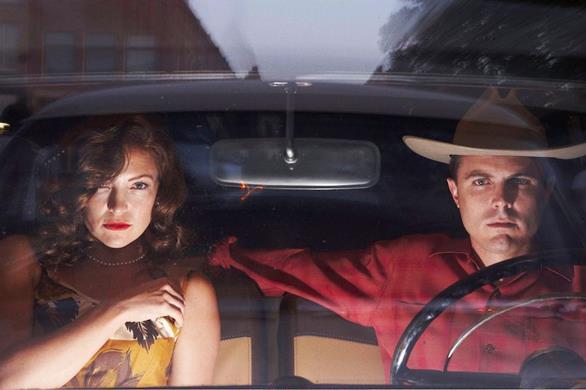
In a feature film career spanning just 15 years, The Killer Inside Me is Michael Winterbottom’s 18th directorial credit. Despite a work rate that makes even the likes of Woody Allen and Francois Ozon seem like slackers, Winterbottom has never yet made an uninteresting film (bad ones, sure) and this film, a controversy magnet since its debut at Sundance in January, has proved no exception.

The film is based, apparently extremely closely, on a 1952 novel of the same name by pulp noir writer Jim Thompson and tells the story of Lou Ford. Ford (Affleck) is a deputy in Central City, West Texas. He’s also a psychopath. The twists and turns are many, and the exposition minimal, but it seems that Ford wants revenge on local businessman Chester Conway (Beatty) and when he gets involved in a blackmail plot involving Conway’s son and the prostitute (Alba) they are both having an affair with, he takes his chance, killing them both brutally. That, however, is only the beginning, as Lou’s secret threatens to come out and the body count rises.

The Killer Inside Me feels almost out of time. It may be set in the 50’s (convincingly so, with Winterbottom and production designer Mark Tildesley coming up with strong period detail that suck us into the time and place), but the film itself, the way it plays, is more reminiscent of the first generation neo-noirs of the 70’s. Like those films The Killer Inside Me isn’t afraid to let you have questions. There’s not, as seems so common these days, expository dialogue to introduce each of the characters, instead writer John Curran expects us to do a little work, to understand these relationships step by step, from the way the characters relate to each other. It’s also willing to take its time, a quality which leads to one of the film’s most indelibly disturbing moments, as Ford simply, patiently, waits for someone to die. In an age where everything in movies seems to be about making sure that there’s hardly time for audience to take a breath, and that everything is explained as if to a retarded chimp, this approach is genuinely refreshing.

This is perhaps Winterbottom’s most star studded cast, but there’s no stunt casting at work here. Casey Affleck, who doesn’t work all that much, again seems to give himself over completely to his performance. He’s interesting casting as the psychotic Ford because with his baby face and his soft voice, which sounds at times as if it is yet to break, he appears completely unthreatening. This is, of course, why he’s perfect for the part, because watching him you can believe that he wouldn’t be suspected. That’s not to say that when Ford’s mask slips Affleck is ineffective, quite the reverse. In the moments when Ford is unleashed, Affleck is quite chilling, never more so than when, as he’s beating Alba’s face to a pulp, he says “I love you, it’s almost over”. It’s a complex character; a man who seems to need to destroy everything he claims to love in the most personal, brutal, way possible, and Affleck’s layered performance brings some much needed humanity, while never letting us miss the monster beneath, something especially strongly felt as he sits and calmly submits to questions from Simon Baker’s detective, not betraying a single hint of emotion.

Since The Killer Inside Me is Lou Ford’s story, and he’s in every scene, the other actors all have rather small roles, but each of them impresses in their few scenes. Jessica Alba really doesn’t have much to do, and it’s hard to see what attracted her to the role of Joyce, as most of her part is lying semi-naked in bed with Affleck. There’s not a huge amount of acting involved. However, she’s affecting as she cries “I love you” to Ford as he beats her in that horrific scene, and there’s enough genuine emotion in that moment, and the few others when she’s called upon to do more than lie on a bed in her pants, to suggest that if she had part that allowed her to stretch, there’s perhaps more to her than a pretty face. Kate Hudson has a better part as Lou’s fiancé, and for the first time in a long time she gets to show just how good she can be when there’s a part for her to get her teeth into. As Amy, Hudson is much harder edged than we’re used to seeing her on screen, given her previous work she seems an odd fit for noir, but she manages to disappear behind the character. As with Alba, her character is rather underwritten, but Hudson makes more of the role than was likely on the page, making Amy an interesting and rather complex character. In still smaller parts there are strong one or two scene contributions from Elias Koteas, Ned Beatty, Brent Briscoe and Bill Pullman, who turns up unexpectedly towards the end of the film, bellowing.


After several films that have been very loose and improvisatory in nature, this is a bit of a departure for Michael Winterbottom. Stylistically it’s much more controlled, with the camera much more steady than in his recent work, this contributes to the film’s retro feel, while also helping place it in its period. However, there is still a loose feel to the acting (perhaps a result of the fact that Winterbottom doesn’t do rehearsals) which results in several strong and memorable moments, notably a shocking one in which Affleck spits at Kate Hudson’s character, in a moment that feels as vicious as any of the punches thrown in the film.

The very first audience reaction to The Killer Inside Me, at Sundance, was from a woman who stood up during the Q and A and said that Michael Winterbottom should be ashamed for having made it, and Sundance should be ashamed for having screened it. That reaction has snowballed into some rather hysterical press coverage of the film’s violence. Let’s be absolutely clear about it; The Killer Inside Me is a very violent film, and the violence in it is graphic and upsetting. However, there’s nothing wrong with that, it’s brutal, but it’s not gratuitous.

Personally, the violence I find offensive is that of films like Crank - High Voltage, in which brutal violence is meted out to women and played for laughs (a stripper is shot in the breasts, causing the silicon from her implants to leak out). The Killer Inside Me deals in very personal violence, but the scenes are deceptive. Their protracted nature and bone crunching sound effects make their impact more explicit than what they actually show. Much of the time what you are seeing is not the punches landing, but Lou’s face as he lands them, like every scene in the film, those scenes are about him. The second outburst of violence shows only two punches, and again it is the sound, the erratic breathing of the victim, and the drawn out process of death, that makes you feel more than you actually see. Here’s the other thing about the violence of the film; it’s upsetting. Isn’t that a good thing? Lou is a psychotic killer, shouldn’t the film show his brutality in the ugliest way possible? It’s not fun, sure, but why should it be?

I was hoping that writing this review would help me shake out my feelings about The Killer Inside Me, but it really hasn’t worked. There is much I admire about the film, from the performances, to the direction, to its sheer impact, right down to the excellent opening credit sequence. It still troubles me though, though I don’t think the film is out and out misogynistic I do find the relentless focus on women being hit, often in a sexual context, pretty disturbing (and, in the case of several flashback scenes, pointless). I respect this film, I can’t deny that it’s well made, or that Michael Winterbottom has added yet another genre to the list of those he’s mastered, but I don’t know that I can recommend this film to anyone, and I don’t even think I like it very much. Make of that what you will.

Saturday, December 5, 2009

Review Post 57: Festival of German Films

German Film Festival 2009
This is my fourth year attending the German Film Festival at London’s Curzon Soho. This year I was joined by a German friend (my Brother’s girlfriend Andrea). She picked the films, though they were both films that I would likely have seen if I’d gone on my own.

Neither of these films has been passed by the BBFC as yet.

EFFI BRIEST
DIR: Hermine Huntgeburth
CAST: Julia Jentsch, Sebastian Koch,
Misel Maticevic, Juliane Kohler


Apparently the story of Effi Briest is very famous in Germany, something of a classic novel, and like much of our classic literature, much adapted for the screen (the last version was by Rainer Werner Fassbinder). The story is set in late 19th/early 20th century Germany, and sees young Effi (Jentsch) married off by her family to the wealthy, much older, Baron Instetten (Koch). On moving to Instetten’s house on the coast Effi finds herself bored and takes refuge in an illicit relationship with dashing young Major Von Crampas (Maticevic).

The story feels familiar almost to the point of formula, and some of the plot devices (the letters especially) are so hackneyed that you can see almost every turn of the story coming from a few miles off, even if, as was the case for me, you don’t know the story anyway. The only thing that isn’t especially predictable is the ending, changed from the book quite substantially, and it sticks out like a sore thumb. After spending nearly two hours very properly in period the film tries desperately to cram in some contemporary relevance. It is as if the character of Effi is suddenly flung fifty or sixty years forward in time, such is the change in her attitude. It’s odd, and doesn’t work at all.

This isn’t the big issue though. The real problem with Effi Briest is that it is a curate’s egg. It looks beautiful, the acting is strong, most of the scenes work in and of themselves and yet this ornately made thing doesn’t add up to very much, doesn’t do very much. It just sort of sits there, lovely to behold, fleetingly engaging, but ultimately forgettable and unable to connect on any real emotional level.

Julia Jentsch is surely one of the finest German actresses working - for the proof see her performance in Sophie Scholl - and she is customarily brilliant here. One of her best moments comes when she isn’t even facing the camera. When Effi is visited by her estranged 6-year-old daughter, who almost immediately asks to go home, the devastation that Effi feels registers viscerally even though the reaction shot is of her back. Much of Jentsch’s best work is done in the absence of dialogue, of which she actually has surprisingly limited amounts, she has an interesting face, which can be either beautiful or boyish depending on the angle, and while her work is always subtle she is always highly expressive, laying bare her character’s emotions at all times.

Sebastian Koch, so good in Paul Verhoeven’s Black Book, has perhaps the most difficult role. Instetten seems to be a man devoid of, or even unaware of, emotion. Playing what is essentially a blank vessel without becoming boring is a hard task, but Koch just about squares the circle. The real issue with his performance is perhaps inherent in his casting, and that simply that Instetten doesn’t really come off as the villain I suspected the story wanted to cast him as. The rest of the supporting cast generally does good work, but the film does create a major problem for itself by casting such a non-entity as Misel Maticevic as Crampas. He looks as if he’s just left high school, and Matcevic never really gives him much personality. I never really bought the love between him and Effi. However, Julian Kohler, Barbara Auer and Andre Hennicke all contribute strong character work.

Hermine Huntgeburth’s direction is generally fine (with the exception of some bizarre scenes involving Effi’s nightmares, which seem teleported in from another film). The period detail is beautiful and there are some nicely designed shots, while the scenes in a deserted shack where Effi and Crampas meet are especially attractive, with the light spilling in through cracks in the walls and roof. The thing is Huntgeburth never really stamps much identity on the film, it’s a film that looks as if it could have been made by 100 directors (if, for example, Joe Wright had done it, I can imagine the only real difference being the presence of Keira Knightley).

It isn’t that Effi Briest is a bad film, and actually if you’re a fan of Julia Jentsch (and if you aren’t, why the hell not?) it’s worth seeing because her performance is exceptional, but it’s one of a very few things to raise this largely forgettable film out of the extremely ordinary.


ALLE ANDEREN
[EVERYONE ELSE]
DIR: Maren Ade
CAST: Birgit Minichmayr, Lars Eidinger,
Hans-Jochen Wagner, Nicole Marischka


NOTHING happens in Everyone Else, but that’s not why I hated it, after all, nothing happens in The Dreamlife of Angels, nothing really happens in Before Sunset. The people in Everyone Else are horrible, but that’s not why I hated it, after all, there’s nobody remotely sympathetic in Henry: Portrait of a Serial Killer, there’s nobody especially likable in Pulp Fiction. I hated Everyone Else for one overwhelming reason: I didn’t give a shit.

It doesn’t matter if you love or hate a character in a movie, just as long as you are interested in them, and none of the people in Everyone Else are even remotely interesting. For two hours we spend almost every moment with late 20’s couple Gitti (Minichmayr) and Chris (Eidinger) and yet in all that time all that we really learn about them is that she's in A and R, he’s an architect and both of them are selfish navel-gazing wankers. The couple are staying in a villa belonging to Chris’ parents, while he supposedly works on plans for a renovation, though we only see blueprints fleetingly. Most of the film consists of the petty bullshit of a disintegrating relationship.

I’m not sure what Maren Ade wants us to take away from this film, which amounts, most of the time, to a pair of pretty bad actors being sniping at one another. In La Seperation I cared about what happened to the characters played by Isabelle Huppert and Daniel Autueil, not because they were likable, but because the whole thing felt horribly real and raw. Everyone Else doesn’t, the stiffness of the acting (particularly Minichmayr’s) undermined any identification I might have felt with the story because I simply didn’t believe that these people were a couple, and I especially didn’t believe Gitti when she (repeatedly) begged Chris not to leave her.

Every time something interesting threatens to happen the film works against it. Gitti and Chris meet a couple who have invited them on a boat tip. These people are never seen again, Gitti and Chris never go near a boat. Gitti and Chris have dinner with another couple; Hans (Wagner) and Sana (Marischka) and Gitti essentially spends the entire dinner abusing them. Nobody says anything. The next time they have dinner Gitti threatens Sana. Nobody says anything, and Hans and Sana go home. It’s almost as if Ade has decided to evade drama at every turn.

Every scene is brutally overextended, speaking to a meandering, improvisatory style and an unwillingness to edit. Worst, perhaps, is a scene in which Gitti, Chris, Hans and Sana listen to a terrible song together. It goes on and on and fucking on, I wondered if they were just going to sit there for the whole damn thing. Everyone Else is a mind-pulverisingly tedious film, two hours that seem to last forever. Don’t waste your precious time on it, spend it with someone you actually like instead.

Tuesday, November 17, 2009

Review Post 55: The White Ribbon / The Girlfriend Experience

DAS WEIßE BAND
[THE WHITE RIBBON]
DIR: Michael Haneke
CAST: Christian Friedel, Burghart Klaußner, Leonard Proxauf,
Rainer Bock, Susanne Lothar, Leoni Benesch


Michael Haneke’s cinema is deliberately, often explicitly, challenging. The White Ribbon lacks the extremes of films like Funny Games and The Piano Teacher but, like its director’s previous work, it is an uneasy experience.

The White Ribbon often seems like a set of contradictions. It is a film about violence, physical and psychic; but that violence is almost never shown. It is a mystery, a whodunit; but we never find out any answers, and the answers never seem to matter. It begins by saying it wants to clarify things, but then spends two and a half hours obfuscating. This is a film that could easily have dealt in explicit shock (imagine the same material in the hands of, say, Gaspar Noe), but what Haneke does instead is create an undertone; an atmosphere of impending doom and of utter dread that begins as an almost imperceptible background note, but grows with every passing frame to a crescendo. This makes The White Ribbon a deeply haunting, troubling film; the unease all the more deeply felt because you can’t find any reason or any culprit for the events that precipitate it.

The film deals with strange violent events in a highly religious German village in 1913 and 14. What it seems to suggest is that these events, which range from the tripping of a horse, leading the local doctor (Bock) to break his arm to the vicious attack on a local disabled child, are a manifestation of the abuse that everyone in the village seems to mete out. Though there is nothing explicit shown it is clear that abuse runs deep. The pastor (Klaußner) humiliates his ‘sinful’ elder children by making them wear ribbons to remind them they must be pure, deprives his family of food when the children misbehave and even ties his son’s hands to the bed frame so that he can’t masturbate, and in the most appalling scene the Doctor dispassionately details to his Midwife and lover (Lothar) how she now disgusts him. Some have read the violent events and the cycle of abuse as a suggestion of the incipient fascism that would come to fruition 20 years later. Personally, I think I’ll have to see the film at least once more to decide what I think Haneke is saying with it, but it is a rich enough film that I’m looking forward to doing just that.

Technically The White Ribbon is flawless. Haneke and DP Christian Berger shoot in stunningly crisp black and white. It’s Haneke’s first non-colour film, but he demonstrates a total mastery of both black and white and of his frames. The light in the film is beautiful, with stark whites and deep blacks dominant, in a story comprised almost entirely of shades of grey. The photography calls to mind directors like Bergman, Murnau and perhaps especially Carl Dreyer. Each shot is a beautifully composed tableau, a perfectly stark image, often painterly in its beauty. Even some of the more disturbing images, like that of a gruesomely (and symbolically) killed bird, are as startling in their beauty as their shock value. Another thing that really makes the film appear somewhat out of its time is the casting. Haneke’s casting department deserves some sort of award, not only for finding such a capable group of actors, especially among the many children who play pivotal roles, but for finding actors whose faces seem to fit the period. Haneke has said that this was a painstaking process, and that he saw 7000 candidates for the children’s roles, weeding out the modern faces. It’s stood him in good stead, as The White Ribbon is very convincingly set in its early 20th century period.

The children are uniformly excellent. In one especially strong scene the Doctor’s daughter (Maria-Victoria Dragus) tells her adorable young brother about death, both of them giving supremely natural performances. Also impressive is Leonard Proxauf, in perhaps the most important juvenile role, as the pastor’s eldest son. There’s a powerful, barely repressed, simmering rage behind his eyes in a few scenes (which lends a little credence to the idea of at least this character being an incipient fascist). It’s an effective and rather chilling piece of work. The adult cast is also excellent. The only lighter moments come from a little romance between the school teacher (Friedel) and his young fiancé (Benesch, a beautiful young actress who seems lit from within), but even these scenes sometimes have an undertone of darkness, as in a deeply uncomfortable carriage ride late in the film. Friedel does well as a man who seems something of an outsider looking in at this slowly imploding community, and as the only possible point of identification for us. Burghart Klaußner is chilling as the film’s biggest hypocrite - a man who preaches against and punishes sin, yet sins himself and ignores news of bigger sins when it is brought to him - but he’s best in the one moment when his severe mask seems to slip, letting us see for one brief moment that he does have emotions. Best of all are a pair of barnstorming performances from Ranier Bock and Haneke regular Susanne Lothar as the doctor and the midwife. That devastating scene in which he tells her how he is disgusted by her is astounding cinema, the kind of thing that burns itself into your brain and remains there long after the credits roll.

The White Ribbon is certainly an austere film, and there are audiences who will find it distancing because of that. Many will also find it frustrating, because of Haneke’s total refusal to answer the many questions his film throws up. It’s not a film for the casual cinemagoer, it demands your attention, it demands reflection and, frankly, it also demands repeat viewings. The White Ribbon is not an easy film, but it is a great film, the work of a man who has not only made a storming return to form (after the curious, pointless, Funny Games US) but who is working at the height of his powers, it’s a sight that should be seen. Twice.


THE GIRLFRIEND EXPERIENCE
DIR: Steven Soderbergh
CAST: Sasha Grey, Chris Santos,
Glenn Kenny


If Che; a two part, four hour plus epic, years in the planning, was a five course dinner then The Girlfriend Experience represents a palette cleanser for Steven Soderbergh; a quick shoot, with largely improvised dialogue, and a lot of non-actors, and an eventual runtime of just 74 minutes.

The film centres on ‘Chelsea’ (Grey), a high class, very high priced, call girl who specialises in ‘girlfriend experiences’. Rather than turning a simple trick she is paid to spend time with clients; go to movies and dinner, talk, listen to their problems and, yes, to have sex with them. For many of the men it seems that being with Chelsea is as much about companionship as it is sex. Soderbergh began shooting the very week that the US economy crashed, and these concerns also weave their way through the film, impacting on ‘Chelsea’s’ clients as well as on her real life as Christine Brown and her relationship with boyfriend Chris (Santos).

My problem with the film was that, in dealing so closely and personally with ‘Chelsea’s’ life it should have felt rather intimate and observed, but for me Soderbergh’s own photography and editing undermined that. There’s a veneer to the film, a rather self-conscious artsy feel that strives to be off the cuff, but feels extremely designed and artificial. You could read this as clever, as reflective of the dual realities of Christine’s life. I don’t buy that. Most galling for me was Soderbergh’s very consciously metaphorical use of focus, I felt especially battered over the head by it in a bar scene, which has Grey and Santos out of focus as they talk, but snaps Grey into sharp focus when Santos leaves the frame. I get it Steve, but it’s not as clever a device as you think. The non-linear editing was also a problem for me, because it was another thing that seemed just to shout “you’re watching a movie”. Another issue is that, even at just 74 minutes, the film feels baggy. There’s a lot of very dull, time marking, stuff about Chris trying to maximise his earning potential as a personal trainer, stuff about which I really don’t care. What saves The Girlfriend Experience, somewhat surprisingly, is its star Sasha Grey. I’m not a big porn watcher. Of course I’ve seen some, but the only porn films I’ve seen all the way through are so-called classics Deep Throat and Debbie Does Dallas. I hadn’t seen any of Grey’s work prior to The Girlfriend Experience.

Let’s say this for starters; this girl is wasted on porn. Now obviously I’m making a judgement call here, but I’m guessing that Face Invaders 4 (charming) doesn’t call for much in the way of characterisation, which is a shame because in The Girlfriend Experience Grey demonstrates an ability to create a very convincing, multi-dimensional character. Christine and ‘Chelsea’ are very different personalities, and Grey draws that distinction impressively. What is particularly striking is the fact that she creates each persona so convincingly that we are never sure whether Chelsea is a mask that Christine puts on, or vice versa. It’s a complex piece of acting and Grey disappears into it completely.

While the film as a whole doesn’t quite work, some individual scenes are excellent. All of the scenes in which ‘Chelsea’ is interacting with her clients are nicely done, with the actors playing the johns (many of whom, apparently, are based on real people) all doing good work and Grey impressing with her ability to show how ‘Chelsea’ adapts her persona to each individual client. The film’s most striking moment is a scene featuring film critic Glenn Kenny as a blogger called ‘The Erotic Conniseur’ who, in return for a freebie, says he can give ‘Chelsea’ a review that will increase both her client base and her price. Kenny and Grey are both brilliant, in a scene that is skin-crawlingly unpleasant, sad, scary and also hilariously funny. In the film’s most memorable line the blogger tells Christine he’s planning to take a group of escorts to Dubai, which is “great, because it sounds like white slavery, but it isn’t”.

The Girlfriend Experience is ultimately an interesting failure. It’s hard to care about the characters, and the narrative is so choppy that it is difficult to get wrapped up in it, but it is worth seeing because, in Sasha Grey, it heralds the arrival of an impressive actress who I really hope we’ll get to see in more mainstream films.


Q and A


After the screening of The Girlfriend Experience Sasha Grey did a 30-minute Q and A session. Without her heels she would have been tiny (in them she was still perhaps a touch under my 5’ 7”) and she looked so petite that she seemed almost fragile (a notion that seemed ridiculous after she spoke). Still just 21, she looks even younger and is delicately beautiful, more so than on screen, in person.

I’ve been to a lot of Q and A sessions, but I’ve seldom seen a person who seemed smarter, more confident or more engaged than Sasha Grey. There were some stupid questions, even some that bordered on insulting, but she fielded all of them with good grace and gave full, thoughtful answers, always trying to engage the questioner personally. Most of the questions centered not on The Girlfriend Experience, but on her porn career and how she was going to combine it with a burgeoning mainstream career (she said that she's not putting up any boundaries). An interesting question asked whether she was interested in higher production value, more cinematic, adult films. To this she answered that she's setting up her own production company (Greyscale, a good name) and that she wants to move into making adult films with more plot and better production values, if not huge budgets. My favourite question was perhaps the last. Are you a feminist? She said that she is, but that she could see both the positive and negative sides of that description, before ending on the note of "isn't every woman basically a feminist?"

After she left the stage I managed to grab a brief personal moment, just to shake her hand (I didn’t have anything to get signed) and say how much I had enjoyed her performance.