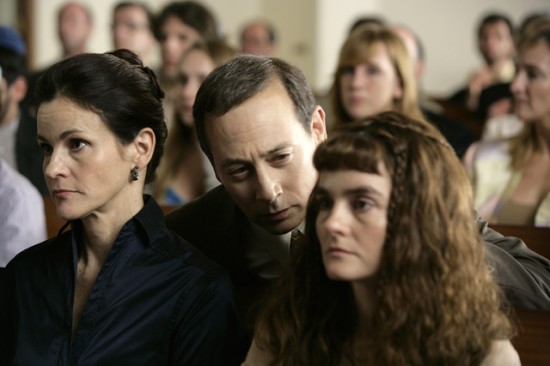
LIFE DURING WARTIMEDIR: Todd Solondz
CAST: Alison Janney, Shirley Henderson, Ciaran Hinds,
Christopher Marquette, Paul Reubens, Ally Sheedy


Nobody could accuse Todd Solondz, the provoc-auteur behind
Welcome to the Dollhouse,
Happiness and
Palindromes of making easy films.
Life During Wartime is no exception. A cold, caustic, challenging film, it will likely split audiences right down the middle.
Life During Wartime is a pseudo-sequel to
Happiness, taking place 11 years on from the events of the first film it again follows the extended Jordan family, and the various people in their lives. The odd thing, and I’ve no idea if this was always what Solondz intended, or if it was a decision forced on him by circumstance, is that though the characters are the same the entire cast has changed. It’s quite distracting at times - more so with some characters than others - the performances aren’t the problem as much as the fact that the old cast is near constantly at the back of your mind. If you can shake off the spectre of
Happiness, a very strong film begins to emerge in
Life During Wartime.
The main thrust of the story sees Joy (Henderson) is separated from her husband Allen (played by Philip Seymour Hoffman in
Happiness and now, in a truly strange piece of casting, by Michael K. Williams of The Wire). Joy goes on a trip to visit her older sisters, first to Florida to see Trish (Janney), who is now dating a much older man (Michael Lerner), whom her young son greets with suspicion. Joy then finds herself in California visiting Helen (Sheedy), now a successful, Keanu Reeves dating, screenwriter. The whole time Joy is dogged by visions of long dead Andy (Reubens), who once took her on a disastrous date. Meanwhile, Trish’s ex-husband Bill (Hinds) is released from a 10-year prison sentence for molesting friends of his now college age son Billy (Marquette). There is, as you can see, a lot to keep track of, but Solondz’ screenplay manages to find enough time to give us full and developed portraits of all the characters, both old and new.
One issue with a lot of Solondz’ films is that his work can feel less like a complete film than a series of self-contained scenes, almost as if he were staging a series of beautifully designed one-act plays. That flaw is very much on display here, and yet I almost didn’t mind, because even though they don’t draw together entirely satisfactorily the individual pieces that make up the film are each so well formed that they work beautifully in and of themselves. This is perhaps best seen in the scenes featuring Charlotte Rampling (as an older woman who picks up Bill at a bar) and Ally Sheedy. They are both outstanding scenes. Rampling does her ice queen act to practiced perfection, and her withering “
It was hard work, I’m old” is so cutting you almost expect Ciaran Hinds to bleed. Ally Sheedy, though, what a wonderful surprise. Just seeing Sheedy on screen now is rare enough, and that’s a terrible shame, because in her last two truly notable roles (this and
High Art) she’s given searing, Oscar worthy work that just leaps off the screen at you. In just ten minutes Sheedy completely runs away with the film. She’s bitchy, hurtful, awful and absolutely hilarious, especially in her repeated references to Keanu. Those scenes are just brilliant, as good as any I’ve seen recently, and yet the movie would essentially be the same without them. There are many scenes like that in
Life During Wartime.

Most integral to the film are Alison Janney as Trish and Shirley Henderson as Joy. It’s great to see these actresses get a proper showcase, both do consistently outstanding work in supporting roles, and here prove just as effective in leading parts. Janney, to her immense credit, is probably the only cast member (besides Ally Sheedy) who makes you completely forget the actor who previously played her part. She’s got some challenging scenes and, early on, some of the least realistic of Solondz’ always somewhat awkward dialogue. The fact that she can make the scene where Trish tells her 12 year old son (Dylan Riley Snyder) that she’s in love with the man she’s just been on her first date with (among other, much more inappropriate, things) play as naturally as it does is proof that she can do just about anything on screen. Henderson doesn’t entirely banish the spectre of the outstanding Jane Adams, but she does bring her own interpretation to Joy, and is very effective. Henderson’s mousy quality, both in her looks and her tiny high-pitched voice, works extremely well for a character who spends her life being buffeted between and manipulated by other people.
There are some deeply uncomfortable moments in
Life During Wartime, and this being Todd Solondz, they are drawn out over as long a period as possible, in order to make us laugh and squirm in pretty much equal measure. There are times – as in a dinner scene when Trish, her much older boyfriend Harvey (Michael Lerner) and their respective sons get together for the first time, and the desperately sad scene between Bill and Billy – when you almost feel like you want to get away from the film, so uncomfortable is it. These, though, are among
Life During Wartime’s best, and in the case of that dinner scene, funniest, moments. The cast is large, but they all do strong work. The only real problems for me were Paul Reubens, whose performance as Andy seemed simply to be a Jon Lovitz impression and Ciaran Hinds. I can’t take anything away from Hinds, he’s very good in the film, but he’s just so far from Dylan Baker’s performance that I couldn’t connect the character in
Happiness with the character in
Life During Wartime.
At times, like all of Solondz’ films,
Life During Wartime dwells in ugliness. There’s little explicit here (brief topless shots of Rampling and Janney are as upfront as the film gets in that respect) but like Happiness this is a film about the evil people do to one another, about psychic violence (literally, in the case of Joy and Andy’s conversations). More than that,
Life During Wartime is about the consequences of people’s actions, the way that what Bill did destroyed his family so completely that his younger children have been told that he is dead, the way that Andy tries to make Joy guilty for his suicide, and so on. Yet as it dwells in this ugliness, the film is quite beautiful to look at. Solondz and cinematographer Ed Lachman give it a highly designed, slightly unreal, look. It’s a very formal looking film, at times almost stagey, but always striking.
To be honest, reviewing a Todd Solondz film is almost a useless exercise, if you’ve seen any of his films before chances are you know what you’ll think of this. You either loved or hated the last one you saw, and
Life During Wartime won’t change your mind. If you are new to his work, then this is as good a starting point as any, you won’t bring the baggage of
Happiness to it and you can be sure of several outstanding performances and a beautifully shot movie. You can also be sure of seeing something that you aren’t going to feel ambivalent about, that in itself ought to be reason enough to catch this film.
Морфий[MORPHIA]
DIR: Aleksey Balabanov
CAST: Leonid Bichevin, Ingeborga Dapkunaite, Andrei Panin

Apparently heroin is bad. Really bad.
Morphia is based on a series of semi-autobiographical short stories by Mikhail Bulgakov. The film is set in Russia, during the winter of 1917, and tells the story of Dr Polyakov (Bichevin), a young surgeon who arrives at a remote hospital which has had to endure several months with just a paramedic (Aleksandr Mosin) and two nurses (Dapkunaite and Svetlana Pismichenko) to sustain it. Polyakov is talented and well liked (especially by Dapkunaite’s nurse Anna), but after a vaccination leaves him in pain he begins to develop an addiction to the morphine that Anna administers. As time goes on he sinks deeper into addiction, and begins to take Anna with him.
Morphia is a technically excellent film. You can’t fault Aleksey Balabanov’s shot selection, the period detail is brilliant, the lighting is stunning, and always realistic to the fact that the locations of the time seldom have electricity, and the production design team simply out do themselves. Special mention must also go to the effects make up artist, whose work makes the many scenes of operations - especially one horrific amputation - so hideously close to reality that you can almost smell it.
Another laudable aspect of the film is its acting. This is what drew me to the film in the first place. Ingeborga Dapkunatte, a Lithuanian born actress, has been living in London and working in the UK for some years now. She’s one of those actresses that you are likely to recognise, she does a lot of small parts on television, and always impresses, but she seems to have struggled to find big roles here and I thought it would be interesting to see her in a large part in her native language. Dapkunaite doesn’t disappoint. She’s a warm and charming presence as nurse Anna, but also brings solid dramatic weight to all her scenes. She sometimes disappears for long stretches of screentime, and when that happens the film misses her.

Alexsandr Mosin is perhaps even better, he gives a nicely layered portrait of Vlas the paramedic, making us believe that this is a man who has seen just about everything, and yet is still able to greet it with a little black humour and a degree of optimism, along with Dapkunaite he’s a chink of light in an otherwise dark film. Leonid Bichevin looks a little young for the lead, but then Polyakov is supposed to be relatively newly qualified, it can be a little distracting though that he sometimes looks to be in his very early 20’s. However, Bichevin is a solid actor, and he takes you along on Poyakov’s dark journey.
With all this quality on display, it is a shame to say that it often feels like it is allowed to go to waste by the script and by the construction of the film. A major issue is that Balabanov seems to feel the need to acknowledge with his structure the fact that the film is based on short stories, and so we get innumerable title cards breaking up the narrative. Winter. The First Injection. First Amputation (an odd one, given that the film features only one amputation). They come up with irritating regularity, some segments last less than two minutes, and every single time a new card came up I felt jolted out of the film. It is as if Balabanov wants to remind us that we’re watching a movie, I can’t imagine to what purpose.
Perhaps the biggest problem with
Morphia is the simplest. I really didn’t care. The script never gives Polyakov enough depth to make him truly compelling and, good though Bichevin is, that meant that I never really cared what happened with his morphine addiction. I was far more interested in Anna and in Vlas the paramedic, and would much rather have seen what happened with them at the hospital rather than follow Polyakov into his addiction treatment. The film’s ending should have left me shocked and shaken, but instead it left me feeling, so what? This is a shame, because there are enough good things in
Morphia (especially Ingeborga Dapkunaite’s performance) to make it worth seeing, but it’s hard to recommend a film that wants to be hard hitting but ends up so easy to shrug off.