In August and September several independent cinemas around London (led by the Roxy Bar and Screen) are showing a programme of films celebrating the wide ranging programming that used to play at the late, lamented Scala cinema (I never got to go there). In celebration of this 24FPS and MultiMediaMouth.com a pair of tickets to give away to each of two screenings.
First; The Eastern Action All Dayer Starting at 3pm (and finishing around 11pm) this all day festival of Hong Kong badassery features John Woo's Heroic Bloodshed trendsetter A BETTER TOMORROW, Sammo Hung's martial arts Dirty Dozen EASTERN CONDORS, Yuen Woo-Ping's cult classic TIGER CAGE II and Lam Ngai-Kai's apparently utterly mental THE CAT
To win a pair of tickets to this screening simply email the answer to the following easy question to sam@24fps.org.uk or sam@multimediamouth.com
WHAT WAS THE NICKNAME OF THE CHINESE OPERA TROUPE TO WHICH SAMMO HUNG, JACKIE CHAN AND YUEN BIAO ALL BELONGED AS CHILDREN?
Second; The Life and Death of Colonel Blimp: Introduced by Tilda Swinton Chosen for the season and due to be introduced by one of Britain's finest and most iconoclastic actresses, this is a great chance to see Powell and Pressburger's much loved classic up on the big screen.
To win a pair of tickets to this screening simply email the answer to the following easy question to sam@24fps.org.uk or sam@multimediamouth.com
WHAT COLOUR ARE THE SHOES REFERRED TO IN THE TITLE OF MARTIN SCORSESE'S FAVOURITE POWELL AND PRESSBURGER FILM?
For each screening the prize is a pair of tickets. Transport is not included, and seating will be first come, first served on the night; specific seats cannot be reserved. Good luck.
DIR: Daniel Zirilli CAST: Tony Schiena, Heath Herring, Louis Herthum, Bai Ling, Dean Cain I love martial arts movies. Sometimes I just want to switch off my brain for 90 minutes and engage with a movie at a visceral level. That's what films like Circle of Pain are designed for. If you're looking for something to pass a friday night with some friends, some beer and some pizza, then this ought to go over perfectly well. That's not, however, to say that it's an especially good movie.
The story couldn't be more formulaic if it tried. It's that tired old tale of the fighter (in this case karate champ Schiena) with a dark past pulled out of retirement for one last bout against a younger up and comer (UFC fighter Herring). Schiena has a roommate (Cain) who has been confined to a wheelchair since they had an accident in the ring, and this haunts him so much he's never fought since, so he trains with the eccentric Willy (Herthum, last seen in The Last Exorcism) to get over this block.
And then, oh then there's Bai Ling. Ling plays the owner of the Multiple Martial Arts franchise putting this bout on and does so in the riotously terrible way we've come to expect from her. She's an appalling actress, never for a second convincing as anything but the utterly insane Bai Ling, but her broken English and apparently equally broken mind are hilariously entertaining.
Next to Ling's lunatic display (watch for the scene where she shouts "shut fuck up" at her own crowd) the rest of the performances come off dull, but the cast aren't bad, considering that they are largely fighters rather than actors. Tony Schiena is flat, but Heath Herring has some charisma. The worst performance comes from Shannon Leppard, making an embarrassing debut as Schiena's ex wife.
But the story and performances aren't really the point. What people really want to know about when it comes to films like this is the fighting. If you're a fan of MMA then you'll likely love this film. The fights are plentiful and the pairings varied. For me, I can't quite get into MMA as a cinematic style. It seems to stake out a no man's land between the brutality of a style like Muay Thai or Hung Gar and the grace of Wushu or Wing Chun. The choreography does a good job of putting across the power of these fighters but personally I missed the lightning speed of a Yuen Biao, the humour of Jackie Chan and the groundbreaking choreography of their best work.
Ultimately Circle of Pain wasn't really for me, but if you like this sort of thing then you'll like this. It's an acceptable way to kill 86 minutes, but personally when I next reach for a martial arts film it will probably have Sammo Hung in it rather than Tony Schiena.
Every friday from here on out, 24FPS will be bringing you a free, legal, movie that you can watch online.
I thought we'd start with a special treat to tie in with Martial Arts Month, so this week's movie is a comedy kung fu treat starring Jackie Chan, Sammo Hung and Yuen Biao...
WHEELS ON MEALS
NB: This is a dubbed version (sorry) but watch it for the amazing stunt and fight sequences, and especially Jackie's outstanding fight with Benny 'The Jet' Urquidez. Enjoy, and come back for next week's pick.
SCOTT PILGRIM VS THE WORLD DIR: Edgar Wright CAST: Michael Cera, Mary Elizabeth Winstead, Kieran Culkin, Jason Schwartzman, Alison Pill, Ellen Wong
SCOTT PILGRIM VS THE WORLD is officially a flop in the US, having met with a distinctly underwhelming $10 million on its opening weekend. However, Edgar Wright’s third film, whatever its box office fate around the world, is a cult hit waiting to happen. The story of the geeky unemployed musician Scott Pilgrim (Cera), who if he wants to be with the girl of his dreams (Winstead as Ramona Flowers) must defeat her seven evil exes, may be fantastical, but it’s also universal. As Ramona notes, “everyone has baggage”. Add that to the breathless invention of Edgar Wright’s visuals, the sharp and funny screenplay, and pop culture savvy enough to impress the most jaded of hipsters and you’ve got a cult on your hands.
Happily, SCOTT PILGRIM VS THE WORLD will deserve its eventual success, because though it is far from perfect this is certainly one of the most purely entertaining films of 2010, and one of the very few quality American made films of the year (notably, like KICK ASS, it was made by a British director). Right from the word go, when the film opens with an 8-BIT rendition of the Universal logo and music, you can tell that Edgar Wright is going to cut loose and enjoy himself for every frame of this movie. That can be a problem; it can mean that a film essentially becomes a masturbatory indulgence for a director, but not so here. For the most part the audience has just as much fun as it is evident the cast and crew did while making the film.
However, there is a pretty big hole right at the centre of the film, in the form of Scott Pilgrim himself. It’s partly the character, who is a whiny irritant, whose apparent success with women (by my count we’re supposed to believe that he’s slept with Alison Pill and Brie Larson’s characters, that Ellen Wong is madly in love with him and that Ramona Flowers is also interested in him) is close to inexplicable, because he’s as charmless as he is dull. The point at which I most wanted to slap him was when Scott’s roommate (the excellent Culkin) tells him that before he begins seriously dating Ramona he should break up with his current girlfriend; Knives Chau (Wong) and Scott replies “But it’s hard”. It may also be Michael Cera that is the problem, because he gives the exact same performance that he’s previously given in SUPERBAD, JUNO, YOUTH IN REVOLT and several others. He’s always Michael Cera, rather than Scott Pilgrim.
Amazingly, this central hole doesn’t fatally wound the film, indeed it is enjoyable in spite of its leading character and actor, something thanks largely to the hilarious and brilliantly inventive screenplay by Wright and Michael Baccall and to the exceptional supporting cast. Aside from Cera and Winstead everyone in the film is basically a guest star, and they all make the most of their few minutes. I was especially fond of Alison Pill’s sardonic Kim (the drummer in Scott’s hideously named band, Sex Bob-omb), which reminds me, why don’t we see more of her? More great contributions come from Anna Kendrick, as effortlessly brilliant as ever as Scott’s sister; Aubrey Plaza, whose character’s foul mouth is bleeped and obscured in a lovely meta joke; Ellen Wong, who makes an engaging and energetic debut as Knives and Kieran Culkin, who is probably the closest the film comes to having a real, identifiable person.
The seven evil exes are all great, but it is worth mentioning a few in particular. Mae Whitman, whose opening line to Scott: “You punched me in the boob. Prepare to die, obviously” is one of the film’s funniest, is very funny as Roxie Richter, and has perhaps the film’s best fight (we’ll get to that later). Chris Evans is spectacularly slimy and funny as egotistical movie star Lucas Lee, who employs his stunt team to fight Scott for him. However, it’s Brandon Routh who nearly runs away with the movie. The latest Superman has shrugged off the earnestness of SUPERMAN RETURNS and marked himself out as a really strong comic actor, and his turn as super powered Vegan Todd is one of the real highlights of the film (along with that sequence’s Vegan Police).
It would all be for nothing, though, if the girl weren’t worth it. Ramona Flowers is only sketchily drawn, but I immediately bought into the idea that Scott, indeed any man, would be willing to fight seven evil exes to be with her. Mary Elizabeth Winstead is dazzlingly beautiful, clearly, and I’m not sure she’s ever looked better than she does here, but that’s not the reason you buy into Scott’s quest. It’s hard to put your finger on, but there is simply something about Winstead; call it charisma, call it allure, call it je ne sais quoi, she’s just compelling. That’s why you buy it, and that’s also why she’s going to be a big, big star. I found her, and Ramona, as enchanting as Scott does. It’s a lovely performance; she’s a little mysterious, but there’s a sense of fun behind everything she does.
Aside from the romance storyline with Ramona, SCOTT PILGRIM VS THE WORLD really has two concerns; music and fighting. Of these the music works less well. Beck wrote the songs for Scott’s band Sex Bob-omb, and apparently the brief was that they should be somewhere between awful and awesome. Sadly the accent falls on awful. When all is said and done Sex Bob-omb are almost as bad as their name, the best thing about them being the many and varied ways they introduce themselves (“We are Sex Bob-Omb and we are here to make you think about death and get sad and stuff.”) It’s probably deeply uncool to say so, because they are presented as the film’s corporate sell out, but the best music here comes from Clash at Demonhead, the band led by Scott’s ex, Envy Adams (Brie Larson). Of course it helps that the fantastic Metric wrote and play their song. It’s a nice way to get the characters together, but frankly the musical sequences often outstay their welcome, and one robs us of what could have been a very cool action scene.
I have recently railed against a lot of action films, because they have, thanks to shaky-cam, close ups and slam bang cutting they have barely let us see their action (I’m glaring at you, THE EXPENDABLES). That’s not the case here. You can tell that the action was worked on with the assistance of the Jackie Chan stunt team; it is intricate, fluid, frequently amazing to watch, and the actors seem to be doing the bulk of their own stunts. The highlight for me was the most clearly Hong Kong influenced fight, which has Mary Elizabeth Winstead and Mae Whitman fighting, Whitman armed with metal whip and Winstead with a massive hammer. It’s a really funny fight, never more so than when Winstead grabs Cera and uses him as a prop to fight. That said, all the action is great, and Wright handles it brilliantly. He still cuts fast, but his editing is fluent, keeping the geography of each scene intact, and his angles tend to be set a little way back, so that much of the time we can see the whole of the performers bodies as they fight. This is how you do comic book action; stylised, sure, but never so much so that anything is lost to the style.
I enjoyed SCOTT PILGRIM VS THE WORLD a great deal, and yet I can’t quite recommend it unreservedly. Michael Cera is a problem; an almost determinedly uncharismatic actor who nearly scuppers a movie which is saved by the quality of everything around that rather poor centre. See it at the most packed screening you can, because this is a movie that will benefit from an audience. I’m sure that you’ll have a lot of fun with it. I did.
This directorial effeort from Chaing (more frequently a cinematographer) probably has more weight if you know some Chinese history. It's set during World War 2 and has a small group of resistance fighters opposing the Japanese army, who want to set up a poison gas factory in a small, newly occupied, town. The performances are broad; shining heroes vs eeevil Japanese baddies, but MAGNIFICENT WARRIORS has quite a bit going for it.
Chaing keeps the pace up, close to frantic at times, and in 88 minutes doles out a lot of action both violent and comedic. Despite the rather perfunctory story and performances, the cast are also quite engaging, getting by more on charm and charisma than any real acting ability. Richard Ng is fun as a drunk who gets swept up in the action, the beautiful Cindy Lau has some great moments to show off her martial arts, and makes for a sweet, if not helpless, ingenue and Derek Yee is solid and charming as the hero.
However, it's Michelle Yeoh, in an early starring vehicle, who holds the attention. She's very young here, but already the charisma that she'd bring to films like WING CHUN and CROUCHING TIGER, HIDDEN DRAGON shines through. Though she's not a trained martial artist Yeoh's on screen fighting is fluent and hard hitting (her prop use is especially brilliant), her years as a dancer and talent for physical mimicry (as well as a willingness to do her own stunt work) serving her well.
MAGNIFICENT WARRIORS isn't quite a classic, but it's an enjoyable movie. There are some technical failings (even in the Cantonese version the dubbing is appalling, and some of the editing isn't great) but the action is great and the film as a whole is always engaging.
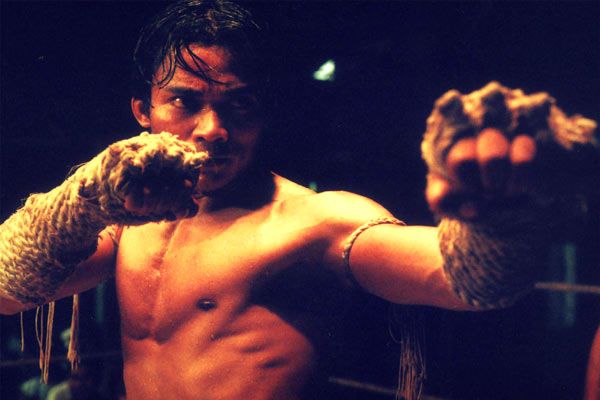
ONG BAK DIR: Prachya Pinkaew
Martial arts films have often been laughed aat for the thinness of their stories, but Tony Jaa's movies really deserve those giggles. Okay, ONG BAK (village boy goes to Bangkok when his village's idol is stolen, retrieves it through kicking people) has a more complex story than TOM YUM GOONG ("Give me back my elephants!"), but not by much.
The thing is, to denigarte ONG BAK for its lack of little things like a well thought out story, compelling performances, or any sort of dramatic weight would be to completely miss the point. This isn't so much a story as it is a breathtaking showreel for tsar Tony Jaa, his stunt team, action director Panna Rittikrai and director Prachya Pinkaew. After 30 minutes or so of exposition and scene setting, ONG BAK explodes into life, and though it becomes little more than a series of tenuously linked fight and stunt sequences the invention, style, skill, and power on display is such that the story could involve the reading of the Thai phone book and it this would still be thrilling cinema.
The action is among the best ever filmed. An early chase sequence shows off Jaa's amazing agility and timing (catch the awesome flip he does between two sheets of glass), but it's the raw power of the Muay Thai fighting style, perhaps best seen in what has been called the Fight Club sequence that was really new and excting when this film was first released.
As an actor, Jaa's flatness can be forgiven, but sadly he lacks the presence of a Jackie Chan or a Bruce Lee, and much of the time you do feel that you're watching a stuntman rather than a star. The support is better; Petchai Wongkamlao and Pumwaree Yodkamol are both funny and charming as the city slickers along for the ride with Jaa, and that keeps the downtime between the action scenes bearable, if never especially engaging. Fortunately the film is chock full of action, so it never slows down long enough to get really dull.
For me, ONG BAK has since been bettered by the same team's vehicles for Jeeja Yanin, especially the jaw dropping CHOCOLATE, but this was the west's introduction to Thai martial arts cinema, the film from which the rest have flowed, and as well as bringing us alot of quality films since, ONG BAK holds up as a genuinely astonishing showcase for thai martial arts, if not a great film.
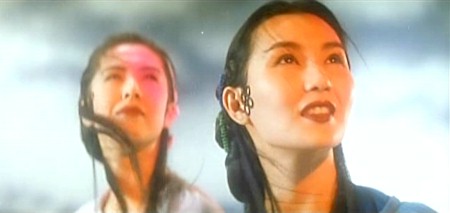
Less a martial arts film than... oh God only knows what this film is... God, or perhaps Tsui Hark, but I wouldn't put money on Tsui Hark. It seems to tell the story of two snake spirits who take human forms (the heart stoppingly beautiful forms of Maggie Cheung and Joey Wong). Wong's White Snake is older than Cheung's Green, and thus she's more able to appear human, and even manages to forge a relationship with a young scholar (Wu Xing-Guo). Theere's also something about a powerful monk (Zhao Wen-Zhou) who has taken it upon himself to destroy these two 'snake evils', this involves a lot of wire assisted leaping around and much use of the incantation "Bo ye ba la hung", which you will know as well as the sound of your own name by the time these 93 minutes are up.
Green Snake is like eating a three course meal consisting purely of LSD. It makes very little sense, you're never sure what's going on, but some of it sure is beautiful. Wong and Cheung both give fine performances under the circumstances, and Cheung is especially effective as the impetuous Green, but the film's pleasures are largely visual, and centred on its female stars.
Many scenes revolve around the scantily clad, frequently wet, Cheung and Wong almost making out. Honestly, if you can think of something better to hang a movie on I'll be happy to help you get it made. It's never explicit, and there's not a frame of nudity from either Cheung or Wong, but dear God it's sexy.
So, if you're not too concerned about little things like a coherent narrative, and you've got a thing for Chinese girls Green Snake comes highly recommended. Otherwise, this one's not really for you.
A highly entertaining, if pretty silly, remake of King Hu's 1967 film. The plot is a tad confusing but let me try. Maggie Cheung (sigh) owns the Dragon Gate inn, in the middle of the desert. For some reason both bandits (led by Tony Leung Ka Fai and Brigitte Lin) and government agents who are hunting them end up there. There's lots of fighting. At the end Donnie Yen shows up (as a eunuch, of course) and the big final fight ensues. So, yes, it's all a bit mystifying and it's certainly not for newcomers to the wuxia genre but there's plenty to recommend here.
Maggie Cheung's performance is infectious, she overplays the comedy to the hilt but the sillier she is the more fun her performance (and, I know I say this whenever I review one of her films but, she's SO beautiful that just watching her is a joy). Brigitte Lin is also terrific in a much more steely and more action oriented part than I’m used to seeing her in and Donnie Yen, sadly not in the film enough, shows up and struts his stuff impeccably.
As far as the fighting goes it's all well worth watching but there's a couple of sequences that really stand out. First a fight between Lin and (a heavily doubled) Cheung in which Lin, having just had a bath, strips Cheung of her clothing one item at a time as they fight. Neither is ever exposed but it's hugely sexy as well as being a solid fight. The final fight is also magnificent with some stunning shots of the cast fighting in what is almost a sandstorm and some awe inspiring physicality from Donnie Yen. It ends in a touch so ludicrous that it's laugh out loud funny but that's the tone of the movie and doesn't hurt a great sequence.
Sadly there's not quite enough action as the tension at the inn seldom boils over and another downside is that Tony Leung Ka Fai is rather bland (perhaps if he and Donnie Yen had traded roles there'd have been a better film here). At the end of the day, as is the case with most wuxia films, if you like the genre you'll find things to enjoy here and if you don't, well, you aren't reading this are you?
REDBELT DIR: David Mamet
When I first heard about Redbelt I did a double take. It seemed like such an odd fit: David Mamet’s martial arts movie, really? While it’s neither the best martial arts movie I’ve seen, nor the best David Mamet movie I’ve seen it is an interesting, and occasionally outstanding, example of each.
Mamet’s name, and his reputation and history as a writer, is enough to attract a stellar cast to play alongside members of his stock company whenever he makes a film, and Redbelt has a truly outstanding cast. Chiwetel Ejiofor impresses in the leading role of Mike Terry, a Jiu-Jitsu instructor who, for reasons I won’t reveal, finds himself having to break his cardinal rule as a fighter, and fight in a competition. Ejiofor seems to be doing the vast majority of the fighting himself and while moves seem quite basic the choreography is well put together and the length of the takes and the combinations of moves are pretty impressive, but Ejiofor’s strength is the drama and he plays it flawlessly, from an American accent so good that you’d barely believe he’s British to hitting every beat of Mamet’s always intricate dialogue just right. Another British actor, again playing an American, also impresses in a smaller role. Emily Mortimer is quickly growing into one of the most reliable character actresses around and here she plays a complex role, with a lot of different facets and an extreme arc absolutely convincingly with only a few rather brief scenes to do it.
Among the rest of the supporting cast there are (too) small parts for Mamet regulars Rebecca Pidgeon, Ricky Jay and David Paymer and excellent turns from Brazillian actress Alice Braga as Ejiofor’s wife and Max Martini as his star pupil. The real surprise, though, is Tim Allen. Allen is usually found slumming, but has previously shown that with a good script (the Toy Story films, Galaxy Quest) he’s an effective comic lead. Here, though, he’s got an entirely dramatic role as action movie star Chet Frank, and he absolutely eats it up, grabbing it with a zeal that suggests he knows exactly how good a chance this is to prove that he really can act. Now if he’d only stop making crap like The Santa Clause and seek out more roles like this.
Mamet’s screenplay is talkier than you’d expect for a martial arts movie, but truly it’s the talk that is the film’s most compelling aspect. As ever with Mamet it overflows with quotable dialogue (“We got a deal”. “What good's a deal if no one's making any money”?) and in typical fashion things that seem incidental end up paying off in ways you don’t expect, as in a beautiful second act sequence here, which draws a morass of dangling threads together to set up the final conflict.
It is, sadly, that final conflict that ends up making Redbelt somewhat less than the sum of its parts. The last act is very familiar, and it’s done with little panache, particularly when Mamet, the master of dialogue, wraps proceedings up with a (hopelessly cliché) silent sequence. Worse is that the final fight isn’t very dynamic or exciting and that several moments that promise rather more drama are thrown away, never to be seen. Still, for three quarters of its running time Redbelt is vintage Mamet, with a nice side order of kicking.
HEART OF THE DRAGON DIR: Sammo Hung
Fung Tat (Jackie Chan) is a cop. He's always wanted to get a job on a ship and sail round the world but can't as he has to care for his elder brother Dodo (Sammo Hung) who is mentally handicapped. Tat is in the process of trying to marry his girlfriend (Emily Chu) so he can leave Dodo in her care and go off sailing but when his brother falls in with a gang of thieves he must save him and clear his name with the police.
Heart of the Dragon is far removed from a typical Sammo Hung / Jackie Chan film. The first thing that audiences will notice is that Sammo doesn't fight, though he does a couple of stunts, the other most notable thing is that Heart of the Dragon is overwhelmingly a drama, allowing Jackie and Sammo both to play far against type for perhaps the first time in their careers.
As Dodo Sammo really gets to create a character and he shows that actually he's a pretty versatile and talented actor, given the chance to stretch. We never get specifics on what is wrong with Dodo but Sammo's childlike performance is charming and never condescends to the audience or becomes so broad as to be insulting to the mentally handicapped as so many films have.
Jackie is also effective as Tat. In one particularly excellent scene he rails against his uncomprehending brother about how he's not been able to go away because he's had to devote his life to caring for him. Jackie always gets to be more adult when Sammo is directing him (perhaps it's because, as his big brother, he trusts Sammo to stretch him) and that's certainly true here. Even outside of the dramatic scenes his fighting is more brutal, more outwardly violent and his relationship with Emily Chu both cynical and suggestive of a more adult side to the character, particularly in a couple of kissing scenes which from anyone else would be mild but are probably as sexual as Jackie has ever allowed himself to be on screen.
This is very much a drama. After an opening action beat (which includes a rare and sadly brief smackdown between Jackie and the late, great Lam Ching Ying) it settles down into being a very serious piece which lets the acting rather than fists and feet do the work and it works better than you'd ever expect because Sammo and Jackie hold it together (though supporting cast members like Mang Hoi are sometimes found wanting). So committed was Sammo to this tone that he actually cut action scenes from the main body f the film, holding off on the action until the traditional end fight which, it has to be said, is a beautiful thing. I love Jackie Chan's films and he's created some of the greatest action ever put on film but he never looks better, or more dangerous, than when he's directed by Sammo and this is no exception, fast, furious and violent it's a great release after a long wait for some action.
Heart of the Dragon is not a film for people new to Hong Kong martial arts movies as it's far from a traditional entry in the CVs of Sammo Hung and Jackie Chan but it's well executed in all respects and a recommended watch for fans who want to see Sammo and Jackie trying something new and doing well at it.
ARMOUR OF GOD DIR: Jackie Chan
Asian Hawk (Jackie Chan) used to be a pop singer along with friend Alan (Alan Tam) but now he's an Indiana Jones style fortune hunter. When Alan's girlfriend (Rosamund Kwan), also Hawk's ex, is kidnapped he and Alan must retrieve all three pieces of the Armour of God as a ransom for the corrupt group of monks who hold her.
Every time he does a film Jackie Chan does things that could quite easily kill him. He fell off a clocktower in Project A (actually he did three takes of that one), he slid down a long pole lined with lightbulbs in Police Story and he's been injured countless times, dislocating bones you never thought you could dislocate (the sternum). He's only come close to dying in one stunt though, a rather simple one on this film. Jumping out of a tree from about 15 feet up Chan missed his target, the cameraman rolled out of the way to avoid being landed on and Chan landed on a rock, cracking his skull. Fortunately he was able to get emergency brain surgery, though he still has a plastic plug stopping the hole in his head.
Armour of God did get finished though and there's little in it to suggest that its star and director had nearly lost his life early in the schedule as Chan still executes some truly breathtaking stunts. It's not, sadly, one of Chan's best but Armour of God does have some real standout sequences. The opening sequence isn't so much inspired by Indiana Jones as it is a direct lift but it's strong with some great stunts and the same exuberant action feel as the Indy films captured. Sadly after this the film settles into a largely action free midsection which throws too much focus on a bland Alan Tam (whose introduction, with an entire canto-pop song, is truly a test of endurance). The ending set piece does, as ever, liven things up with Jackie fighting four female opponents as well as some monks before diving off a cliff onto a hot air balloon and sliding down the balloon into the basket (something he did for real, mere months after his operation).
Aside from the action this isn't a great film but there's enough decent action and endearing performances from Jackie and Spanish model Lola Forner to recommend it.
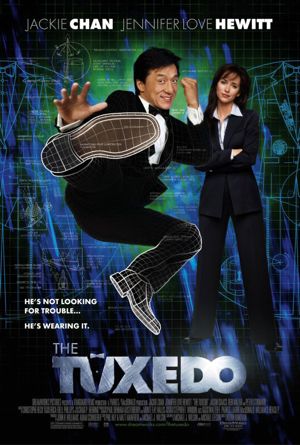
THE TUXEDO DIR: Kevin Donovan
Jimmy Tong (Jackie Chan) works as a cab driver until one day a passenger offers him a job as driver to super spy Clark Devlin (Jason Isaccs). When Devlin is injured in a bombing Jimmy takes his place, using a tuxedo of Devlin's that confers superpowers on the wearer.
Suited up Jimmy and partner Del Blaine (Jennifer Love Hewitt) (who, being on her first assignment, thinks he's Devlin) go up against an eeevil bottled water manufacturer (Ritchie Coster) who is planning to poison the world's water supply, leaving only his mineral water safe to drink (muahahahaha).
It's not an easy time to be a Jackie Chan fan. His Hong Kong output has been slipping in quality (he's been trying to act, God help us) and his Hollywood films lurch from one embarrassment to the next. This might be the best of his US work to date, I realise of course that that's like saying 'Whaddya know, this sewage smells better than that sewage', but still, small mercies.
The Tuxedo is certainly beset with problems. First among them is the prevalence of wire work (not great wire work at that) in the action and stunt sequences. Time was Jackie lived by the words: I am the special effect. But time marches on and this can be put down to age and injury rather than laziness or a lack of ideas on the part of Jackie and his stunt team. The smaller moments are the best, true they've been slightly aided by effects but still the displays of agility, particularly when Jackie has to fight while trying to put his tux back on, are as amazing as ever.
Debuting Director Donovan isn't the man for the job. Too often he botches the action particularly in a sequence with the most obvious fake leg ever put to film and his leering fascination with Hewitt's cleavage, magnificent as it may be, makes you wonder if it was an adult or a 13 year old boy behind the camera. However there are bright spots. Chan's having fun, which often seems not to be the case lately, clearly he enjoys the slapstick comedy and, for all the frustrations of working in English, his comic timing and screen presence still win through. Hewitt may be utterly miscast but she makes the best of things and actually puts in a sparky performance that serves the film perfectly well.
So it's dumber than you can possibly imagine but there's also fun to be had. There's some hammy cameos from Whose Line Is It Anyway's Colin Mochorie and from Peter Stormare as a mad scientist and just enough of Jackie's trademark action to make it fun. Clearly no masterpiece then, but hardly as mortifying as Shanghai Noon or The Medallion
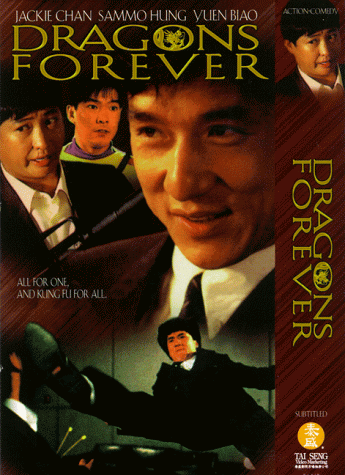
DRAGONS FOREVER DIR: Sammo Hung
Jackie Lung (Jackie Chan) is a lawyer hired by a chemical processing factory to make opposition to their polluting ways, which are threatening the fish farm run by Miss Yip (Deannie Yip), disappear. However Lung discovers he is working for gangsters (led by Yuen Wah) and with the help of friends Fei-Hung (Sammo Hung) and Tung (Yuen Biao) sets out to destroy the drug refining and smuggling operation really operating through the factory.
The legendary 'Seven Little Fortunes' opera troupe of Sifu Yu Jim Yuen included many of the great stars of Hong Kong martial arts cinema but the three that made the greatest impression on the industry were Jackie Chan, Sammo Hung and Yuen Biao. The three made numerous films together but only in three of those did they all have starring roles. Project A, Wheels on Meals and Dragons Forever. Being a Sammo Hung film it is darker than Project A and lacks the exuberant fun of that film but Dragons Forever, like many of Sammo's films, not only shows off his cast's astonishing abilities to their best effect but allows them to stretch them selves in areas they usually wouldn't.
All three of the stars play against type. Jackie, normally the moral underdog hero, is cast as a shyster, skirt chasing lawyer and when we first see him is defending a rapist in court (though he does give him a hell of a punch after the acquittal). Sammo gets to be a bit of a ladies man, something that his build would usually preclude and Yuen Biao plays a very odd character, an old friend who appears to have gone mad. It is perhaps this deviation from their usual personas that meant Dragons Forever was something of a box office disappointment on its release. For me though the changes to the familiar personas are a welcome way of providing some variety in a genre that too often only distinguishes itself in the choreography of the fighting.
There's quite a lot of plot in Dragons Forever and that allows for not just a lot of fighting but quite a bit of comedy and even a few more dramatic interludes. These vary in their success. For example there's a charming sequence with Sammo and Deanie Yip night fishing while sharing some food (this, apparently, is based on how Sammo and his first wife passed the time when he was broke) which works beautifully but a broader scene when he pursues Yip down the street with a megaphone trying to get her to go on a date with him pushes the boat out a bit far.
A lot of the comedy involves physicality and never is this better executed than in a scene at Jackie's apartment as first Yuen Biao and then Sammo gatecrash as he tries to woo Pauline Yeung and the tries to hide their presence from her. If the Three Stooges did kung fu it would probably look like this ludicrously entertaining sequence.
Though the comedic action is hugely entertaining it really has nothing on the true action beats. There's an excellent early scene for Jackie, which takes place on a boat (the venue for his second date with Pauline Yeung) and again shows off his absolute mastery of fighting with props. The three brothers all fight together in a stunning scene in a club, which uses a real disco as a standing set in ways that look astoundingly painful. There's a one time only occurrence for fans too, as Dragons Forever is the only film in which you can see a three way fight between Jackie, Sammo and Yuen Biao.
The plot wraps up (with, sadly, just about the worst scene in the movie) at the end of act two to set up the final few reels for the traditional showdown. It's here that Yuen Wah, reprising the robotic bad guy he played to such effect in Eastern Condors, comes into force and Benny Urquidez arrives in the film. Urquidez (who Bey Logan, who should know, describes as pound for pound the greatest martial artist alive) fought Jackie in Wheels on Meals (and it's that fight that Jackie named his favourite he's ever taken part in) and was brought back as the formidable last reel opponent here.
Their confrontation is quite simply one of the finest ever filmed. It starts out slow and over about ten minutes amps up to a frenzy of punches and kicks, all of it executed brilliantly. The timing is spot on, the use of props inventive, adding to the scene and Sammo even lets the action pause for a quick comic beat and let the audience catch a breath. Even if it's not the best martial arts sequence ever filmed (for me that's the Sammo directed duel between Frankie Chan and Lam Ching Ying in The Prodigal Son) it's still right up there and a truly fitting finale to the last of the three brothers films together.
SHANGHAI NOON DIR: Tom Dey
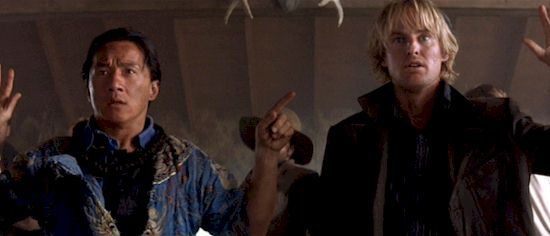
China 1881: When the Princess Pei-Pei (Lucy Liu) is kidnapped from the Forbidden City and held for ransom Chon Wang (Jackie Chan) begs to be included in the party sent to rescue her. When the train they are travelling on is robbed by Roy O'Bannon (Owen Wilson) and his gang and his uncle is killed Chon Wang goes after Roy. Eventually they team up and ride off to save the princess.
When even the outtakes at the end of a Jackie Chan film are less entertaining than spending the same amount of time slapping yourself in the face you know it's been a really bad day at the office for the clown prince of Kung Fu movies. Shanghai Noon is an embarrassment. The comedy, from both Chan and sidekick Owen Wilson is thuddingly unfunny (and, in one extended sequence with some indians, more than a little bit racist). The physical comedy for which Chan is justly famous is here reduced to such tired gags as him getting off his horse the wrong way and then walking funny; oh my sides, how they ache.
The most serious crime though is that the action is not only rather dull (shocking, what with Jackie, his stunt team and Yuen Biao working on the film) but ineptly shot. Dey forgets to let us see Jackie in several of the big sequences, including a long fall which is the best stunt in the film (an embarrassing standard).
Chan, Wilson and Liu are fine, doing what little is asked of them perfectly well but there's little to love here. There are no moments to rewind gasping 'how'd he do THAT?' None of the fights really get the blood pumping and the comedy is a laugh desert the fact it's not the worst of Jackie's American films speaks only to how catastrophically awful The Medallion really was.
SHANGHAI KNIGHTS DIR: David Dobkin
Chon Wang (Jackie Chan) and Roy O'Bannon (Owen Wilson) are reunited after Chon enlists Roy's help in avenging his Father's murder and getting back the imperial seal that he was killed for. This involves going to England to meet up with Chon's insanely hot sister (Fann Wong) and pursue the killer; evil Lord Rathbone (Aiden Gillen)
I hated Shanghai Noon but clearly I'm a glutton for punishment so here we are. There's good news and bad: the good news; this sequel is better than Shanghai Noon, the bad news; barely, and by default.
Alfred Gough and Miles Millar clearly decided that they'd run out of cliché jokes about Native Americans and how out of place Jackie Chan was in the wild west so they've moved the story to England. What that results in is some of the worst xenophobic English jokes and clichés since the despicably unfunny Three Men and a Baby. There are only two accents in this England; an incredibly overplayed 'aristocratic' one, which reaches its most ludicrous point with the monumentally terrible performance of Aidan Gillen and the world's most cliché 'apples and pears' cockernee, which contributes to the mortifyingly dreadful performance of young Aaron Johnson.
A constant annoyance is that the film has absolutely no regard for historical context. Set in 1887 it takes place in a London where Jack the Ripper is already terrorising the streets (those murders took place in 1888), motion pictures (first demonstrated in the 1890's) exist and Charlie Chaplin (1889-1977) is already 10 or so. Obviously we don't come to films like this looking for historical accuracy but when these jokes are such a big part of the script shouldn't they at least have a basis in fact?
At least the cast is game. Chan and Wilson work hard but they can't mine laughs from the mirthless abomination that is the screenplay and Gillen certainly puts forth effort (even doing some creditable sword fighting) but has been misdirected; his cliché villain lacking only a moustache to twirl. Fann Wong lights up the screen with her beauty but her character is so thin as to be anorexic and few of her actions have any motivation (notably her character's attraction to Roy). However, untrained as a martial artist though she may be, she looks great in her action sequences.
The action sequences are better than last time out. Unlike Tom Dey, Dobkin makes sure we can see Jackie in the action set pieces, makes sure we know it's him, the choreography is better too, a sequence involving a ladder recalls some of Jackie's best work and harks back to the mastery of props he showed in films like Project A. Sadly the fight between Jackie and Donnie Yen, long awaited by fans, is something of a letdown. The tussle is grounded for much of the time and lacks any real drama (though the pay off, provided by Wong, is good).
For the action, the outtakes (always a highlight of Jackie's films) and for Fann Wong this is worth a look but what surrounds it is, at times, torturously poor.
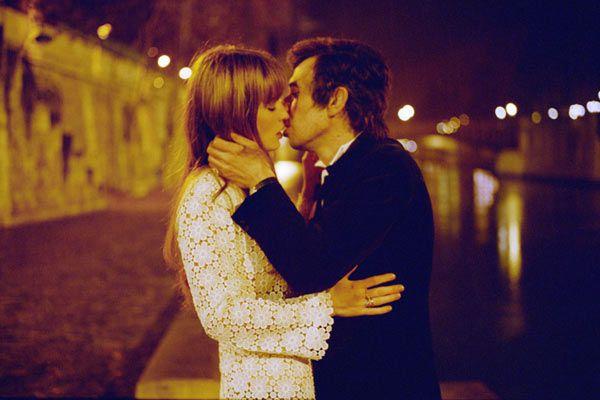
Comic book artist Sfar makes an arresting directorial debut with this biopic of a man perhaps best described (by a friend of a friend) as ‘France’s pervert laureate’. Sfar covers most of Gainsbourg’s life, from his childhood (when he was still Lucien Ginsburg) in Nazi occupied Paris, to his controversial career as a musician and his prolific womanising with some of the world’s greatest beauties; Juliette Greco, Brigitte Bardot and Jane Birkin among them. It’s a scattershot film, inevitable really when you are covering roughly 50 years, but it’s also an unusual and entertaining work.
Sfar follows the basic biopic form, most notably in the scene when Gainsbourg writes Je t’aime (moi non plus), which has the same slightly clunking feel as the moment in Ray when Jamie Foxx, as Ray Charles, writes Hit the road, Jack, but in both style and storytelling this is a rather unusual film. Sfar employs a clever device of giving Gainsbourg’s rebellious streak physical form (as a caricature known as Gainsbarre, which is, apparently, a very good pun in French). Doug Jones, surely the cinema’s foremost pantomime artist at the moment, gives Gainsbarre shape, and makes him by turns a funny, mischievous and sinister presence in the film. It’s a contrivance, and one that could have been heavy handed, but it is beautifully handled and the touch of surrealism it lends the film feels strangely appropriate to the unpredictable man at its centre.
The performances are top notch all round, but special notice has to go to Eric Elmosnino, he may look more like a cadaverous cross between Gainsbourg and Rowan Atkinson, but he embodies Gainsbourg completely, to the point that it seems less performance than possession. It’s not an easy part, Gainsbourg grows progressively more loathsome as the film goes on, but Elmosnino makes him entertaining, if not likable. There is also a tinge of sadness to watching the film, because the other stand out performance is given by British actress Lucy Gordon, who makes for an eerily convincing Jane Birkin. Gordon killed herself just weeks after finishing this role; a tragedy made even more senseless when you see how she leaps off the screen here.
I knew nothing about Serge Gainsbourg going into this film, and though I’m not sure I know much more now, I certainly had fun for two hours.
FAINTHEART DIR: Vito Rocco
Charming, but ultimately far too safe and familiar to leave any lasting impression, this British rom-com about a battle re-enactor (played by the excellent Eddie Marsan) trying to win back his wife (Jessica Hynes) feels like exactly what it is; a film made by committee. The script, director and several cast members, were chosen through votes on Myspace, who also put up much of the funding (it appears to have been a commercial disaster, as the film never even received a cinema release in the UK).
Faintheart is a custom made feel good movie, almost embarrassingly unoriginal and lack anything constituting a surprise in even one of its plot developments, the fact that it isn’t awful is down largely to the excellent performances. Marsan is more dialled down than normal, since this film he’s made a name playing explosive characters, but he’s effective here as a normal guy just trying to be the best husband and father he can. Jessica Hynes is also effective; from her looks to her naturalistic acting there’s nothing Hollywood about her, and that works well for the film. There’s also a strong comic relief turn from Trainspotting’s Ewen Bremner.
The direction, sadly, is as rote and by the numbers as the screenplay, and the minor roles (the ones, one assumes, cast from Myspace audition tapes) are played by actors more suited to local theatre, but Faintheart gets by on a handful of performances better than the script deserves and a good deal of charm.
THE 36TH CHAMBER OF SHAOLIN DIR: Liu Chia-liang
Directed by and starring Gordon Liu (now best known as Pai-Mei, and various other characters across the two volumes of Kill Bill), this Shaw Brothers effort is one of the generally acknowledged classics of martial arts cinema. Unfortunately I found it tremendously disappointing.
The story is by the numbers (young man on the run from the Manchus who killed his family takes refuge and trains in martial arts at Shaolin temple) and it takes forever to get going. Even the training sequences largely disappoint, thanks to the sheer dullness of the tasks (one seemingly endless sequence has Liu attempting to jump over a pool of water).
It is only in the last twenty minutes or so, after Liu leaves Shaolin and finally seeks his revenge that the film picks up. Here the choreography (though still very classical) is at least a little faster and punchier, but still, it’s all very rote. Groundbreaking in its day, yes, but looked at now 36th Chamber comes up very short.
TEMPLE GRANDIN DIR: Mick Jackson
Every now and then, movies offer up a lovely little surprise, and this is certainly one of 2010’s. Claire Danes plays the real Dr. Temple Grandin, a profoundly autistic woman who has overcome many of her anxieties to become a great engineer and a leading expert in the field of the welfare of animals being raised for food. The story is simple enough biopic stuff, but Mick Jackson uses the visuals beautifully, managing to communicate in a way that is neither heavy handed nor unclear, the way that Grandin says she is able to think in pictures.
Jackson also draws an exceptional performance from Claire Danes. She’s always been actress who, to me, has exhibited more charm than skill, but here she completely melts away to leave behind only the character of Temple Grandin. I’ve spent a great deal of time with autistic people, and Danes’ is probably the most sensitive and most accurate portrayal of a profoundly autistic person that I can remember. She’s careful never to use Grandin’s disabilities for comedy, never to mock her, but at the same time she makes no play for sympathy. She presents Grandin as a complete and complex young woman. I’d be tipping her for an Oscar, but unfortunately the film debuted on HBO, and so is ineligible.
Temple Grandin is an excellent film, with fine performances all round from a cast that also includes Julia Ormond, David Stratairn and Catherine O’Hara (terrific in a rare straight role), but it is, at the end of the day, Claire Danes' film, and she carries brilliantly, giving a performance I would never have suspected she had in her.
ZOMBIE GIRL: THE MOVIE DIR: Justin Johnson / Aaron Marshall / Erik Mauck
Zombie Girl: The Movie is a highly entertaining documentary about 12 year old Emily Hagins, as she makes her feature directorial debut with a self-penned zombie movie (she wrote the script aged 10) called Pathogen. The doc is never fawning (it shows Hagins fucking up on many occasions, and even the odd moment of petulance towards her near saintly mother) but it doesn't mock either, choosing to highlight the sheer excitement that Hagins has to be making her own film. She's an engaging character too, smart when she stops to think, and witty too. I've ordered Pathogen on DVD on the strength of this film (watch for a review soon), but in its own right Zombie Girl is definitely a film to show the young aspiring filmmaker in your life.
DRUNKEN MASTER / THE LEGEND OF DRUNKEN MASTER DIR: Yuen Woo Ping / Jackie Chan and Lau Kar Leung
In 1978 Jackie Chan had already been working in martial arts movies for about a decade, mainly for low budget director Lo Wei, but he’d just scored his first hit, with a film made in an agreement that saw him loaned to Seasonal Film and director Yuen Woo Ping (now famous as the martial arts choreographer of The Matrix and Crouching Tinger, Hidden Dragon). Following their hit with Snake in the Eagle’s Shadow Yuen, Chan and co-star Yuen Siu Tien (Woo Ping’s father) set out to top it with Drunken Master, another in a long line of tellings of the tale of Chinese folk hero Wong Fei Hung.
Rather than showing Wong Fei Hung as the martial arts master he became, Drunken Master fits itself brilliantly to Jackie Chan’s very particular talents, effectively inventing the comedy kung fu genre in front of your eyes. Chan’s Wong Fei Hung is a mischievous young man with a very disapproving father (his name was Wong Kei Ying, and we’ll be looking at a Yuen Woo Ping film about him before martial arts month is out). When he, in a single day, manages to offend his aunt and a rival martial arts teacher, Fei Hung is banished by his father, who sends him to study kung fu with Beggar Su (Yuen Siu Tien), whose brutal training style and eight drunken gods kung fu prepare Fei Hung for a climactic battle with hired killer Thunderfoot (played by Korean superkicker Hwang Jang-lee).
Drunken Master is in many ways the prototypical martial arts film, from the introductory bout over the opening credits, to the hero who knows some kung fu, but must learn a new style to triumph, to the comic beggar character to the training set pieces almost every scene here has been repeated ad nauseum by every martial arts filmmaker for the last 32 years. It is, then, amazing that the film feels so fresh. Chan’s strength was always his effortless onscreen charm, and here it’s in full evidence, as is his breathtaking martial arts skill and his teriffic comic timing (he’s the past master at making you laugh in the middle of a fight.
It’s broad, of course, and the story and acting aren’t really what you’d call good, but Drunken Master is an enduring classic; it’s a lot of fun and the balance of slapstick comedy and awesome martial arts is endlessly engaging.
The very belated 1994 sequel, Legend of Drunken Master, finds a 40-year-old Chan still trying to play a young Wong Fei Hung. It’s not especially convincing, particularly when he’s opposite the 31-year-old Anita Mui as his mother. It’s also a rather heavier film in some respects, with a multi-stranded plot that takes in Wong Kei Ying’s fortunes as a chemist, factory workers being mistreated by their employers and the smuggling of precious Chinese artefacts. Sadly the plots aren’t terribly engaging, and you end up not really caring who the villains are, or what they’re doing.
The good news is that the martial arts sequences are even sharper than in the original. Chan’s near his physical prime here, and his speed is just mindblowing, especially in the drunken boxing scenes. Action highlights include a frequently crouched bout with co-director Lau Kar Leung, the finale in which Chan again fights an astonishing kicker (this time Ken Lo, then his real life bodyguard, in a scene that took two months to film), an sequence where Wong Fei Hung fends off swarms of enemies with a single piece of bamboo and a wonderfully funny fight in which Wong’s mother continually throws him wine bottles, so he can become drunk enough to win.
The comedy is equally sharp, with Chan on strong form, but upstaged by a very silly and really hilarious performance from Anita Mui. Many of Chan’s fans rate this as the best of his late period work, and it is up there, but as a sequel to Drunken Master it’s a disappointment overall.
THE KARATE KID [2010] DIR: Harald Zwart CAST: Jackie Chan, Jaden Smith, Wenwen Han, Taraji P. Henson
Let’s get one thing absolutely straight; there is no karate in this movie (well, there is, on TV, in one scene). Jackie Chan doesn’t teach karate, Jaden Smith doesn’t do karate. As is stated over and over again in the dialogue, this movie is about Kung-fu. Aside from that minor detail, and the fact that the titular kid is now just 12, rather than 15 or 16 in the 1984 original, this is a reasonably faithful remake of the beloved (but, whisper it, actually not very good) movie that many of my generation grew up with.
That means that this version shares many of the weaknesses of the original; for instance, the villain is exaggeratedly, inexplicably, and seemingly irredeemably evil. Only if he had a moustache to twirl and punctuated each line with “Muahahaha” could he be more ridiculously evil. There’s also the matter of the ending; different here, but still cheesier than a warehouse full of gorgonzola. Where this remake scores over the original though is in the action stakes.
The biggest hole in the original Karate Kid series was the fact that you never believed that either Pat Morita or Ralph Macchio could do karate (well, that and the utter ridiculousness of that crane pose). Here that’s not a problem, rather than Pat Morita you’ve got Jackie Chan, Asian cinema’s clearly indestructible martial arts star, he’s been doing breathtaking kung-fu on screen for more than 35 years. The action is clearly heavily influenced by the presence of Chan and his stunt team, who worked training Jaden Smith for months before production. It’s punchy, and often times quite surprisingly brutal (the PG certificate that BBFC have allowed this through with is a nonsense, it’s clearly a 12A, and seriously upset a couple of young members of my audience). But it’s also quite thrilling to watch, and crucially, looks like real kung-fu.
The story is very basic, in place of Maachio’s Daniel-san we have Jaden Smith as Dre, who has been moved to China after his mother (Henson) is transferred there for work. On his first day he meets pretty Meiying (Han), but some of the other kids at school don’t approve of Meiying being seen with Dre, so they beat him up. This leads (eventually) to Dre taking up kung-fu training with handyman Mr Han (Chan) so that he can fight the bullies at a climactic kung-fu tournament.
The big problem with the film is twofold; first, it is indulgently overlong, and could easily stand to lose 30 of its 140 minutes. The opening third of the film is incredibly repetitive, and no matter how engagingly some of the chase and fight scenes between Dre and the bullies are staged, there are a great deal more of them than are really required to tell the story. Perhaps the more pressing issue is that of Jaden Smith. Look, I’m sure Jaden Smith is a nice kid, but let’s not pretend that he’d have any sort of film career were he not the son of (executive producers) Will and Jada Pinkett Smith. I think I got a bike for my tenth birthday, it seems that Jaden got a multi-million dollar movie franchise. I don’t like to beat up on a kid, but Smith has all the charisma of the peg he repeatedly hangs his jacket on and the expressiveness of someone slipping into a coma. He has two gears; blank and stroppy (we get much more of blank) and is one of the dullest leading performers in a film this year.
Fortunately there are compensating factors; Wenwen Han gives a nice performance as Smith’s love interest (though the scene where she dances to Lady Gaga’s Pokerface (not THAT song) sexualises her in a rather uncomfortable way), but its Jackie Chan who makes this movie worth the ticket price. Chan’s opera brother Sammo Hung (who, frankly, would have been my first choice for this part) has settled nicely into character roles, but Chan has struggled with his acting, especially in English. Happily he gives his best ever performance as Mr Han, giving his scenes with Smith a real warmth and brining real weight and credibility to the one scene in which he’s got some dramatic heavy lifting to do. That aside, Chan is also in astounding shape for 55, and his one action scene has all the brilliant dexterity fans expect (even if it is a little more heavily cut now). It’s a surprising performance, I didn’t know that Chan had that car scene in him (He may have had little help because, though it’s not credited, I think the pictures he looks at in that scene are of his real wife and son).
Really though it’s the action that you’ll want to see the film for, the training sequences take a while to warm up, but once Mr Han shows Dre what he’s been learning with jacket on, jacket off routine (replacing the original’s wax on, wax off) the film really picks up with a blistering exchange of technique, which appears to have been done in long takes and without doubles, and finally the film kicks into high gear and largely stays there. The tournament is much more fun here than in the original; the fighting so much more varied and dynamic. This new Karate Kid is by no means perfect, but it’s fun, and it’s got some really great action. All in all, it’s a remake that betters its source.
My review of Chocolate can be found here, so rather than rehash it and tell you again how amazing this film is, I'm just going to let you see for yourselves. You're welcome.
In addition to speeding up the Top 100 posts (hopefully to 4 entries a week, at least) and the usual reviewing load this month I'm going to be running a special feature here at 24FPS. Every day in August I'll be looking at, and posting at least a mini review for, a different martial arts movie. There will be a mix of classic and new films, some I've seen a dozen times before, some I'll look at for the first time. We'll look at movies with Jackie Chan, Tony Jaa, Bruce Lee, Sammo Hung, Yuen Biao, Lam Ching Ying, Jeeja Yanin, Michelle Yeoh, Cynthia Rothrock and more. So, throughout August you can get your kicks (oh what, you thought I'd leave that pun alone?) right here at 24FPS.
A couple of years ago 24 year old Jija Yanin made an auspicious film debut in Chocolate, starring as a young autistic girl who learned her movies from watching the likes of Bruce Lee, Jackie Chan and Jija’s own mentor Tony Jaa. It would have been easy to just allow Yanin to repeat herself, to make Chocolate over and over again, but instead Raging Phoenix finds her changing her martial arts style and stretching her acting muscles a little more.
The story, such as it is, has Yanin as Deu, a young rock drummer who seems to have very few people in her life. While she’s hungover a gang attempts to kidnap her, but she’s saved by a mysterious martial artist (Tang) who, along with the other members of his gang, then teaches her their form of fighting; a blend of drunken boxing, muay thai and moves based on hip hop dance moves. Once she’s trained up, the gang seek to extact revenge on a people trafficking ring.
Simplistic doesn’t even begin to describe the story and screenplay, but as with any martial arts movie, that’s not what this one is about. It’s about feet and hands and elbows and knees. Thee fights are the centre of the film and though the martial arts style remains largely the same the tenor of the fights ranges from the comedic (the first time we see the whole of Tang’s gang, in a fight scene in which they use Yanin as a sort of deadly rag doll) to the brutally bruising (the entire last twenty minutes, including an especially jaw dropping sequence across rope bridges on three levels). There’s also a great training sequence, very reminiscent of those in Drunken Master, only with the pretty, petite Yanin standing in for Jackie Chan.
Whatever your feelings about Raging Phoenix as a whole (and it is a rather slapdash affair in many ways) there is one thing in it the brilliance of which it would be churlish to deny, and that’s Jija Yanin. She’s a movie star through and through, possessed of screen searing charisma, which, along with her cute face and awesome athletic prowess, draws you both to her character and into the story. She’s not the world’s best actress, but while we’re not exactly talking Isabelle Huppert with Muay Thai skills, Yanin can act. There is one particular scene, on that bridge towards the end of the film, where she really seems to dig into deep emotional reserves and find something that really feels quite raw and real. It’s not what audiences will be coming to the film for, but it certainly makes it more involving, and suggests that Yanin can have a long career.
If the film is not quite as astonishing as Chocolate (and it’s not) that’s really for two reasons. First off, Raging Phoenix doesn’t have that incredible shock of the new, that sense of discovery that Chocolate did and perhaps more problematically the story this time out is so threadbare that the stakes feel rather lower. That said, this is still one of the best martial arts films of the last few years, and comfortably puts Jaa’s Warrior King and Ong Bak 2 in the shade. The pupil has outshined the master, I can’t wait to see what she does next.
Why is it on the list? Okay, so I can’t claim Police Story as great art, but I certainly can claim it as great fun, and that means more than you might think sometimes. There’s an interesting tale behind Police Story. It came out of Jackie Chan’s frustrating experience on his second attempt to break the US market; The Protector, in which he was hilariously miscast as a tough cop, closer to Dirty Harry than Drunken Master (it’s also just weird hearing Jackie say fuck). Disappointed with that film, and with the fact that it bellyflopped both at the US and Hong Kong box office, Jackie set out to make a cop movie with martial arts action, but one that would be made on his terms. The result? A franchise launching masterpiece and one of the most entertaining martial arts films ever made.
The story, should we wish to dignify it with the description, sees Jackie getting into comic scrapes while protecting a reluctant mob witness (played by his sister in law, Brigitte Lin Ching-hsia) and combining his job with a mishap prone romance (with a very young Maggie Cheung). But as with all of Jackie’s movies, it’s not really the story that matters so much as it is the energy and the set pieces. On those terms Police Story is his finest hour. The action is impeccable, and the film brilliantly paced. Many martial arts films tread water for an hour before going all out in their last 25 minutes with a colossal action set piece, but Police Story spreads out the action, from giant stunt set pieces to the incidental moments (perhaps my favourite stunt in the film is a simple leap over a high gate, the pure grace with which Jackie does it is just wonderful to see).
In one of the most audacious set pieces Jackie clings on to the side of a moving bus, hanging from an umbrella. Like all of the film’s stunts this is done by Jackie and for real (albeit with an umbrella with a strengthened steel handle) and it looks genuinely perilous, especially when people inside the bus start attacking him. This very real peril just heightens both the excitement and the sheer bloody amazement as you watch the sequence.
As a physical comedian, Chan draws much from silent clowns like Chaplin and Keaton, and here there’s a vintage set piece in which he tangles himself in several phone cords while juggling calls at police headquarters, and the third (and perhaps most important) physical aspect of the film is also brilliantly executed, with the fights, especially a comic fight with stuntman Mars and the many in the film’s astounding mall set finale, among Jackie’s best work.
That finale is an astonishing 20 minutes, the several months of filming on it caused the stunt team to dub the film Glass Story, due to the sheer amount of stunts that had both stuntmen and actors (including both Lin and Cheung) thrown through double thickness sugar glass. It culminates in one of Chan’s most lunatic stunts, which is saying a great deal, as he slides down a pole at least two storeys long, lined with lightbulbs which pop as he goes. He burned the skin off both hands, almost broke two vertebrae (narrowly avoiding paralysis), and dislocated his pelvis. The thing is, the pain (and the outtakes show much of it) was worthwhile. Police Story is one of the greatest films of its kind, a crowning achievement for Jackie Chan as stuntman and especially as director.
Standout Scenes Operation Boar Hunt An astounding car stunt (lifted wholesale for Bad Boys 2) leads into the jaw dropping bus sequence. One of the best sustained action scene ever filmed.
Glass Story A mayhem filled last 20 minutes, packed with strong fights (a great one with Dick Wei) and amazing stunt work all round.
ONG BAK - THE BEGINNING DIR: Tony Jaa / Panna Rittikrai CAST: Tony Jaa, Sorapong Chatree
Tony Jaa famously went a little nuts while making this film in the jungle. One day the director/star disappeared from the set, and didn’t return for two months. This may go some way to explaining some of the shortcomings of this film.
Ong Bak - The Beginning, has nothing to do with the first film. This film is set in the 1400’s, as opposed to modern Thailand, and there is never any mention of Ong Bak. In the first film Jaa was a novice monk, here he’s a bandit seeking vengeance for the death of his father. Really though, who cares about the plot? This, like all martial arts films, is really about wanting to watch people punch and kick each other in various breathtakingly choreographed ways. The big problem there is that this film gets so bogged down in what is a deeply simplistic and rather poorly told plot that it takes forever to really get going. The last twenty minutes are one long, punishing, awesome, action sequence but up until then there is the feeling that Jaa and co-director Rittikrai are treading water.
The love interest is especially botched. The film spends a long time in flashbacks building up a love interest for Jaa, and when the film has them meet again towards the end… nothing happens. It as if someone forgot to write the scene. This is perhaps a small mercy, because Tony Jaa may be an amazing screen fighter, but he’s a terrible actor, and his squeaky voice doesn’t help, as it completely lacks gravitas. Perhaps it is unfair to denigrate Jaa for his acting, after all, Jackie Chan is no actor, nor is Yuen Biao. The difference is that those performers have real screen charisma; you connect with them. Jaa is a blank slate - an unspeakably hard blank slate who is amazing at martial arts, sure, but a blank slate nevertheless.
Still, the first 70 minutes of the film have smattering of decent action, and the insanity of the last 20 minutes makes up for the fact that much of what has gone before is often pretty dull. Jaa’s movies famously claim to use no wires, no doubles and no CGI. That’s certainly in evidence here, as the final fight, which sees Jaa take on a frankly ludicrous amount of enemies, looks genuinely arduous and painful. The choreography is fluid, varied and stunning and Jaa and Rittikrai film the mayhem beautifully, always making sure that you can see the action, rather than obscuring it with the shaky-cam and hyperactive cutting so fashionable in Hollywood action films. Most jaw dropping is perhaps the prop sequence involving an elephant, which boasts stunts that one imagines even Jackie Chan might have balked at. There are also an admirable variety of styles on display here. Jaa’s thai boxing had become rather tired by the end of Tom Yum Goong (a.k.a. The Protector / Warrior King), but he’s learnt the lesson and here uses weapons - particularly a three sectioned staff - and traditional kung-fu to fine effect.
Ong Bak - The Beginning isn’t a great martial arts film, and may leave you feeling short changed, with an ending so abrupt it seems that the makers just ran out of film. That said, there are twenty minutes of near peerless action to enjoy here and if you like martial arts movies then that might just be enough.
THE IMAGINARIUM OF DR. PARNASSUS DIR: Terry Gilliam CAST: Heath Ledger, Christopher Plummer, Lily Cole, Andrew Garfield
Terry Gilliam may be the unluckiest filmmaker alive. Disaster has befallen many of his films, both during and post-production, and The Imaginarium of Dr Parnassus nearly ended up as the second film he was unable to finish.
The story of The Imaginarium of Dr Parnassus concerns the eponymous character’s (Plummer) bet with the Devil, here known as Mr Nick (Waits). The currency is souls, the wager whether the easy pleasures of Mr Nick’s world or the imagination fuelled world behind Parnassus’ magic mirror can capture more and the prize, initially eternal life for Parnassus, has changed over the course of 1000 years. Now Parnassus must beat the devil to five souls or Mr Nick will take his daughter (Cole).
Unless you have spent the last 21 months on Mars you almost certainly know that about halfway through the production of Dr Parnassus the film’s star, Heath Ledger, died of an accidental drug overdose. Terry Gilliam was good friends with Ledger, having previously worked with him on The Brothers Grimm, and wanted to finish the film and preserve Ledger’s final performance. He managed to do so through a rather brilliant re-conceptualisation of Ledger’s role in which, each time the character of Tony enters into the realms of fantasy he is played by a different actor - Johnny Depp, Jude Law and finally Colin Farrell. In any other film this would have been a ludicrous solution to a seemingly intractable problem, but because of the nature of this film the device not only works brilliantly but it plays so naturally that you could believe that this was always how the film was supposed to be. Each actor gives us a different side of Tony, and they all do sterling work given the unusual nature of the job.
As you might expect of a film with a production history as troubled as this, Parnassus is a mess. Sometimes it is a terrible mess, at other moments it is a glorious mess, but it always remains a mess. The story sounds clear enough in the summary, but throwing Tony into the mix adds a lot of unnecessary complications into what is already a compelling tale before he comes along and the film starts to stumble in a second half that folds in on itself over and over, eventually beginning to trip over itself. The fact that Mr Nick keeps changing both the rules and the final prize in his wager with Parnassus doesn’t help either. At times I thought I’d quite like a flow chart to help me follow this movie.
Story, however, often seems like a secondary consideration for Gilliam, his often dazzling visuals taking precedent. He certainly doesn’t disappoint on that score here. There are moments of breathtaking visual loveliness; Cole’s dance with Farrell leaps to mind, as does the world of the Imaginarium as a whole. The only downside to the visuals is that sometimes it looks like the money has run out. This is most notable during Jude Law’s sequence, in which the CGI looks like something out of an early Playstation game. Whenever what we are looking at exists physically it is wonderful, with costume and production design departments outdoing themselves in every scene.
The performances are also something of a mixed bag, with some surprising ups and downs. Ledger, sadly, isn’t very impressive. He’s supposed to be British, but his accent goes on a world tour in every sentence with words that are in estuary English, then broadly American, before emigrating to Australia. You can’t fault the energy of his performance, or the sense of fun that comes from it, but it’s a shame that the technical aspect of it is so slipshod. Winning the wooden spoon is British actor Andrew Garfield, who is determinedly wooden as a young man who travels with the Imaginarium and is in love with Parnassus’ daughter Valentina. As Valentina, Lily Cole is the big surprise of the film. Cole is a model, and you can see why, she’s a stunningly beautiful, doll like redhead. Cole is also, apparently, incredibly intelligent (she’s at Cambridge University) and in her performance you can see the work of a smart and talented actress. What she lacks in experience Cole makes up in screen charisma and vivid emotion. She’s the emotional centre of the film, and the idea of the wager works largely because she is so good, especially in the scene in which she discovers the truth from her father. Christopher Plummer is effective as Parnassus, but he actually has little to do and little real effect on the story other than as device to make it possible. A mischievous performance by Tom Waits, who has an enormously good time hamming it up as Mr Nick, is also a real treat.
At times The Imaginarium of Dr Parnassus feels less like a film than it does the contents of Terry Gilliam’s mind, emptied onto celluloid. This result in some wonderful oddness (a chorus of Policemen in suspenders singing “We Love Violence”) but also in a film that often feels disorganised and never quite pulls together in a satisfying way. This problem rears its head as Gilliam seems unsure how to close the film (settling, sadly, on a forced happy ending that runs against the grain of the film). Like much of its director’s work Dr Parnassus is frustratingly uneven, but when it works it can be dazzling.