Tuesday, January 26, 2010

They Made Tom Watch... 3


What’s it about?
Chipmunks that sing. Sorry, I needed the space for below.

What did I think of it?
While watching this, I had so much time on my hands from trying to not watch it, I tried to think of metaphors I could use in this review, to let you know, in customarily hilarious style, how terrible it was.

Unfortunately, the only one I can remember is comparing it to Hitler’s blitzkrieg tactics at the beginning of the Second World War, as the movie continuously, relentlessly and mercilessly assaulted my senses with the tanks of high octave pop, while dive-bombing me with the Luftwaffe of incongruous plot points, all followed by the infantry of awful acting.

I’ve said it a lot about other films, but this film is utter shit. As a point of comparison, I’d rather watch Night at the Museum 2 AND Planet 51 BACK TO BACK than have to watch this again.
Specifically, what was wrong with it, I hear you ask. This film is meant to be funny. I think. But it misses me on all levels. I know the film isn’t for me, and hyperactive 7 year olds will probably love it… but I really wish they wouldn’t! It’s bad! It’s bad for them, and what’s bad for them is bad for society! Who wrote this? Who thought they were doing something good? Something productive? Why would they do this? I can only assume that they’re adults because I doubt that even the people that commissioned this shit would take a script from a 9 year old. It’s NOT FUNNY. Even the 2 jokes aimed at the adults are really, awfully unfunny and dated. They’re aimed at my parent’s generation. One is a Silence of the Lambs joke! A SILENCE OF THE LAMBS JOKE! A SILENCE OF THE LAMBS JOKE! My mind has started to dribble out of my ears attempting to intellectualise this movie. Piece of shit.

Who is it for?
Literally no one.

What is it like?
Having your mind tenderised while listening to a tuning fork.

Good Stuff
Jason Lee is in this movie! Granted not for long, but still. I feel very sorry for him. Though I suppose it is his fault.

Bad Stuff
Do I even need to fwrite anything here? I need a lobotomy after watching this. Piece of shit.

Saturday, January 23, 2010

Review Post 62: Avatar

I said I wasn’t going to do this, but during January a lot of people have been asking me when I was going to review Avatar (one friend, jokingly I think, accused me of dereliction of duty). So I went yesterday. I did this for YOU. You’re welcome.


Avatar
DIR: James Cameron
CAST: Sam Worthington, Zoe Saldana,
Sigourney Weaver, Stephen Lang


The review of Avatar in British film review magazine Total Film begins with this sentence: “First, let’s be clear… Avatar is much more than a film.” Well, that’s just bollocks. Avatar isn’t more than a film, Avatar isn’t even a film.

Yes, I know it cost $300million, I know it’s a giant sized cinema experience; in IMAX, in 3D, that doesn’t change the fact that what I spent 161 minutes watching was not a film. Avatar is in fact a pair of lectures (one on why war is bad, the other on why trees are good). These lectures are presented in the form of a computer game that you can’t play, with occasional live action cut scenes to fill in some exposition, and I’m sorry but that, for me, isn’t a movie. If I want to be lectured I’ll go and listen to a lecture, when I go to Avatar I want to see a balls to the wall entertaining sci-fi movie. Cameron can deliver those, remember the first two Terminator films? With Avatar though he’s so bound up in his visuals and in his chosen lecture topics that everything else falls away.

It’s not that I don’t agree with Cameron. War is definitely, generally, bad, as was the way that Native Americans were treated by European settlers (an inescapable undertone to the way the mercenaries in this film treat the Pandoran natives the Na’vi). Trees are a good thing, and deforestation encroaching on the way that ancient tribes living in the rainforest live is, again, definitely bad. I know these things, I don’t need a glow in the dark lecture in 3D to tell me. For much of its running time watching Avatar is like someone screaming left wing propaganda at you while smacking you in the face with a baseball bat. During the scenes at the military compound, especially those featuring Stephen Lang as the film’s cartoon GI JOE style villain the bat-wielding maniac bellows “the war on terror is bad, we’re making things worse”. When we see the corporate side of the Pandora operation (personified by Giovanni Ribisi) discussing the need to extract the… I swear this is really what they call it… Unobtainium on which the Na’vi’s home sits the endless refrain is “we went to war for oil”. Once we’re out in Pandora the tone shifts, as Cameron embraces environmentalism. The Na’vi are exactly what the right talk about when they denigrate ‘tree huggers’ and in their rather vaguely defined earth mother religion Cameron finds only the most naked and most obvious message of how, hey, we should all love the planet cause it, like [toke], loves us, man. Again, I’ve got sympathy for the message, politically I’m on board, but I’m not at a fucking political rally, I’m supposed to be at a movie.

Even if Avatar were a movie, it wouldn’t be an especially good one. It is, it has to be said, visually stunning. The 3D works almost perfectly, the CGI is for the most part absolutely convincing and the Na’vi don’t have those dead soulless eyes that so undermine other motion captured characters. Cameron is also a past master at action scenes and though the ones in Avatar are few, and far between, they are all well executed and cut together in a manner that (shaky-cam aficionados take note) makes sense geographically and has a real sense of movement generated not by cuts but by camera and character motion. The problem is that the thrill of the visuals dies down very quickly, and by the time the wow factor is gone you’ve still got 150 minutes of movie to fill. Its then that all of the film's problems, visual and dramatic, start to become clear.

The 3D is technically strong, though there is still a softness to the image, especially when the screen is crowded with characters, or on foreground motion, that I find very off putting, and which isn’t a problem for 2D films. The larger issue with the 3D is simply that, despite Cameron’s repeated claims that it is a process that utterly changes how we see cinema, it is utterly, utterly pointless. It’s not immersive by any means, because the shots in which the technology is fully exploited all shout ‘look at me, I’m in 3D’, instantly lifting us out of the ‘film’. 3D is not, and never will be, a storytelling device, everything that this film says and does will be exactly the same in 2D, it may well be better actually, because something won’t pop up and announce itself every few minutes as being part of a cinematic process. While the effects generally work brilliantly there are issues with the CGI on the Na’vi. Their texture is often a little strange, they look a little like figures made of blue playdoh at times, and that issue is magnified when they are seen in long shot, in which they lack weight and presence.


James Cameron has always been a less interesting and less talented writer than he is a director; even in the brilliant Terminator 2 much of the dialogue clunks like the gears in Arnie’s endoskeleton. Actually, Cameron’s writing skills seem to have regressed even since Titanic (whose screenplay is a minefield of mind bogglingly awful lines). The bludgeoning obviousness that Cameron brings to Avatar’s ‘subtext’ is also present in its second hand storytelling (it’s Dances With Big Blue Aliens), portentous dialogue, ham handed character development and overwrought emotion. The battle lines are drawn in stark black and white: Lang’s military commander is basically two small horns and a forked tail short of being Satan himself, while the Na’vi are depicted as almost entirely perfect pure beings, their only anger coming from our encroachment. Cameron’s never been a subtle filmmaker (look at True Lies), but at least the emotion of T2’s ending felt earned, and was something you shared in. I was never emotionally engaged by Avatar. I’d say that that could be due to how little of this film is real at any level, but that’s a cop out; Up may be the single most emotionally devastating film of the past decade, and not a frame of that contains any real elements. The fact is that Avatar is more interested in seducing you with flashy images and then battering you with its message than engaging your heart or your brain.

Among the actors, adequacy is the order of the day. Sigourney Weaver, Joel Moore, Giovanni Ribisi, Michelle Rocriguez, Wes Studi, CCH Pounder and Laz Alonso all do perfectly well with what they are given (a one note stereotype each). Only a few cast members distinguish themselves. Sam Worthington’s lunkheaded performance in Terminator: Salvation made for an underwhelming debut from a man tipped to be the great action star of the next decade, and Avatar does nothing to enhance his reputation. Once again, the Australian actor contributes a rote, largely emotionless and only intermittently American accented performance, a void at the centre of a film in desperate need of a strong anchor. That’s nothing though, compared to the monumentally terrible performance given by Stephen Lang. Lang is one of my least favourite actors. In movie after movie I’ve watched him give performances hammy enough to keep me in sandwiches for a year, Avatar is no exception, he plays every line as if he’s the moustache-twirling villain of an expensive panto (oh, right).

One of the few things I genuinely enjoyed in Avatar was Zoe Saldana’s performance as Na’vi warrior woman Neyteri; another in Cameron’s long line of battle hardened heroines. Saldana’s performance has a conviction, both physically and in her dialogue scenes (sadly her partner is Worthington) that is missing from the rest of the film. The Na’vi seem to have some animalistic qualities, especially when they fight, and Saldana brings these out beautifully (when Worthington does it it’s like watching Cameron give him an acting exercise “be a cat”). Thanks to Saldana’s performance, deftly combining heart and ferocity, Neyteri emerges as the only memorable thing in Avatar.

Writing this review feels odd for me, because I honestly can’t see Avatar as a movie, and that means that it feels out of place on this site. I may as well write a review of my shoes (which started out very comfortable, but now I’ve walked in them so much that the padding’s just about gone, three stars). Here’s the bottom line. Avatar looks spectacular, and if that's enough for you; if you don’t mind spending the best part of three hours watching someone play a pretty 3D computer game as they lecture you, well, enjoy. Me? I’m going to watch a film instead.


Well, there you are, I reviewed it. Incredulity and death threats in the comments or by email. Thanks

Thursday, January 21, 2010

Review Post 61: The Book of Eli / Descent Part 2 / Up in the Air

THE BOOK OF ELI
DIR: The Hughes Brothers
CAST: Denzel Washington, Gary Oldman, Mila Kunis


Allen and Albert Hughes made a splash with their directorial debut Menace II Society, but their follow ups; Dead Presidents and From Hell (boasting, from Johnny Depp and Heather Graham, two of the worst accents in cinema history) had me convinced that these twin brothers were one hit wonders. The Book of Eli may not have the same restless energy that made Menace II Society feel so dangerous, but it does mark a return to form and suggest that its directors may yet do something really special again.

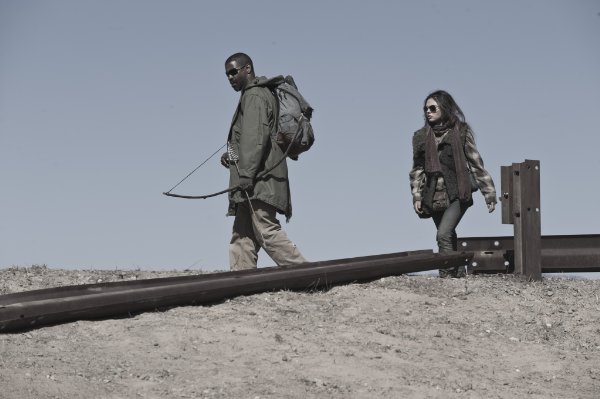
In this post apocalyptic actioner Denzel Washington plays ‘the walker’, who has spent the 31 years since the world as we know it ended (with ‘the flash’) walking across the USA with a mission; to carry the last existing copy of one very important book west, where he believes he will find a place that it can be kept safe and where its power will be used for good. Along the way he comes to a small community of other survivors, presided over by Carnegie (Oldman), who is searching for the book, and plans to use it to rule and control what remains of humanity.

There are two things that the pre-publicity for this movie is attempting to hide. The first is both hugely obvious and so essential to what the film is that I have to disclose it here, the second I will not discuss. So, lets just say it for those who haven’t worked it out; ‘the book’, yes, it’s a bible. The reason I have to mention this is that it is this that lifts The Book of Eli out of the mass of post apocalyptic action films and makes it somewhat of a different beast. You can see it as an allegory, with Washington’s walker as a messiah, touched with the duty of bearing God’s message. You can also read the film as an indictment of organised religion. It’s stated that after ‘the flash’ religion was essentially blamed, and thus all but died out and Oldman (very much in the mould of a televangelist) wants to use the message of the bible to control people and gain profit for himself. This is a pretty vicious message to deliver; especially in a mainstream film that will likely play on over 1000 screens in the USA, but it’s undercut by a respect for the message itself that begins to border on preachy.

Ultimately I think The Book of Eli’s comments on religion, and its sermonising, are an interesting device, and they at least show that some thought has gone into the film at a level significantly deeper than ‘that would be cool’. However, the sledgehammer subtlety of both the satire and the ultimate embracing of Christianity did make me feel like I was being preached at in stereo. Strip away these overtones, and what remains is an entertaining futuristic western, with some really strong action sequences and a handful of decent performances.

Denzel Washington is reliably solid, if not brilliant, as the walker. For the most part his performance is strong, convincing as a man who has been on a lonely mission for more than half his life, and suddenly has to get used to having a friend (Kunis, whose Solara tags along with Washington rather than remain with abusive stepfather Oldman). The surprise is how well Washinton handles the action. He’s not known as a screen fighter, but training from Bruce Lee’s protégé Dan Inosanto has meant that Washington is able to do all of his own fighting. To their credit, the Hughes Brothers allow us to really see the action, often shooting in long takes and allowing us to see Washington from head to toe as he fights. It’s through these choices that it becomes clear how hard Washington has worked on the physical aspect of the film, and how well it has paid off.


Among the supporting cast, Gary Oldman largely reprises his role in Leon, frothing at the mouth and hamming outrageously as Carnegie. He’s not bad exactly; he knows how to do this and make it fun, but it’s not a remotely believable performance and does sometimes feel like it belongs in a different movie from the one Washington is in. Mila Kunis looks beautiful enough, even in unflattering clothes and without make up, to tempt the holiest of men. She gives a perfectly adequate performance, but the film ends at exactly the point that I really became interested in following her character. You have to credit casting director Mindy Marin with imagination, in some of the smaller roles she’s gone for some really unexpected choices, notably surprising cameos from Tom Waits and British character actors Michael Gambon (boasting an atrocious accent) and Frances De La Tour as a heavily armed couple of pensioners.

Allen and Albert Hughes give the film an appropriately washed out style, with dust the recurring motif. The whole world appears to have turned to dust and there are no bright colours left; everyone is clad in blacks and greys and browns. They also create action scenes that entertain and (Michael Bay take note) whose geography is always completely understandable. Most of the action also manages to serve the story, rather than feeling like the result of a script meeting in which someone said ‘we need an explosion’ (Michael, are you listening?) It’s not an especially original looking film, but it’s extremely well made, has some memorable moments (an early fight in silhouette especially) and is engaging to look at without being show offy.

The final twist, sadly, doesn’t work, and actually makes Denzel Washington’s performance seem weaker in retrospect. The Book of Eli is a pretty majorly flawed film in some respects, but it’s perfectly entertaining and it does have something to say (or, in fact, something to shout) and that’s pretty rare in a major Hollywood film.


THE DESCENT PART 2
DIR: Jon Harris
CAST: Shauna MacDonald, Krysten Cummings, Gavan O’Herlihy


When I heard about this film I had two initial thoughts: How? and Why? I now know the answer to the former [Sarah (MacDonald) wakes up in hospital, but soon gets dragged back into the caves with a search party to look for her (very dead) friends]. The latter, however, remains a mystery. If you saw The Descent anywhere but in America you’ll likely share my initial bafflement about the possibility of a sequel, because the whole point of the first film’s ending was that (spoiler alert) EVERYBODY’S FUCKING DEAD. However, in the US, the film ends with Sarah’s escape from the caves and drops the reveal that it’s a dream sequence, thus leaving the film open to exploitation… sorry… continuation.

The thing that was so wonderful about Neil Marshall’s original film was the simplicity of it. 20 minutes to establish some characters, half an hour of white-knuckle claustrophobia and then the capper; half an hour of a good, nastily violent, monster movie. Despite this absolute simplicity the film was involving, because Marshall understands how to set up characters that we’ll sympathise with in short order, and then when they’re trapped we actually care, and that’s what makes things frightening. I’ve seen hundreds of horror films and the thing that unites all the really scary ones, be it Martyrs or The Silence of the Lambs or even Halloween is that I’m invested, that I care about the characters escaping. The Descent Part 2 is not scary. At all.

The screenplay is credited to James McCarthy (his debut), James Watkins (writer/director of crappy asbo slasher Eden Lake) and J. Blakeson (whose The Disappearance of Alice Creed marks him as one to watch, and who will soon be attempting to tipp-ex this out of his resume), and it feels exactly like a film written by committee. There are plenty of people in the film, but none really developed enough to call characters (and that includes Sarah). There’s lots of incident (much of it drawn near verbatim from the original), but little connective tissue. It feels as though each of the three screenwriters has written some scenes featuring the same vaguely defined people and then they’ve been bundled together. There’s only a thin through line and the now mixed gender cast (three boys and three girls) robs this instalment of the interesting casting gimmick of the first.

There are a couple of agreeably nasty scenes (one, where two characters have to cross a chasm using the body of Sam (Myanna Buring) is especially yucky) but none are ever less than predictable. The thudding inevitability really got to me when the grizzled cop (character traits: is a dick, has white goatee) played by Gavan O’Herlihy handcuffed himself to Sarah. As soon as that happened I knew the exact play by play of the next sequence and, shot for shot, was proved right. Most of the violence looks pretty much the same as that in the first film, there’s no evolution either in the look of the crawlers or in the way that Sarah fights them. I had watched the original film the night before seeing this, and the violence really was like déjà vu.


Jon Harris, who edited the first film, makes his directorial bow here, and his work is solidly adequate. That wouldn’t be such a problem except that he’s trying to follow in the footsteps of Neil Marshall, who is a proper filmmaker with a particular and interesting eye. Rather than find his own way Harris apes Marshall’s style, meaning that this film comes off as a low grade photocopy of the original, rather than something cut from the same cloth. In the most irksome moment Harris shows us the single best scare from the first film (the characters see it on the camcorder on which it was recorded), which still made me jump. Then Harris basically repeats that same scare, and it doesn’t get us. That’s the difference between a filmmaker and a shooter.

You won’t catch the cast of The Descent Part 2 acting. Now, when I say that about Jennifer Jason Leigh or Saoirse Ronan it’s a compliment. I’m saying that they disappear into their character so totally that you forget who they really are. That, as you may have guessed, isn’t what I mean right now. When I say you won’t catch anyone acting it’s because there is precious little acting in this movie. Oh lots of people say lines at each other, lots of people pretend to bleed, but there’s never any sense of connection or reality. The Descent followed six girls into a cave. The Descent Part 2 follows six actors on to a soundstage. The saddest thing is the sidelining of Sarah. Not only is she our point of identification (being the only person we’ve seen before) but Shauna MacDonald can act. Unfortunately she has almost nothing to do for the first hour of the film. That said, when she’s allowed to step up to the plate she’s as capable and ferocious a final girl as before.

The cut and paste screenplay results in some moments of egregious stupidity, notably an entirely out of character moment for Sarah and a jaw-droppingly stupid, utterly unmotivated coda. I really wanted to like this film, even an unrequired sequel can turn out to be brilliant (see Before Sunset), but The Descent Part 2 plunges into a cave system, discovering hitherto unplumbed depths of utter redundancy. It’s not without exhilaratingly visceral moments but, while bloodletting can be fun, what’s the point when you don’t give a shit?


UP IN THE AIR
DIR: Jason Reitman
CAST: George Clooney, Anna Kendrick, Vera Farmiga


Up in the Air arrives in UK cinemas feted by US critics and audiences alike. I’ve heard several people say that this film numbers among the best of the 21st century so far. I’d like to share that enthusiasm (if only because its been a while since I saw a great new film), but while I liked Up in the Air, sometimes a great deal, I can’t quite whole heartedly embrace it.

I like George Clooney. I liked him on ER, I liked him in From Dusk ‘til Dawn, I liked him in Michael Clayton, I even liked him in the rather average The Men Who Stare at Goats. Nobody liked him in Batman and Robin, but I digress. Despite the fact I like Clooney, and he’s very good here, I can’t escape the nagging feeling that I’ve seen this performance before. The best actors go away on screen, and whether it’s the sheer bludgeoning force of his celebrity or the fact that this just seems like a George Clooney performance, Clooney never manages that as Ryan Bingham. From the sardonic voiceover to the effortless charm that manages to stay just the right side of oily, it just doesn’t feel new, or specific.

Clooney’s Ryan Bingham is loaned out by his employers to other employers who want someone else to fire their staff for them, a job that sees him on the road 322 days of the year (“which means I spent 43 miserable days at home”). Then along comes a young hotshot (Kendrick) with the idea that they can do their ‘transition counselling’ over the internet via video conferencing. It’s when Bingham has to take this young colleague; Natalie on the road with him that Up in the Air really, well, takes off. This story does lend itself to an episodic structure, but to its credit the screenplay by Sheldon Turner and director Reitman does manage to find a couple of through lines in Bingham’s relationships with Natalie and with his on the road lover Alex (Farmiga).

The two female stars of Up in the Air are hogging the awards attention; both were nominated for Golden Globes and today both have been nominated for BAFTAs. Its not undeserved attention. Vera Farmiga is a sensational actress; she’s been toiling away in supporting roles for about a decade, getting her first real notice for her appearance in Martin Scorsese’s The Departed. I’ve said before that her dedication to her roles and her ability to be just about anything and look just as the part demands (a gorgeous woman, she’s dressed down effectively several times) reminds me of Jennifer Jason Leigh. Alex isn’t her best role, actually she’s a little bit of a sketch (handily self summarised when she says to Bingham “think of me as you, but with a vagina”) but Farmiga gives her character and life that almost certainly weren’t on the page. It’s not her most award worthy performance, not by a long shot, but the fact the mainstream is noticing Farmiga at last is a great thing.

The real star of this film, for my money, is Anna Kendrick. Like Farmiga she’s been quietly building a career in indies (Rocket Science) and supporting roles (she’s the one thing in the Twilight films that quiets my urge to destroy the screen). Up in the Air is what she must have been waiting for, it’s a brilliant role, perfectly suited to her and she just eats it up. Kendrick’s Natalie Keener is a brilliant, if rather brittle, 23 year old who seems to be becoming a mover and shaker in the business of firing people in very short order. This initial take on the character is beautifully played and rather funny, but it’s when that façade begins to slip that Kendrick excels. The cracks of emotion as she warms to Bingham, the empathy she can’t quite repress as she does her job, these things help to humanise Natalie, but it’s when the floodgates open that Kendrick earns her near inevitable Oscar nomination. When Natalie breaks up with her boyfriend it initiates the best sequence of the film; an endlessly funny fifteen minutes of total brilliance for both Kendrick and the movie as a whole, it’s the highlight of a beautifully judged performance.

The frustration of Up in the Air is that it sometimes just runs off the rails, becoming sentimental despite its main character’s lack of sentiment. At one point the story takes a major detour for Bingham to attend his Sister’s (Melanie Lynskey; good, and underused as ever) wedding. This whole sequence feels as though you’ve nodded off and woken up in a different (cliché laden) film, and though it does end rather less than conventionally (and yet, utterly unsurprisingly) the film does indulge, in a way that seems entirely out of character for Bingham, in one of those grand romantic gestures that features in every rom-com you’ve ever seen.

This is a film that has moments of greatness, but as a whole isn’t great. I was entertained by it, I laughed a good few times and I saw one genuinely fantastic performance. I think the real problem is that it’s just not all its been built up to be. Most of the time this is an amiable, enjoyable film. It’s got a refreshing intelligence and wit and is amusing without resorting to vulgarity, but there are times when it just sits there, rather like a man waiting for a plane, just marking time before the next spark of inspiration, the next brilliant bit. Uneven then, but worth driving, if not flying, to see.

Wednesday, January 20, 2010

A new crush

Well, not that new actually. Every time I've seen Anna Kendrick, since seeing her in her first big role in Rocket Science, I've found her rather beguiling. She's not a Barbie doll, rather she's got a down to earth prettiness and that, combined with her obvious intelligence, talent and humour, has me rather smitten, especially after today's screening of Up in the Air.

Free image hosting powered by PostImage.org Free image hosting powered by PostImage.org Free image hosting powered by PostImage.org Free image hosting powered by PostImage.org

You're welcome.

Tuesday, January 19, 2010

They Made Tom Watch... 2

My younger brother Tom is a projectionist at a multiplex, and part of his job is to screen new films before release, to check the prints. He also has to write a report on each film for the staff. So, each Tuesday, we're going to share with you his thoughts on what

They Made Tom Watch
This week...


Genre: British Gangster

What’s it about?
Given that I only really understood about 10% of the dialogue, I’m not entirely sure. I think someone owed someone else some money, and for some reason, was not allowed a reasonable payment plan, nor ever offered any interest rate. So he has to get it. Oh, and some other people don’t like him. I think. Or they liked him a lot, and had a funny way of showing it.

What did I think of it?
Yo yo… I’ll make this review into a dope rap hit,
What do I have to say about this movie? It was shit.
I can’t understand any of the dialogue,
Most of the acting is wooden as a log,
Of all the things wrong with this there is a catalogue,
I’d rather sit for 2 hours on the bog.
So, to wrap it up in a nutshell,
Sitting through this film was utter hell.

I just don’t get it! I don’t understand what there is to like about this film. Our ‘hero’ is a complete twat, utterly unsympathetic, and what he does is annoying, illegal and reprehensible! For me, this isn’t the makings of a gripping or fun time. But maybe I’m just getting old.

Who is it for?
Chavs, wannabe gangsters, scary drug-dealing types.

What is it like?
The criminal side of The Wire, but devoid of any talent in any facet of it.

Good Stuff: My review. Yo.

Bad Stuff: Once again, all of it. Why are there so many bad films? Who lets people make them? Who goes to see them? I DON’T UNDERSTAND!

Monday, January 18, 2010

The Week in Movies 3

11 - 17/01/2010


The Leader, His Driver, and the Driver’s Wife
DIR: Nick Broomfield

The first of a pair of films (the second is His Big White Self) that Nick Broomfield made about Eugène Terre'Blanche, the leader of South Africa’s white supremacist party the AWB. This film is set in the final days of apartheid, and there is a sense of the AWB becoming more radical as the country moves further away from their repugnant position. Broomfield captures much racist ugliness, and the smiling faces behind which it hides. Unfortunately he doesn’t really probe, or ask challenging questions. Much of the film is taken up with repeated attempts to get an interview with Terre'Blanche, and when he finally obtains it Broomfield is five minutes late, which results in much of the interview being Broomfield apologising for his tardiness.

The Leader… is an ugly film about awful people. There are fascinating things here, particularly given the time at which the film was made, but Broomfield never probes deeply enough to get the best out of his subject.


By the People: The Election of Barack Obama
DIR: Amy Rice / Alicia Sams


This documentary gains impressive access to Barack Obama during both the Primary and Presidential campaigns. The primaries take up the great bulk of the running time, and make for a fascinating watch. Rice and Sams focus less on the candidate than they do those surrounding him, capturing everyone from the most lowly staffer (one lovely scene has a nine year old boy making calls on behalf of the campaign) to the campaign managers. The camera zeros in on moments of elation and of near despair, and chronicles the campaign in riveting detail.

There are a couple of issues. The first is the clear partisan nature of the film, there’s nothing negative here at all (which isn’t to say that there aren’t moments the campaign isn’t going brilliantly, just that they are all presented with a partisan gloss). This isn’t to say that the filmmakers should have done a hatchet job on the campaign, but a slightly more questioning nature would be a plus. There is also a tendency for the film to spread itself a little thin, we meet a lot of people, but there isn’t quite enough time to give all of them enough screentime to fully tell their stories (how, for example, does a 9 year old end up manning phones for the Obama campaign?) By the People is surely only the first film to explore the election of America’s first black president, and it’s a good start, but it certainly leaves room for other filmmakers to tell this story in the future.


Kiss of Death [‘95]
DIR: Barbet Schroeder

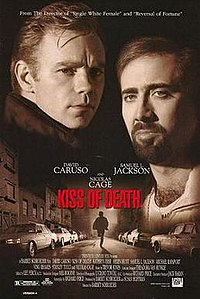
I haven’t yet seen the original (yes, I know), but I’ve got a soft spot for this remake of the apparently classic noir. David Caruso (best known for taking off and putting on sunglasses in one of the CSI shows) actually gives a decent performance as the ex-con trying to get his family out of the criminal life by turning informant and serving up crime boss Little Junior (Nicolas Cage, bulked up, goateed, and chewing up and spitting out all available scenery in a deliriously nutty turn) for the cops.

Schroeder handles the direction well, keeping things low key visually; a smart choice given that the screenplay and performances (Stanley Tucci’s DA comes to mind) can be rather overblown and in amongst the silliness there are a couple of strong pieces of acting. Kiss of Death is lucky enough to have an on the rise Samuel L Jackson in its cast, and though his role (as a cop injured busting Caruso, and now assigned to him) is thin he makes the best of it. Then there’s Kathryn Erbe, a fine actress who really ought to be much better known than she is. She’s excellent as Caruso’s young wife, again making the best of a nothing of a part.

Kiss of Death is by no means a great film, but it’s an enjoyable, if slightly silly, entertainment, and sometimes that’s all you need.


The Ladykillers [‘55]
DIR: Alexander Mackendrick


Well, it certainly makes the Coen Brothers 2004 remake look even worse than it already did, but for me this Ealing comedy still ranks as a bit of a disappointment.

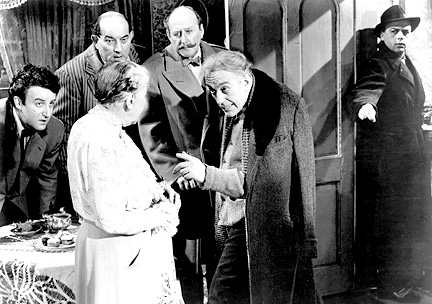
That’s not to say that it isn’t funny, there are some wonderful scenes of farce as the criminal gang led by Alec Guinness are repeatedly interrupted during their planning by the well meaning little old lady (Katie Johnson) in whose house Guinness is lodging. The scene when the gang first arrive is priceless, as is an extended piece in which the gang has to attempt to recapture one of her pet birds.

The problem is that the film leans rather hard on this one note, and after a while it begins to grow less funny due to overfamiliarity. The performances, especially those of Guinness and Johnson, are excellent, and I laughed a lot in the first half hour or so, and at a scene in which all of Johnson’s friends come for tea, but The Ladykillers isn’t quite the classic I’d been led to expect.


Mystery of the Wax Museum
DIR: Michael Curtiz


This is the first version of a story most famously told in the Vincent Price film House of Wax (itself since remade). Viewed now, Mystery of the Wax Museum clunks horribly in parts (especially the awful scenes with Glenda Farrell as a fast talking reporter), but it’s also extremely entertaining in parts and historically interesting. This is an early colour film, made in the two strip Technicolor process. The colours aren’t always particularly realistic, but that actually aids the film, giving it an eerie air of unreality, and making the ‘wax’ figures work rather well.

Lionel Atwill gives a hugely overblown, but enjoyable, performance as the artist driven mad after his creations are destroyed by an unscrupulous business partner (in an excellent opening scene) while Fay Wray makes for a decent scream queen, and is more radiant than ever thanks to the colour. Perhaps the most famous image in the film, and the creepiest, is seen when Wray accidentally smashes Atwill’s wax face, revealing the scars beneath. It must have been a hell of a shock in 1933, and it still works now. Even at just 74 minutes this film can feel very slow, but it’s fascinating just to look at if you’re interested in film history, and boasts some great sequences.


Batman
DIR: Tim Burton


In the wake of Christopher Nolan’s (outrageously overpraised) take on the character Tim Burton’s Batman films have come in for a lot of stick. Batman is by no means a perfect film, but I’ll take it over Nolan’s films any day. Burton brings the darkness that was an important part of Bob Kane’s Batman, throwing out much of the camp of the TV show in favour of a colour palette dealing mainly in varying shades of black, and an attempt to treat the characters and especially the duality of Batman and Bruce Wayne with a degree of seriousness.

Where he scores over Nolan is that Burton never forgets that he’s making a superhero movie, he never forgets to make the film fun. Jack Nicholson has an absolute ball as The Joker, enjoying the mischief of the character in a hammy, but entertaining, performance. The costumes and props are appropriately outlandish and silly, but the design of the film is brilliant; sleek, gothic and beautiful in all aspects from Gotham itself right down to the Batsuit. Michael Keaton remains, for me, the definitive Batman and Bruce Wayne. He’s sidelined quite a bit, but manages to give both characters some psychological depth and make both sides of this person interesting.

There are problems; the plot is a mess, Batman is sidelined, the suit is clearly constricting, meaning that action scenes can lack a little punch, Prince is brilliant, but his songs are just out of place in this film, and Kim Basinger, though pretty, makes for a wooden love interest. It’s no masterpiece, but Batman is a better film than it’s been credited as lately.


Outrage
DIR: Kirby Dick

Kirby Dick’s (This Film is Not Yet Rated) latest takes to task gay politicians who vote against gay rights legislation, calling them out as hypocrites. That’s fine to a point, but I think how much you end up liking this film will be more about how you feel about its methods than its content.

During the film Dick ‘outs’ several politicians he believes to be gay, some times on quite flimsy evidence. I felt rather uncomfortable with this, because someone’s sexuality is, I feel, their business, and coming out should be a personal decision. The thing is that, politically, I don’t really care whether someone voting to ensure that gay people can’t marry is gay him or herself, because it’s no less wrong if they are straight.

I agree with the thesis of Outrage; gay people in politics should be able to feel comfortable to come out, and they should feel comfortable to vote for gay rights. However, I’m not so on board with the way Dick goes about making this argument, and thus I can’t really recommend the film.


Horsemen
DIR: Jonas Akerlund


Music video director Akerlund’s serial killer thriller starts out stupid, and proceeds downhill from there. A miscast Dennis Quaid plays a homicide detective investigating some grisly murders, which seem to be linked to the passage in Revelation telling of the four horsemen of the apocalypse.

The film never establishes any identity for itself whatsoever; instead it is merely a gory riff on The Silence of the Lambs and Se7en, with a shade of Saw thrown in, as a way of throwing a bone to the gorehounds in the audience. Horsemen is relentlessly generic, with every scene seeming a shadow of a better one in an infinitely superior movie. Akerlund largely hangs back, seeming disengaged by the material, and the final twist is at once terminally stupid and hugely obvious.

There are two distractions while watching Horsemen. First, wondering how material this bad attracted a cast this good (Quaid, Zhang Ziyi, Lou Taylor Pucci, Patrick Fugit, Peter Stormare, Eric Balfour) and second, Zhang Ziyi, yes she’s a touch old to play 18 and yes, her talent is buried under her halting English, but dear God she’s beautiful, those eyes. Really though, the fact that the best thing about this film is gazing into Zhang Ziyi’s eyes doesn’t speak well of it.


Anne Frank Remembered
DIR: Jon Blair

This very sad, but authoritative, documentary about Anne Frank tells the well known story of her hiding, but where Jon Blair’s film excels is in the telling of what happened afterwards. Anne’s diary ends days before she was taken from her hiding place, ultimately to die in Bergen-Belsen at just 15. What’s so fascinating, and so horrific, about this film is that it provides a series of revelations, showing just how close Anne came to surviving the war (she died of typhus barely a week before Bergen-Belsen was liberated).

The film really hammers home the sense that you get from her diary, the here we lost a remarkable young woman who would have given much to the world. Like all documentaries about the holocaust, Anne Frank Remembered lives in the shadow of the monumental Shoah, but this is likely to remain the definitive film telling of this one very sad story.


Batman Returns
DIR: Tim Burton


Tim Burton’s Batman sequel is a great example of what happens when a filmmaker with a particular vision is allowed to do pretty much what he likes, on a grand scale. It’s a little messy, a little unfocused at times, but Batman Returns makes up in verve and in fun what it lacks in polish. For me the problem is that the story tips the balance towards Danny DeVito’s Penguin, rather than Michelle Pfeiffer’s more complex, more interesting and considerably better acted (and, let’s be fair now, sexier) Catwoman.

The look of the film is darker, and even more demented, than that of Batman and the blackly comic tone adopted by Burton is highly entertaining (as is Christopher Walken’s typically off the wall performance as Max Shreck; a sort of evil Bruce Wayne. Daniel Waters’ screenplay cleverly puts Catwoman and Batman together; two people who are going through many of the same things, but have ended up at cross purposes. It’s an interesting relationship, well played by both Pfeiffer and Keaton, and I wish they’d been allowed to explore it a little further.

There are moments (mostly with Penguin) that are just a little too silly, and the film is overcrowded with characters, but Batman Returns is a great entertainment, and a pretty smart one into the bargain.

Friday, January 15, 2010

Cinematters: Qualified?

Over the last few weeks I’ve had some correspondence to the site, both via the email address and in comments, asking for my qualifications as a critic. I thought that it might be an idea to address the issue via a cinematters. So here I’m going to try and give you a picture of how I got here and I’ll also try and consider whether qualifications should be required to be a critic, and if so, what they are.

First off, here’s the email that prompted this discussion (I’ve not changed one character of this, besides to remove the correspondent’s name)
Sam,
I have to say 24 frames a second, never before have I read such utter nonsense.
Are you a frustrated actor perchance?
A frustrated director?
A frustrated writer?
A frustrated pundit?
What exactly are your credentials?

Vaguely amused
[sender]

I sent a brief reply, but perhaps I should expand on what I said. So, here are what I would consider my formative experiences and ‘my credentials’ as a film critic.

One of my earliest memories is film based. I’m four (so this is 1985, fact fans) and I am sitting inches from our tiny TV, trying to watch what must be a relatively early airing of the first Star Wars. It was about this time, and because I wouldn’t sit back from Star Wars, that we realised I was going to need glasses.

Skip forward four years. I’m almost eight and on a trip with my Cub Scout group, we’re at the Angel Centre cinema watching Indiana Jones and the Last Crusade, and I’m almost under my seat because on screen the villain’s face is decaying before my shocked eyes. That was it; that was the moment that I was sold on cinema, the moment that it became clear to me that this was incredibly exciting way to tell stories. On the ferry to Holland later that year Indiana Jones and the Last Crusade is playing at the small screening room on board. My Mother and Brother are both seasick, but between tending to them I see the film at least three more times, sneaking in whenever I can, not caring which parts I see.

Another three years pass. I’ve just turned eleven, and I’ve just had two liver transplants. In my isolation room at the hospital there is a VCR and a TV (which my school has paid for, as well as another set for the adjacent cubicle). To keep me occupied my Mother has joined the video shop down the road from the hospital. I’m soon watching films all day every day, and run out the shop’s suitable stock in a matter of weeks. Thereafter I start asking nurses and doctors to bring me movies from home.

Since then I’ve never looked back and my interest and taste in movies has never stopped evolving. I decided early on that whatever I did with my life I wanted movies to be a central part of it. I started out, like most teenage movie fans, wanting to make movies. Thing is (as you can probably tell from the incredibly basic design of this website) I’m not an artist, and though I enjoyed acting I was never especially good at it (that said, Kristen Stewart has a career). I was the resident movie buff at secondary school, and friends would always ask me what they should be going to see at the cinema, or for recommendations for home viewing (every time I went to a friend’s house it would be with a bag full of video tapes). Just over ten years ago this led me to start writing a little email newsletter (pretty much what The Week in Movies is now, but with grades and MUCH shorter) to send out to a few friends.

That newsletter didn’t last long but it, along with my discovery of something on the internet called ‘a forum’ (my first was Cinephiles, where I posted as Yosemite Sam for about a year), really gave me a taste for writing about movies, rather than trying to write movies. At college, doing a media qualification, one of my early assignments was to build a website and, clearly, there was only ever one subject it was going to be about. Thus was Movie Reviews by Sam Inglis (oh, the boundless imagination) born. The site looked like shit, and was built with almost no technical knowledge and the use of MSFrontpage, but the writing was good and I kept the site going until I ran out of space to host it (it was on Geocities, which also means that it is now gone). Here’s a sample review from that site: The War Zone. After that my writing about movies was largely confined to the Joblo.com forums, where I’ve been posting as SAI (my initials, not Elektra’s forked weapons) for over eight years now.

While at college I was also expanding my cinematic horizons, decimating the foreign language section at my local video shop, renting an average of one film a night and, thanks to my course, starting to analyse movies on a deeper level than before. We went to two film festivals and at each I saw more movies than anyone else on the trip (sixteen in a six day trip to the Venice film Festival in 2001, including a day when I saw five, starting with a 9am screening that I walked to in shoes still wet from the previous night’s rain and concluding with a midnight movie). It’s this kind of pursuit of cinema, this excitement about it, that has led me to the point I’m at now, having seen something like 7000 different films and still always setting myself goals as to what I want to see, what I want to discover, next.

So that’s how it started, what about my ‘credentials’. Well, if you want to talk formal qualifications I’ve got an AVCE in Media and Communication and last year I went back to college, in preparation to take up a degree course. I did a Film Studies A Level, a two year course, in a year and came out with not just an A but one of the highest marks in the country. In September I’m taking up a place at the University of the West of England for a Film Studies degree, with a view to teaching in the future. That’s all well and good, and it certainly serves me well, but you know something? When it comes to a qualification for writing this site, that’s all crap.

Here are all the qualifications I think a critic really needs:
1: A wide interest in and experience of film
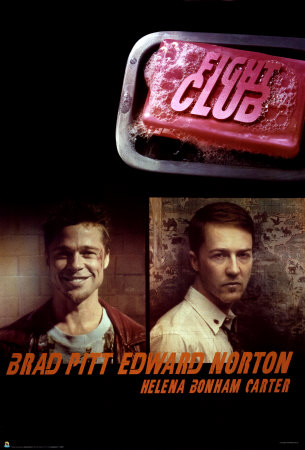
You’ve got to LOVE it, that’s the bottom line, and if you don’t love it don’t type word one. Loving it isn’t quite enough on its own though, you’ve got to have some knowledge and understanding, and that really ought to go back further than to Fight Club (which I recently saw described as ‘a really old movie’, which made me feel positively decrepit… at 27). You don’t have to be an encyclopedia - God knows I’m not, I learn new things about movies every day, and that’s what excites me about them - but if you don’t at least know a little about silent cinema, about the studio system, if you’ve never seen a foreign film, if you only watch modern studio films… Well, if that’s the case I’m not going to say you can’t be a critic, but you certainly won’t be one whose opinion means anything to me.


2: An honest, coherently expressed, opinion
My writing isn’t perfect. It’s the result of one guy whose grammar is a little shaky writing thousands upon thousands of words of site content himself with only the help of MSWord’s spelling and grammar checker. What I feel I do always deliver though is an honest and readable opinion; a properly structured argument, backed up with examples from both the film under review and frequently from other films as well. I don’t care if you think I’m right or wrong (though clearly I like people to agree with me), I’ll make my case and the rest, really, is up to you. Aside from a couple of reviews that I’ve not been happy with (we all have our off days) I think I’ve always presented a coherent film focused argument, and that, and no more, is what I believe the job of a critic to be.

I can sit here all day and rattle off what I see as my qualifications; 20 years of being obsessed with films, 10 years writing about films for an audience, 7000 films seen (including films from 30 or more different foreign countries), formal qualifications in media and film studies, but if you don’t like the site (as the correspondents who prompted this article clearly don’t) what does it matter? If you don’t like my style, which can be, I’ll admit, very upfront and even confrontational, well that won’t do wonders for my traffic to the site, but really, I’d rather you read a critic you do enjoy. Enough people seem to like my stuff, so don’t worry about me.