Wednesday, January 13, 2010

Review Post 60: Daybreakers / Exam / The Road

DAYBREAKERS
DIR: The Spierig Brothers
CAST: Ethan Hawke, Willem Dafoe,
Claudia Karvan, Sam Neill


Daybreakers has, it must be said, a rather cool premise; most of the world’s population have become vampires, so many in fact that there are now too few humans to provide enough blood for them to live on. At a leading blood bank Edward Dalton (Hawke) is working on a blood substitute, while outside the vampire army attempts to round up both the last humans and the creatures that vampires have become after being deprived of blood.

For a little while it seems that Daybreakers is going to be interesting, a real twist on the vampire genre, with Edward fighting to find his blood substitute and save his race and us the audience rooting for a set of characters who are usually the villains. Sadly writer/director brothers Michael and Peter Spierig abandon this potentially interesting idea early on, in favour of a rather formulaic (to say nothing of illogical, but we’ll get to that) story about Edward teaming up with a group of humans (including Dafoe and Karvan) to find a cure for vampirism.

On the plus side, though its familiar, ‘borrowing’ from the Blade series and The Matrix films in particular, the film looks pretty good. The action is intelligibly executed, the cinematography and production design are polished and there are some nice ideas here (like the subway coffee stand serving lattes with blood). The CGI is often obvious, but the Spierigs (who also did some of the digital work here) do an acceptable job on what can’t have been a large budget.

Some of the performances are also pretty solid. You have to look hard to find a bad performance on Sam Neill’s resume (a bad film, well, that’s another matter) and he has a good time here chewing both scenery and the occasional neck as a vampiric CEO. It’s not great dramatic work by any means, but it is entertaining. The same can be said of Willem Dafoe, whose character is the key to the potential cure, there is little asked of him as an actor, but he’s clearly enjoying himself and that does sometimes translate to the audience.

Of course, this is the very definition of damning a film with faint praise, and sadly that’s all that Daybreakers warrants. The Spierig brothers may be technically efficient filmmakers, but they never stamp any real identity on this film. I can see Guillermo Del Toro in it (the subsiders), I can see Andrew Niccol (whose Gattaca, also starring Ethan Hawke, is ripped off on a huge scale), I can see the Wachowski brothers (the very Matrix like human blood farm), but I can’t see anything that seems unique to the Spierig brothers.

Though Sam Neill and Willem Dafoe are pretty good, there is a huge amount of terrible acting on display here. Ethan Hawke, who can be excellent and is generally underrated as an actor, is absolutely dreadful, appearing almost catatonic and delivering his lines in a bored monotone that says ‘can I have the money, so I can get back to working with Richard Linklater now?’ Up and coming aussie Isabel Lucas proves that it wasn’t simply Michael Bay’s monumental shittiness as a filmmaker that made her come off as a talentless husk in Transformers: Revenge of the Fallen, with a performance so wooden that you could fashion it into a whole bag of stakes and kill vampires with it and Claudia Karvan, beautiful distraction though she is, adds little and struggles with her American accent.

The biggest problem is the screenplay. First of all, the goal makes little sense. In beginning to cure vampirism all that the ‘heroes’ really achieve is a LOT of death, and all they’ll really succeed in doing is creating a larger human population for vampires to live on. Good plan. Secondly, the way the cure comes about makes absolutely no sense, either in vampire lore or in the context of this film. But this pales in comparison to the major issue. This film is all middle. It is hard to become invested in a story that really has no beginning (we never find out anything about the epidemic of vampirism, or even really about this movie’s form of vampirism), or to care when the credits roll on a film without an ending (things are deliberately left open for, one assumes, a sequel we will never see). So there it sits; a marooned second act in a not especially interesting story. It’s not awful, but it certainly isn’t any good either.


EXAM
DIR: Stuart Hazeldine
CAST: Luke Mably, Jimi Mistry, Chukwudi Iwuji,
Adar Beck, Nathalie Cox, Pollyanna McIntosh


With a debut film a lot of filmmakers set themselves limitations, so that it is easier to finance their screenplays and to realise them on film. A lot of new talent seems to take its first bow with a single room thriller, and so has British writer/director Stuart Hazeldine. Exam sees eight people; four men, four women sit down for a test, the last step in a long recruitment process for a job they all desperately want. They are told that they have eighty minutes to find the answer to the one question before them, but when they turn over their exam papers they are blank.

This is an intriguing mystery to begin a film with, but the intrigue soon becomes played out as the group try everything they can to find the question to no avail. This part of the film is almost episodic; try this for five minutes, argue for five minutes, try the next thing for five minutes. It feels a little like screenwriting via a join the dots book. After about an hour of this Hazeldine seems to worry that the audience will be getting fidgety, so from nowhere he decides that Exam needs both a torture scene and an action sequence. Both feel entirely out of place, and grafted on to sate either a producer or an audience.

Even apart from this rather plodding structure there are greater problems with the script. Most pressing is that it simply rings false. This is especially felt in the way the film ekes out its backstory. Everything is kept deliberately vague, to little purpose. Everybody speaks in pronouns “The company”, “The CEO”, “The virus”. Exam is set ‘soon’, apparently in a future where nothing has a name. It’s weird, distracting, theatrical and distancing. It’s also silly, because there’s nothing very interesting hiding behind the conceit.

In fact the whole of this film feels like theatre. The largely unknown cast is stuck with pretty poor dialogue, but they all deliver it in a forced, deliberate tone that suggests they are talking to an audience rather than to one another. This theatrical feel isn’t helped by the single, rather drab, set on which the entire film takes place. Hazeldine tries to introduce some variety with the lighting, but the film looks rather boring. If it’s not theatre then Exam is a short film. There’s enough material here for a brilliant, suspenseful, 20 minute short, but Hazeldine has elected to show the test in real time, and that leaves him desperate for incident and stretching every scene.

The best thing that can be said about Exam is perhaps that you’ll kick yourself when the question, and its answer, are finally revealed, but I never felt that finding out was worth the 90 minutes I’d invested in the movie.


THE ROAD
DIR: John Hillcoat
CAST: Viggo Mortensen, Kodi Smit-McPhee,
Charlize Theron, Robert Duvall


The Road is unquestionably a beautiful thing to behold. Its images of a devastated and dying world, a world drenched in dust and ash, a world almost devoid of life; human or animal, are genuinely stunning. However, though the film constantly strives to make an emotional connection with us I only felt one in a couple of isolated scenes and found myself largely unengaged by the long second act which comprised almost the entire story.

I don’t know quite how to explain my reaction to this film, because there is very little obviously wrong with it. As well as looking stunning it features two excellent central performances from Viggo Mortensen and debuting youngster Kodi Smit-McPhee. Mortensen, behind straggly hair and a messy, bear like, beard is excellent as man trying desperately to spend his last days finding something, somewhere, which will allow his young son (Smit-McPhee) just a tiny glimmer of hope for a future. There is determination in Mortensen’s voice and physicality, but behind his eyes we can see the sadness for what he’s lost and has yet to lose. It’s a layered and subtle piece of work. Kodi Smit-McPhee is also outstanding, and the two scenes in which the film really got me, really connected with me both focus on the Boy at his most emotional. One especially, when the Man holds a gun to the Boy’s head, trying to find the strength to fire, is almost unbearably raw, because both performances are so real.

I’m not sure what it is with Viggo Mortensen and films about walking. In The Lord of the Rings he spent 9 hours (12 in the extended versions) making sure Elijah Wood could walk to a mountain, and now here he is walking to the sea. Like Lord of the Rings, this film has an episodic structure, which sees Man and Boy going from place to place and person to person. The problem here is that there is an avoidance of incident. On occasion (as in a tense scene when Man and Boy have to hide from ‘bad guys’ in a house they thought was abandoned) this leads to some thrilling sequences, but more frequently I simply found it frustrating that there wasn’t really much happening, in fact I found myself almost nodding off at times.

While Mortensen and Smit-McPhee are excellent none of the few other actors in the film come up to their level, to be fair that’s probably because their characters simply aren’t fleshed out, because actors like Robert Duvall, Charlize Theron and Michael K Williams are capable of a great deal more than the rather flat, thin work that they do here. Talking of flat, the only real flaw in Mortensen’s performance is the voiceover, which is delivered with little of the weight of his dialogue, as if he has very little enthusiasm for it. I can see why he might be unexcited by it though, as, like the flashbacks with Theron’s character, the voiceover is almost totally redundant.

Despite a couple of brilliant scenes (the aforementioned bathroom scene, and a heartbreaking scene on the beach towards the end of the film) I found myself unengaged by The Road, and really feeling its length (which, for a sub two hour film, really ought not be the case). I can accept that it may just have caught me on the wrong day or in the wrong mood, because there are a lot of strong parts here, but for me, at least this time, they never added up to a whole that connected with me. Overall this was, for me, an aesthetically impressive film, but a curiously distancing and slightly dull experience.

Tuesday, January 12, 2010

They Made Tom Watch...

Tom is my little brother (he's 24 and a shade over 6 foot tall, but he's my little brother). He works as a projectionist at a London cinema, and part of his job is to check the prints of new films before they screen to the public. After this he's asked to write a short review for the information of the staff.

When he sent me a few samples of these thoughts I laughed like a drain, so each week we're going to tell you what THEY MADE TOM WATCH

This week


What’s it about?
The improbably ugly Sarah Jessica Parker and Hugh Grant’s relationship is on the rocks (probably because she looks like a horse, and he’s not hideously unattractive). Then they witness a murder, and see the murderer’s face. Then Sergeant Carver from The Wire turns up in a really terribly awful turn. Then these two city slickers go off to the countryside and enjoy some fish-out-of-water comedy.

What did I think of it?
This film, in its unalterable dullness, has left my mind blank. It’s not so bad that I can tear it a new hole, nor is it any good. It is utterly without merit. It almost defies metaphor.
I said almost. It’s like porridge, or Weetabix, but without that vital injection of sugar or jam you lump on yourself [really it’s more like porridge, because at least Weetabix has the advantage of excellent portion control, which really is a boon. You see I have a portion control issue when it comes to breakfast (and most other meals for that matter) where I dramatically overpour vast amounts of cereal into my bowl, so that breakfast costs me £1.50 a morning, whereas Weetabix allowed me to take 2 a day (3 if my girlfriend wasn’t watching) and know I wasn’t ripping myself off. Which was nice.] And so you munch through the uninspiring mulch, knowing that it contains just the right amount of nutrition to keep you ticking over, but never offering any sort of taste explosion in the vein of Jordan’s Country Crisp [my new cereal of choice. To be enjoyed in a 1:2 mix with Bran Flakes (because she’s mental for bran) so that it reaches the level of an acceptably undisgustingly-sugary breakfast]

It must also be said that SJP is really, very ugly.


Who is it For?
Vapid couples so lost in their relationship they want a break from the awkward silence of their lives.

What is it like?
The Proposal.

Good Stuff
It isn’t shit.

Bad Stuff
Nor is it any good.
SJP’s horse-face.

Monday, January 11, 2010

The Week in Movies 2

04 - 10/01/2010

Dead Men Don’t Wear Plaid
Dir: Carl Reiner

Once upon a time, Steve Martin was funny. No, really. I wonder sometimes if it was just a dream, but he really was hilariously funny once. Dead Men Don’t Wear Plaid (what a great title, by the way) is a brilliant noir spoof that, pre- CGI, has Martin playing against clips from classics of the genre, allowing him to interact with Humprey Bogart, Barbara Stanwyck, Ava Gardner, Veronica Lake, Lana Turner and many more. The plot is gloriously silly, but appropriately twisty, with a McGuffin (the Carlotta lists) that could easily have worked in a straight noir, but it’s the parodic dialogue that is most fun. Martin’s narration is a constant joy, with lines like: “I hadn't seen a body put together like that since I solved the case of the Murdered Girl with the Big Tits." and “Carlotta was the kind of town where they spell trouble T-R-U-B-I-L, and if you try to correct them, they kill you."

Carl Reiner’s direction is clever; he and cinematographer Michael Chapman ape the noir style beautifully, and manage to integrate Martin into the clips brilliantly (remember this is long before the CGI tricks of Forrest Gump). Te performances are also great, with Martin brilliantly straight-faced amid the silliness and a wonderfully game Rachel Ward, perfectly cast as the femme fatale (she’d have fit right in with Gardner or Lake in the 40’s). This is perhaps a film most rewarding for film buffs, but even if you haven’t seen the movies it uses clips from, Dead Men Don’t Wear Plaid is still an hilarious comedy.


A Kiss Before Dying [‘56]
Dir: Gerd Oswald

Noir just seems a bit odd in colour, particularly the pastel shades and bright sunshine that much of this Ira Levin adaptation takes place in. The idea is pretty good; when Bud Corliss (Robert Wagner) discovers that this girlfriend Dorothy (Joanne Woodward), who he has been wooing purely for her father’s fortune is pregnant, and likely to be disinherited, he kills her. The death is ruled a suicide, but Dorothy’s sister Ellen (Virginia Leith) begins to suspect foul play, and the evidence starts to point to her new boyfriend; Bud Corliss.

The problem with A Kiss Before Dying is that, after an excellent, exceedingly creepy, first half hour, the film downshifts a gear. The acting isn’t great, with Robert Wagner especially wooden, and the beautiful Leith matching his style, the storytelling is predictable, making the film feel long. The look of the film just doesn’t work, it feels as though it is at cross purposes with the noirish feel of the story. A disappointment.


Overnight
Dir: Tony Montana / Mark Brian Smith
Reviewed in my Top 5 Making of documentaries


Ball of Fire
Dir: Howard Hawks


I’m loath to employ such a huge cliché, but they really don’t make ‘em like this any more. That’s largely because the screwball comedy is an all but dead genre. This wonderful example, by the versatile director Hoawrd Hawks (who also made the greatest of all screwball comedies with Bringing Up Baby), has Barbara Stanwyck as a showgirl who has to hide from the Police. Fortunately she’s been invited to be part of English professor Gary Cooper’s study of slang. Stanwyck ends up staying with a whole group of professors; a cat set among the pigeons. The stuffy Cooper, of course, falls in love with her, much to the chagrin of her mobbed up fiancé Dana Andrews.

Reviewing comedy is hard, there’s little middle ground; it’s either funny or it isn’t, well, Ball of Fire is, minute for minute, one of the funniest films I’ve ever seen. Stanwyck and Cooper clearly like one another (they also made Meet John Doe together in 1941), they spark wonderfully off one another, delivering their rapid fire dialogue crisply, every punchline (which sometimes seems like every second line) hits the bullseye, and their romantic chemistry is fantastic too. Of course, Cooper would have had be a eunuch to fail to have chemistry with Stanwyck, who has never been sexier than in this film.

The other seven professors are based on Disney’s seven dwarves. It’s not all that obvious in the film, but sreenwriters Billy Wilder and Charles Brakett give all of them a lot of very funny business, ensuring that no scene passes by without at least one belly laugh. The look of the film is functional rather than spectacular, but Hawks carries off the mayhem beautifully and Gregg Toland never shot an ugly film. Also worth mentioning is the costuming, largely for Stanwyck’s dazzling appearance in a hays office baiting Edith Head creation in her opening scenes.

Unusually for a romantic comedy, Ball of Fire is both romantic and fall on the floor funny, the fact that it isn’t on UK DVD is a terrible crime.


Indiana Jones and the Kingdom of the Crystal Skull
Dir: Steven Spielberg


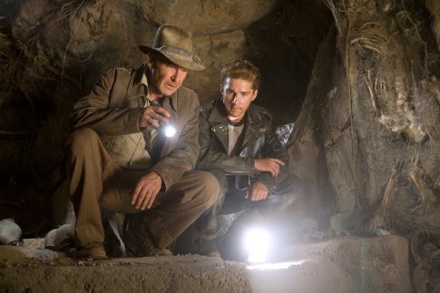
Perhaps the most disappointing cinematic experience of my life. The third Indiana Jones film turned the eight year old me into the guy who is writing this, sadly I can’t for a second imagine the messy fourth film doing the same for kids who were 8 in 2008..

All my problems with the film were magnified on DVD; the bad special effects, the awful screenplay, the legions of pointless characters (does ANONE know what John Hurt is doing here, or what side Ray Winstone’s character was actually on in the end?), the weak villain, Shia, Shia and those fucking CGI monkeys, ALIENS, THE FRIDGE, THE CGI GOPHER.

There are a couple of saving graces though, and they just about pull the film through. Even though he sounds terribly, terribly bored, Harrison Ford is still Indiana Jones through and through, and seeing him in that hat for the first time in 18 years (and Spielberg’s iconic introduction for him) is a moment of childlike glee. Even better than that though, Karen Allen, brining back Marion Ravenwood for a wonderful encore. She’s as beautiful and spunky at 57 as she was at 29 and she and Ford play off each other with such obvious enthusiasm, it’s the scenes between them that really recapture the fun of the franchise, as Indy says when Marion asks if there have been other women “There were a few, but they all had the same problem… They weren't you, honey.”

Indiana Jones and the Kingdom of the Crystal Skull is a pretty terrible whole, with a few sparklingly brilliant bits, and that’s not good enough for this franchise.


Targets
Dir: Peter Bogdanovich


He may have made enough crap to fill the sewer system of a major city, but Roger Corman also gave a lot of great filmmakers their first jobs and their first breaks. We have him to thank for the likes of Jonathan Demme, Francis Ford Coppla, Martin Scorsese and, in this case, Peter Bogdanovich. Boris Karloff owed Corman two days work, so Bogdanovich got to make any film he wanted, providing he used Karloff and came in under budget.

What Bogdanovich came up with is a simple, but disturbing, thriller whose two disparate plots - one following an aging horror film star (Karloff) announcing his retirement, the other following a young man whose obsession with guns sees him become a murderous sniper - crash together in a strong set piece. Despite Karloff’s fine, and rather poignant, performance, the first hour of the film is a little slow and meandering, but it really picks up with an ultra disturbing silent sequence in which the sniper (Tim O’Kelly) hides in a power station and picks off victims as they drive by. It’s an even freakier sequence post Washington sniper.

Bogdanovich’s next would be an honest to god masterpiece; The Last Picture Show, but on a tight schedule, with a lot of limitations, this is a strong debut from a director who seldom gets his due.


A Night at the Opera
Dir: Sam Wood


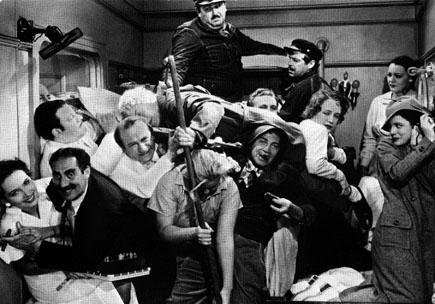
It contains some brilliant set pieces, but this Marx Brothers comedy has some of the momentum sucked out of it thanks to a dull B-story, wet performances from the romantic leads, and several too many musical interludes.

That said, when it’s funny, when Groucho is on, when Harpo is causing havoc, it’s painfully funny. The contract scene is justly famous, especially Chico’s capper “there ain’t no sanity clause” and the physical dexterity on display in the scenes in Groucho’s very small cabin on a transatlantic ship, and Harpo’s destruction of the final operatic performance are as dextrous as they are funny, it’s just a shame that between times the film has to tread water for so long.


La Belle et La Bete
[Beauty and the Beast]
Dir: Jean Cocteau

I’m going to get mail about this one. I was impressed with Jean Cocteau’s beloved version of Beauty and the Beast at an aesthetic level, it is a ravishingly beautiful film, and it really does look like the illustrations from a book of fairy tales brought to dazzling life in crisp black and white. The problem was that I was left unmoved by it.

My main difficulty was with Jean Marais’ performance as the Beast. I understand that there was a different style of screen acting when this film was made, but even making allowances for that, and for the inexpressive make up through which he has to act, Marais’ performance contains more ham than the average delicatessen. It’s a huge thing, with gestures straight out of silent film and vocalisation as if to the back of an endless theatre. I found it rather comical.

The other problem was that I just couldn’t get Disney’s peerless version out of my head, it’s just as beautiful a film as this one, but infinitely more affecting for me, and better acted.


Night at the Museum 2
Dir: Shawn Levy


I love Amy Adams. I saw her first in Drop Dead Gorgeous, but when I saw her in Junebug, like so many others, I was smitten. She’s beautiful, certainly, but it’s not that, it’s the sheer charisma that she seems to exude on screen. It’s the way that she always seems to be able to be bright and cheerful, as if nothing bad could ever happen around her. It’s the way she, like so many of the truly great movie stars, simply seems lit from within. There’s not a movie she can’t save (well, bar Cruel Intentions 2, even Amy Adams making out with a girl couldn’t help that). She’s the only reason I saw this movie, and it took me a little bit by surprise.

Not only was I head over heels for Adams' spunky, adventure seeking, Amelia Earhart (now there, finally, is a reason to get over my paralysing fear of heights) but I actually had rather a good time with the film. It’s by no means brilliant, but there are a few good laughs, some neat comic turns (notably Hank Azaria’s) and it’s all very efficiently done and completely inoffensive, altogether, perfectly acceptable family fare.


Russell Howard - Live: Dingledodies
Fellow Mock the Week panellist Frankie Boyle is perhaps the funniest man in Britain right now, but the young, energetic, relentlessly positive Howard runs him a close second. This live DVD, however, is a lot better than Boyle’s, because this material is almost all new. There are a few things that were used on Mock the Week, but for the most part this is original, hysterical material from a great comic. Well worth checking out.


The Killers [‘46]
Dir: Robert Siodmak
And once again, I suspect there may be mail, as I sharpen a knife and place it to the throat of this sacred cow. It’s not that The Killers is bad, it’s just that it doesn’t live up to either its reputation or its tremendous opening scene, after the menacing first appearance of the killers, and the murder of Swede Andreson (Burt Lancaster) the rest of the story sees an insurance invetigator trying to uncover the story behind Swede’s murder, and thus recover money from a six year old robbery. The structure is rather like Citizen Kane, each witness triggering a flashback.

The problem is that for all the film’s incredible style, for all the fine performances and for all Ava Gardner’s jaw dropping beauty, it doesn’t amount to much more than a rather predictable mystery for me. I knew where this movie was going early on, and it never took me by surprise thereafter. Siodmak certainly produced a film that defines noir visually, but there are far more satisfying examples out there.

Sunday, January 10, 2010

Review Post 59: The Lovely Bones / Exhibit A

THE LOVELY BONES
DIR: Peter Jackson
CAST: Saoirse Ronan, Mark Wahlberg, Stanley Tucci,
Rachel Weisz, Susan Sarandon, Rose McIver


“My name was Salmon, like the fish; first name, Susie. I was fourteen when I was murdered on December 6, 1973.” Those are the first two sentences of Alice Sebold’s novel The Lovely Bones, which, after some time in development hell (and the departure of original writer/director Lynne Ramsay) has now been turned into a film by Peter Jackson. I couldn’t put the book down after reading those opening sentences; they have such a powerful pull, and yet such poetry. They are reproduced in the film, but only after six minutes of screentime, when they land with a dull thud. That neatly encapsulates the problem of this film; it certainly replicates the events of the book, but it mostly misses the feeling of it.

The film tells the same two stories told in the book; that of Susie Salmon’s (Ronan) time in ‘the inbetween’; a heavenly place from which she can still watch earth, and that of her family, attempting to cope with her death and help the police (led by Michael Imperioli’s detective) find her killer, but it doesn’t juggle them as well, and Sebold’s affecting prose is blunted by Peter Jackson’s rather obvious and over literal imagery.

I held out great hopes for this film, not only because the source material was so good, but because it seemed to suit Jackson so well. The Jackson, that is, who made Heavenly Creatures, the one who knew how to use special effects sparingly yet effectively, the Jackson who knew how to make an imagined world feel like an extension of his characters imaginations. The Lovely Bones suggests, sadly, that that Peter Jackson is dead. The real proof of that is in the scenes in ‘the inbetween’. In the novel Susie’s heaven is a simple place, more a replacement for the real world she misses than any traditional vision of heaven. Sadly Jackson drowns these sequences in CGI. One sequence, when Susie sees her Dad (Wahlberg) destroying the collection of bottled ships they have built together, is seen as a huge effects sequence, with giant bottled ships floating and shattering on the sea in ‘the inbetween’.

This is pretty, certainly, and the CGI is good, but there’s just no point to it, and it never connects emotionally. Worse, these effects never seem to come from Susie, there's no story need for them, Peter Jackson just thinks they're pretty. It’s just empty spectacle and that goes for all of the film’s effects sequences. Somebody really needed to explain to Peter Jackson that the simple fact that you can do something with computers doesn’t mean that you should. With the expansion of Susie’s afterlife the earthbound narrative has had to be compressed, and it suffers accordingly. The complex relationships of the novel, and its long timeline, are only lightly sketched resulting in a series of scenes that seem to tell the skeleton of a story, but without any of it having much weight.

It’s all a terrible shame, because everyone here is working hard. Saoirse Ronan is surely one of the great young talents in cinema right now. I honestly think she might be the next Jodie Foster. The Lovely Bones could well bring her a second Oscar nomination before her 16th birthday, and I wouldn’t like to bet against her collecting the prize itself at some point in this coming decade. Ronan is wonderful as Susie. First off there is the note perfect American accent, but that’s just the garnish on a brilliant performance. What’s really amazing about Ronan is her ability, without seeming to be signposting anything, to let us see every flicker of emotion in her characters. She’s a genuinely soulful performer, and that’s perfect for Susie, because what we are supposed to be seeing during much of the film is her soul trapped between Earth and Heaven. She never strikes a false note and, despite the film’s many shortcomings, it is worth seeing just for her.


Almost certain to be Oscar nominated is Stanley Tucci, who is chilling as Susie’s killer (don’t worry, that’s not a spoiler, we know from five minutes in that he’s guilty). Under George Harvey’s thinning sandy hair and mustache, and with a voice that sounds like he’s struggling to speak through a mouth full of marbles, Tucci is almost unrecognisable. Instead of creating a monster Tucci dials back his performance, playing Harvey as an oily, creepy, but not outwardly dangerous, man. There may also be an Oscar nod for Susan Sarandon, though that would be mostly because she hasn’t been nominated for a while, because while she’s fun as Susie’s glamorous, and frequently drunk, grandmother it’s not a very deep characterisation, and is hamstrung by the screenplay, which gives her a total personality transplant in the last half hour, without any real explanation.

Under-writing is a big problem for this film, outside of Susie and Mr Harvey the characters are all very rough sketches and even the sensitive playing of Mark Wahlberg, Rachel Weisz and Michael Imperioli can’t make anything but expository props of Susie’s parents and Detective Len Fennerman, which is a pity, given the complex triangle they create in the novel. The performers aren’t to blame though.

The Lovely Bones has to go down as a missed opportunity thanks to Peter Jackson, in attempting to oversell things, in overindulging in special effects, he’s missed the simple ways in which the book achieves pummelling emotion. This is deeply felt in the pivotal murder sequence. Now, clearly, putting it on screen in the same viscerally disturbing manner that it is depicted in the book could have been deeply distasteful, particularly given Saoirse Ronan’s youth, but the way it is fumbled here is almost inexcusable. In fact, if I hadn’t been told by the narration (and the book) I might not have realised that this was the murder sequence. It completely lacks impact. There are ways to not show the murder, and yet make a truly disturbing sequence, but Jackson just completely misses with this sequence.

Towards the end of the film, if only for about ten minutes, things do begin to work. Jackson juxtaposes Susie's last moments on Earth and her last in ‘the inbetween’, in a sequence cut to the astoundingly beautiful This Mortal Coil version of Song to the Siren. I admit I started to well up here, though as much due to Elizabeth Fraser’s voice as anything. It’s this sequence that, perversely, made me most disappointed in the film, because here’s a glimpse of what the whole could, and should, have been. I wish that we’d been able to see Lynne Ramsay’s version of the book, because here more down to earth sensibility might have allowed a simpler but more affecting film to come through. I’d love to wholeheartedly recommend The Lovely Bones, but I can’t. It’s worth seeing for Saoirse Ronan (as is everything that brilliant young actress is in) but the film as a whole is a failure, just buy the book.


Before I launch into the next review, in the interests of full disclosure, I should tell you how it came about. Last week I got an email to the 24FPS address from one Darren Bender. He is the producer of Exhibit A, which I had seen at its premiere at the Raindance Film Festival in 2007, and been a fan of since. After saying that he enjoyed the site (Cheers Darren) he thanked me for being a fan of the film, and offered to send a copy of the DVD that has just been produced to me.

When the DVD arrived I got quite a surprise, on the front cover was a quote that looked familiar, giving the film five stars and credited to Joblo.com. I read it a couple of times, and then realised that it was from MY review, written after the Raindance screening (taken slightly out of context). I imagine this is a regular occurrence for other critics, but frankly it’s a little odd for me. In my initial reply to Darren’s email I told him that I had been planning to include Exhibit A in my articles on the overlooked films of the 00’s, but I’ve now looked at the film again, and thought a full review was in order.

You can watch Exhibit A online, for free (legally) by clicking on the title below


[This review has been edited from its initial version, first to insert a comment from the film's producer and secondly to remove some possible spoilers.]

EXHIBIT A
DIR: Dom Rotheroe
CAST: Bradley Cole, Brittany Ashworth,
Angela Forrest, Oliver Lee


There has been a trend, over the last few years, away from the use of opening credits in films. This allows us to simply get into the story, without being distracted by five minutes worth of names over the opening scenes. Exhibit A eschews any credits, indeed there’s not even a traditional title card. In keeping with the conceit of the film all we see is an evidence marker, identifying what we are about to see as Exhibit A, its source as Murder Scene and its origin as Daughter’s Camcorder. I’ve often quoted Hitchcock’s first law of suspense; give the audience more knowledge than the characters. This is a perfect demonstration of that cinematic law in action; with that one simple card everything that unfolds in the first half hour of this film takes on a different tone.

Found footage films are tricky. The only one to maintain its illusion perfectly is Cannibal Holocaust, but Exhibit A comes close. The only moments that ring false are the occasional snatches of a beach scene that, apparently, haven’t been recorded over (this same device also rang false in Cloverfield, though it was much more prevalent there).
Darren Bender, Exhibit A's producer, contacted me in regard to this, he says:
In fact the beach only reappears (after the original visit to the dream house they aspire to) when the tape is rewound and viewed. I feel this is clearly plotted and is set up each time. It is true to life because anyone shooting over a tape that has been left running will rewind back to the last thing they recorded and once they reach that start recording again.

Still, with due respect and though it takes little away from the film, I feel it's a rather convenient, filmic, device, revaling an artifice absent from the rest of the film. Otherwise the illusion is perfectly realised, with the cast doing almost all of the camerawork themselves. This can mean that the framing is erratic and shaky, but this isn’t shaky-cam as a stylistic choice so much as it an essential part of the illusion; this family aren’t filmmakers, so their home videos look like home video. The film’s first act introduces the King family; Mum and Dad (Forrest and Cole) and teenage children Joe (Lee) and Judith (Ashworth) as a normal nuclear family. There’s a lot of joking around with the video camera given to Judith as a present, and Dad Andy has good news; he’s got a promotion and the family will be moving to a new, much bigger, house on the coast. Underneath it all is that opening card. It’s clear what’s going to happen, but when, how and why isn’t yet clear, and the tension is excruciating. Though it’s only a short film (just 85 minutes) Exhibit A doesn’t hurry. If anything it could be accused of starting slowly, only gradually do we start to see that something may be amiss in what seems, initially, an almost idyllic family life.

This is where the cast comes in. In a film pretending to be found footage any substandard performance can destroy the illusion irrevocably. That doesn’t happen here. Angela Forrest and Oliver Lee are both excellent and entirely real, but their characters do feel slightly like background figures next to Andy and Judith. It’s a real shame that young actress Brittany Ashworth doesn’t appear to have done anything on film since this performance, because it’s a highly impressive piece of work; unaffected even in the most extreme moments of emotion. There’s a real honesty about her work that helps ground the film and the found footage conceit in reality (it also bears mentioning that she’s a pretty good camera operator, at least for the demands of this film).


To my utter disbelief, Bradley Cole also seems not have worked on film in the last few years. His performance as Andy is the pivotal piece of the puzzle, if it doesn’t work everything else falls away. Fortunately he is exceptional, fully deserving of the BIFA award nomination the film earned for him. Exhibit A is, at its heart, a portrait of a man suffering (through his own fault) a complete breakdown. Without overacting (in a part that could easily have invited a scenery chomping, eye rolling ‘I’m mad, me’ performance) Cole takes us completely believably through Andy’s downward spiral. It's heartbreaking work, and a real insight into a complex character.

The closing twenty minutes of the film are almost unbearable. They unfold in a pressure-cooker atmosphere, trapping you in a situation of unimaginable hideousness. In the quote on the DVD case I called the film’s final scene “The single most harrowing thing I’ve seen since [the rape scene in] Gaspar Noe’s IRREVERSIBLE”. I can stand by that. In a single, static, ten minute take the murders are played out in sickening, if never explicit, detail. Most disturbing is the (improvised?) dialogue; so hideous that it makes your skin crawl. Exhibit A is a film that, in a time when most horror films fling gore at your feet relentlessly but never scare you or stay longer than three seconds in your head, will live in your mind for a long time. It’s a troubling film, in much the same way as some of Michael Haneke’s work, that awful sense of reality means you constantly want to look away. I couldn’t. This is the kind of filmmaking that real movie fans like you and I should be embracing; smart, original cinema that resonates long after the end titles.

Tuesday, January 5, 2010

20 + 10: Pt. 2

10 more exciting things for the next 12 months, in no specific order.

Scott Pilgrim


Edgar Wright’s latest hasn’t really inspired me until now, thanks largely to the fact that I wasn’t fond of Hot Fuzz and that it stars Michael Cera, who can only play one part (one part which is wearing perilously thin). It’s starting to look like a lot of fun though. The cast is cooler than cool (especially with Mary Elizabeth Winstead and Anna Kendrick in the mix), but what has me excited is what Wright is saying about the action. After all the bullet time that has followed in the wake of The Matrix, Wright says he’s going back to fast, furious, Hong Kong style action (he’s got some of Jackie Chan’s stunt team working on the action sequences). “It’s like a cross between Cameron Crowe and Five Deadly Venoms” he’s said. Awesome, assuming he means Say Anything, rather than Elizabethtown.

Testing
One room thrillers seem to be hit (Cube) or miss (Fermat’s Room) with me, but I’m hoping for good things from British director Stuart Hazeldine’s first feature; Exam. It’s the job interview from hell, as the nameless candidates find themselves in a room, given sheets without a question and 80 minutes to find the answer. It sounds bizarre and intriguing; exactly the right conditions for a good thriller.

Beware the Devil
Interviewed on the BBC’s Film 2009, the Midlands based auteur said that his next project would, hopefully, be “one of the scariest films of 2010”. If it happens Beware the Devil will be Meadows’ first proper foray into horror (though there are shades of it in Dead Man’s Shoes). He’s said that just writing the script has been scary, and that he’s going to talk to Sam Rockwell, with hopes of casting him. Meadows is one of the most interesting filmmakers in the UK right now, I’m anxious to see what he can do in genre cinema.

Fests Galore
Wherever you live, there’s probably a film festival near you some time in 2009. I’m lucky enough to live near London, where there seems to be a film festival of some stripe most weeks. My first of the year will likely be the Birds Eye View film festival in March (this year closing with Drew Barrymore’s directorial debut; Whip It!) and my last will almost certainly be December’s Festival of German films, with hopefully many in between. Festivals are where you find the strange and compelling fare, the stuff that often doesn’t reach cinemas at all. The little films, the new talent. Next time you see a festival playing near you, try this; buy tickets for two films you are sure you want to see, then get one for something you have absolutely no knowledge of, whatever happens to be playing directly after one of your two other choices. It may not be great, but it will almost certainly be different (I did that in 2009, and saw Dear Lemon Lima).

Nina Hoss


I don’t know if, in her native Germany, Nina Hoss is as ridiculously famous and as well rated an actress as she clearly deserves to be, I hope she is. Over here few people have even heard her name, and that’s a crying shame because she’s one of the most consistently intriguing and most chameleonic actresses I’ve seen in a long time. Most of her work is unreleased in the UK, so any new release is a reason to celebrate and Anonyma, based on the wartime memoirs of an anonymous Berlin woman sounds like it will provide a great part for Hoss to get her teeth into. Even sight unseen, I can tell you that this should be worth seeking out, if only for Nina Hoss.

Back to the 80’s
The movies have taken a little while to catch up to the music scene, which has spent the last couple of years partying like its 1984, but the pop culture of the 80’s is coming back in a big way this year. Joe Carnahan’s The A Team is being touted as a big franchise for the future, Footloose, The Karate Kid (with Jackie Chan) and (groan) A Nightmare on Elm Street are being remade, but the big excitement for movie geeks is coming from two projects aiming to recapture the fun of 80’s action movies. Nimrod Antal and producer Robert Rodriguez are working on Predators, on a fast schedule for a summer bow, it seems pretty close to the feel of the first film, and has an intriguing cast led by, of all people, Adrien Brody. Then there’s The Expendables, which seems to be Sylvester Stallone’s attempt to cram every 80’s action hero (and Jason Statham) into a single film. After the giant shitpile that was Rambo, I don’t care about The Expendables, but it’s certainly one of the most rabidly anticipated movies of 2010. However, if anyone remakes Back To The Future, I'm marching on Hollywood, and I may be armed.

Marty and Leo: Part 4
Okay, so Gangs of New York was ragged round the edges, but since then both Leonardo DiCaprio and Martin Scorsese have gone from strength to strength when working together. A nearly complete version of their latest; Shutter Island (I miss the original title; Ashcliffe) debuted at Harry Knowles’ ButtNumbAThon, and received very positive notices (notably a typically near sub-literate blowjob from Knowles himself). The trailers look very promising, and the cast (which also includes Jackie Earle Haley, Emily Mortimer, Michelle Williams and Patricia Clarkson) is amazing. But of course it’s Martin Scorsese, so you were already there.

Masters of Cinema
The UK’s Eureka Entertainment continues to release, under this banner, stunning editions of some incredibly rare and fascinating films. Definitely on the slate for this year is a new edition of M (also on Blu Ray), Murnau’s little seen City Girl and the continuation of their Maurice Pialat series, soon, finally, to include the region 2 debut of A Nos Amors. I should own more of this series of releases, and any self respecting movie fan should have at least a few in their collection. Check out their site here.

Twilight to suck less?
Okay, the first two Twilight films are absolutely appalling drivel. The acting is so false that the same amount of expression would be possible if the cast were replaced with stop motion animated Lego men and the filmmaking has been miserably poor at all levels. BUT. David Slade (Hard Candy / 30 Days of Night) is directing the next in the franchise; Eclipse. He’s made plain his contempt for the first film, though he’s since taken back the remarks, which included “Twilight at gun point? Just shoot me.” That attitude, plus the word that he’s deliberately playing up the darker aspects of Eclipse and actually trying to make a horror film (apparently to the consternation of some of his cast), gives me a little hope that, at the very least, this will be a more interesting watch than the first two films.

Ink and paint return


When John Lassetter took over Disney’s animation division the first thing he did was to reactivate its cel animation production arm. He re-hired John Musker and Ron Clements (directors of Aladdin and The Lion King) and set them to work coming up with ideas. The first fruit of that labour; The Princess and the Frog, opens in the UK in time for February half term. I’m seeing it a week early, with Musker and Clements in attendance for a Q and A. You’ll be the first to hear about it. Personally I've missed traditional animation, which is a truly special art form, and I'm looking forward to this return from the company that established it and from two filmmakers who have made some truly great films with these techniques.

Monday, January 4, 2010

The Week in Movies 1

28/12/2009 - 3/01/2010

LA RUPTURE [18]
[THE BREACH]
DIR: Claude Chabrol


One of Chabrol’s justly celebrated Helene cycle of films, which usually deal with a fractious marriage, which often takes in both infidelity and murder and always star his then wife Stephane Audran as Helene. Here Audran is married to a drug addict who, in the opening scene, assaults both her and their young son. Understandably she leaves him, but her rich in laws take their son’s side and hire a private detective (Jean-Pierre Cassel) to discredit Helene, and ensure that she loses custody of her son.

For most of its two hour running time this is a tense thriller, powered by excellent performances from Cassell, Michel Bouquet as the father in law and the outstanding Audran, who is more sympathetic here than usual. In the film’s third act Chabrol mounts an outstanding series of sequences as the detective attempts to create evidence against Helene, but unfortunately, with ten minutes to go, the film runs a little off the rails with a twist and effects that, while they must have seemed trendy in 1970, now feel very dated. It’s a shame, because most of La Rupture packs a real punch. However, this is a minor sag in what is a largely excellent, and visually rather inventive, film from Chabrol.


PERFECT STRANGERS [2003] [15]
DIR: Gaylene Preston
This independent New Zealand film starts promisingly, with a creepy Sam Neill kidnapping and attempting to romance Rachael Blake, but what could have been a tense little thriller loses traction quickly thanks to some risible plot developments. Gaylene Preston is attempting to say something about obsession, and even about Stockholm syndrome, but with a short timeline, a screenplay that never gives its characters much real depth and a middling performance from Blake she’s fighting a losing battle. It’s a nice idea, but chalk this one up as a missed opportunity, despite nice work from Sam Neill.


CLAAY PIGEONS [15]
DIR: David Dobkin


I can’t figure out what this film wanted to be. Is it a comedy? Certainly it’s not funny. Is it a drama? Well, it’s not very engaging. Is it serial killer movie? It’s got nothing to say about crime or criminals. Clay Pigeons sees Joaquin Phoenix suspected of being a serial killer, while he knows that it’s actually his new ‘buddy’ Vince Vaughn. He’s being pursued by an FBI agent played by, of all people, Jeneane Garolalo, whose undoubted comic talents go totally unutilised. Everyone seems to be in a different film; Vaughn is playing broad, for laughs that just aren’t there, Garofalo looks utterly lost without any comedy to play, and Phoenix mumbles his entire part at the floor, so you can’t hear what movie he’s in.

Dobkin, who has since directed Shanghai Knights, Wedding Crashers and Fred Claus (nice career, Dave), shows no visual flair, and at one point there’s a continuity flaw so glaring I can’t believe that nobody fired the editor. It’s a formless, purposeless, mess of a movie.


LA FLEUR DU MAL [15]
[THE FLOWER OF EVIL]
DIR: Claude Chabrol


Chabrol’s 2003 film is a rather typical tale of upper middle class corruption and murder. It concerns the secrets, both present and long buried, of the Charpin-Vasseur family, secrets threatened to be revealed when as Anne Charpi-Vasseur (Nathalie Baye) runs, against the wishes of her husband, for re-election to local office.

The Flower of Evil is a pretty simple, but very tidy thriller. Chabrol is an old master, and he handles both camera and actors with an assured and practiced hand. Baye is excellent as the relatively inexperienced but sharp politician while Benoit Magimel (a frequent collaborator in Chabrol’s later period) and Mélanie Doutey give strong performances as the pseudo incestuous step siblings trying to hide their relationship from their respective parents. A relatively minor Chabrol then, but typically well made and entertaining all the same.


JEANNE LA PUCELLE [PG]
[JOAN THE MAID]
DIR: Jacques Rivette


This is the third film I've seen about Joan of Arc, and another magnificent piece of work that can easily stand alongside both Dreyer and Bresson's films. Rivette's treatment is epic in both scope (covering the last two years of Jeanne's life, rather than zooming in, as the other filmmakers did, on her trial and execution) and in length (five and a half hours, across two very arbitrarily divided parts titled The Battles and The Prisons). In truth Sandrine Bonnaire, in her mid twenties at the time, is a little old to play the 17 - 19 year old Jeanne but that ceases to matter because her performance, which holds centre stage for the entire running time, is remarkable. She portrays Jeanne as a young woman of quiet, yet extraordinary, strength, resolve and faith. You believe that the men she ends up leading would indeed follow this young girl.

Jacques Rivette knows his strengths as a filmmaker, and that they don't really include action, and so the battles themselves are mostly offscreen, detailled by testimony. This may frustrate some, but it makes clear what the film is trying to do, it's an exploration of Jeanne as a person, as a leader, it's not an action movie. What action there is well enough done though, and Sandrine Bonnaire, impressively, does almost all of her own stunt work. The other thing that Rivette misses out is the trial, cutting directly to the sentencing, with a caption that may as well read 'rent the Dreyer or the Bresson'.

Rivette and Bonnaire have here presented the most complete portrait of this extraordinary young woman, it may be slowly paced, and light on action, but the full five and a half hours of this film is a riveting experience and well worth your time for that exceptional central performance.


THE YEAR OF THE RAT
DIR: Julie Ng
This documentary on the making of Willard, by director Glen Morgan’s young assistant, is notable chiefly for its extraordinary access. The on set scenes are pretty typical, if extremely candid, BTS fare. It’s when the film is finished that this documentary becomes fascinating, as Ng candidly documents the process of cutting the film for a PG13 rating, the soul destroying test screenings and the reshoots to make an ending more palatable and commercial. It’s an impressive insight to a world we seldom see clearly.


9TO5: DAYS IN PORN [18]
DIR: Jens Hoffman


I’ve seen several documentaries about pornography (more in fact than I’ve seen porn films) ranging from the almost jaunty Pornstar: The Legend of Ron Jeremy to the unbelievably disturbing Hardcore (which REALLY needs to be released on DVD). Jens Hoffman’s long film falls somewhere in the middle. It’s failing is perhaps in trying to do too much. He touches on so many interesting stories (that of husband and wife pornstars Otto Bauer and Audrey Hollander, that of rising star Sasha Grey, the sad story of Katja Kassin, the inspiring Dr Sharon Mitchell) but he doesn’t take the time to fully explore them. Each story here could well be its own documentary (especially that of Sasha Grey, who is incredibly intelligent and simply oozes charisma) and jamming them all together doesn’t serve them brilliantly.

However, as a patchwork of the modern porn industry 9to5 is intriguing. At times it is a deeply sad film, but then there are people (like Belladonna and the aforementioned Grey) who seem to have their heads and hearts in the right place, and give you a little hope. At times (as when we see Sophie Dee doing what is apparently her first anal scene, and being roughly treated for her trouble) it is difficult to watch, and for a film with much hardcore sex in it it is certainly never arousing, but 9to5 is always interesting. In fact it’s so interesting that I wondered if it would have made a better TV series, where each story could really be given its due attention.


BEWARE THE MOON
DIR: Paul Davis
At 97 minutes this a pretty exhaustive exploration of the making of An American Werewolf in London. Director Paul Davis touches on all the questions fans will want asked, and gets almost everyone associated with the film to talk candidly about it. The only real downside to Beware the Moon is the presence of a presenter, who is completely pointless, has nothing to add to proceedings and looks like he’d rather be shot with a silver bullet than present this film.


POULET AU VINAIGRE [15]
[COP AU VIN]
DIR: Claude Chabrol


Another strong thriller from Claude Chabrol. This one boasts an edgy performance from Jean Poiret as Inspector Lavardin, whose violent investigatory techniques lead him to conspiracy and murder surrounding property developers trying to force a disabled woman (Charol’s by now ex wife and frequent collaborator Stephane Audran) and her teenage son (Lucas Belvaux, who has gone on to become a director of some note himself) out of their home.

All the ingredients of a vintage Chabrol are present and correct, and the film features some strong sequences and nice performances, but Audran is inconsistent and the twist involving her character blindingly obvious, and that undermines the film somewhat. Still, Cop au Vin (and, by the way, et's just take a second to enjoy that pun) is mostly tasty and I’m anxious to follow Poiret’s interesting character and powerful performance to the sequel; Inspector Lavardin.


PAYBACK: DIRECTOR'S CUT [18]
DIR: Brian Helgeland


I haven’t seen Brian Helgeland’s disowned directorial debut since it was in cinemas, and so I don’t remember it especially well, though I remember not liking it much at the time. This Director’s cut though is an interesting beast. It’s ten minutes shorter, at a brisk 90, than the theatrical cut and it has a nicely consistent dark, mean spirited tone to it.

Based on the same source material as Point Blank, Payback sees Porter (Mel Gibson) on a violent mission to claim the money that was stolen from him back from the mob. It’s a nasty tale, filled with violence, profanity and strong guest turns from fine character actors (David Paymer is great as a slimy low level mobster and Maria Bello, who has since matured into one of America’s most interesting and individual actresses, makes an impression as a hooker with a soft spot for Porter).

Helgeland’s stylish direction and his blacker than black script suggest that he should have been given a chance to release his original dark vision to cinemas. It’s no lost classic, there are things here (Lucy Liu as a dominatrix) that just come off as silly, and the plot is a little too linear, often feeling like Porter is a computer game character always advancing to the next (mob) boss, but this version of Payback is more rewarding than I expected.


PEARL OF DEATH [U]
DIR: Roy William Neill

Ever since I first read about him some 15 years ago I’ve wanted to see one of Rondo Hatton’s films. Hatton plays the villainous, deformed, Creeper in this effective Sherlock Holmes film, starring the great Basil Rathbone as Holmes and Nigel Bruce as an amusingly bumbling Watson. At just 65 minutes the story is briskly told, though there’s not much time for any real character depth. Rathbone and Bruce are both excellent though, and bounce off each other nicely, while Evelyn Ankers makes for a beautiful and capable villainess. Rondo Hatton, his face deformed by acromegaly, is a striking silent presence in his first featured role and the whole thing is lensed with a little noirish style by Roy William Neill.

It was also interesting, having just seen Guy Ritchie’s Sherlock Holmes, to note that a scene in which Lestrade has trouble saying the word ‘catatonic’ is drawn, word for word, from this film.


SMASH CUT [18]
DIR: Lee Demarbre


Smash Cut is dedicated ‘to the life and art of Herschell Gordon Lewis’. I know that this is close to blasphemy for a gorehound, but I’ve never seen any of Lewis’ films and, having seen the appalling Smash Cut, I’m no longer sure I want to. There’s a nice idea here; a director of cheap horror films (played by Krug himself, David Hess) accidentally kills a woman, and to hide the body he cuts it up and uses it in his movie, when the footage is praised he keeps killing so he has more ‘prosthetics’. Unfortunately the idea is executed with all the panache of a terrible student film. The effects, even those that are supposed to be real body parts, are patently fake and poorly executed. The performances (including one by Sasha Grey, who promised so much in The Girlfriend Experience) are monotone and tedious and the direction is unimaginative and technically poor.

It may be that the makers of Smash Cut have ended up with exactly the shitty, cheesy mess they set out to make, but intentional or not this IS a shitty, cheesy mess.


FRANKLYN [15]
DIR: Gerald McMorrow


Gerald McMorrow’s feature debut is an ambitious one, it follows four seemingly disparate characters in two separate worlds, which it then has to draw together. On top of this Franklyn also features a great deal of (generally decent) digital effects and quite a few complex action scenes, on a budget about the tenth of that of the Blockbusters it often resembles.

There are things in Franklyn that clunk, some writing that’s a little schematic, a few moments that spoonfeed the audience, but these are certainly outweighed by the times at which the film’s achievement matches the breadth of its ambition. The scenes in the futuristic dystopia of Meanwhile City are extremely well realised, with strong production design (with shades, it has to be said, of Dark City) and some excellent action sequences. It also introduces us to Preest (a typically strong performance from the much underrated Ryan Phillippe) whose look is one of the film’s strongest images, his impassive mask with its black holes for eyes as memorable an image as Rorschach’s mask in Watchmen.

In present day London Bernard Hill gives a fine performance as man looking for his missing son, Eva Green is suitably ethereal in a dual role as a depressed conceptual artist (whose project is, it has to be said, the film’s most tedious aspect) and as a warm primary school teacher and Sam Riley builds on his work in Control with an understated performance as the recently jilted Milo. The interest in the film is discovering how these characters all tie together, and so I shan’t discuss it here, but McMorrow draws his strands together in a clever and rather unexpected way, marking himself out as a talent to watch.


THE HOUND OF THE BASKERVILLES [1939] [PG]
DIR: Sidney Lanfield
The first of Universal’s Sherlock Holmes series, with Basil Rathbone and Nigel Bruce playing the iconic cinematic versions of Holmes and Watson, is based on the most famous of Conan-Doyle’s stories, and it’s a fun and engaging version.

There’s some very big acting here, notably an hilarious performance by Barlowe Borland, whose own Scottish accent is so broad that it actually sounds like a stereotypical comedy scotsman and there are some decidedly wooden turns too, from Richard Greene and Wendy Barrie as the film’s young lovers. However, Rathbone is a great Holmes and Nigel Bruce’s befuddled Watson is very funny indeed. The scenes on the moors look studio bound, but like the rest of the film they are stylish, and establish an iconic look for Holmes (much of the popular image comes not from Conan Doyle but from these films).

All in all this is a light, fast and efficient telling of a strong story, no classic perhaps, but a solid entertainment.


THE BLUE DAHLIA [PG]
DIR: George Marshall


He’s not the best known of names, nor among the revered directors of Hollywood’s golden age, but George Marshall was clearly a skilled filmmaker. With a career that spanned nearly 60 years and almost 200 credits his resume is probably a mixed bag, but The Blue Dahlia is little short of a classic film noir.

Johnny Morrison (Alan Ladd) comes home from the war to find that his wife (Doris Dowling) has become a drunk and is cheating on him, after an argument he leaves her. The next day Mrs Morrison is found murdered with her husband’s gun and Johnny finds himself on the run and getting mixed up in intrigue with his wife’s nightclub owning boyfriend (Howard Da Silva) and a gorgeous, mysterious blonde (Veronica Lake).

Marshall adheres to the classic noir style here, using deep blacks and brilliant whites, making use of inky shadows to create both atmosphere and the shape of his shots. It’s a beautiful looking film of the kind that simply doesn’t get made any more (I love neo-noir, but really, it’s a genre built for black and white). The script, by Raymond Chandler, is sharp as a knife, crackling with hardboiled dialogue and the cast deliver it beautifully. In a film full of strong performances, Doris Dowling stands out in the small part of Mrs Morrison, playing the role as if she were playing a spitting cobra, such venom is there in her every word. Veronica Lake was better known for her dazzling beauty than her acting (and here, in her mid twenties, she is lovelier than ever) but I liked her performance, if anything it’s a little more modern than the others, more natural, less affected.

If you’re even a little bit of a film noir fan then The Blue Dahlia ought to be at the top of your list of films to see, it’s a cracking thriller, stylishly made, with some strong acting, what more could you want?

Sunday, January 3, 2010

Review Post 58: Spread / Nine / Sherlock Holmes

SPREAD
DIR: David MacKenzie
CAST: Ashton Kutcher, Anne Heche, Margarita Levieva


I’ve been following the development of Spread for some time, and I’ve declined the chance to watch it online because I was excited enough about it to want to see it for the first time at the cinema. I’ve actually become less intrigued by it as time has gone on, first because Jennifer Jason Leigh pulled out of a key role (played by Anne Heche) and then because the reviews have been largely savage, but one thing kept giving me hope; Scottish director David Mackenzie, whose entire filmography to date I had enjoyed a great deal.

Considering that Mackenzie’s three previous films; Young Adam, the little seen Asylum and Hallam Foe, had all dealt with sex and jealousy in refreshingly intelligent and adult ways Spread would seem to be right up his street. It’s the story of Nikki (Kutcher) a male hustler, who lives in LA without a job, a place or a car thanks to the older wealthy women he shacks up with and bilks every penny he can from. Essentially he is an amoral character, constantly on the lookout for his next meal ticket. He finds one in Samantha (Heche) a drop dead stunning lawyer of about 40 with whom he essentially trades regular orgasms for a place to live. It all comes crashing down though, when Nikki falls for Heather (Levieva), threatening his thus far comfortable and easy lifestyle. David Mackenzie should have been able to turn that idea into something brilliant, he’s made immoral and amoral characters utterly compelling before, and exhibited a real, sharp, understanding of the battles of the sexes and of sexual jealousy. It’s a shame and a surprise then to see him come horribly unstuck with this American debut.

I wonder if, given that he’s one of the producers, Kutcher was pressed on Mackenzie, because I can’t imagine that he would have won the role of Nikki any other way. First off, he’s a bit old for it. Kutcher was probably 30 during filming, and while he’s certainly handsome he looks 30. Nikki seems as though he should be younger, first because the character is clearly written as some beautiful 22 year old, using his looks to scam desperate women and secondly because, though he’s street smart, Nikki is so shallow that it’s hard to imagine him being much past his early 20’s, he just seems to have so little idea about life and about people that I can’t buy a man of Kutcher’s age in the part. More of a problem than Kutcher’s age is his acting. He’s so lifeless that to call him a cipher would be to oversell his performance. Kutcher drones Nikki's voiceover in a sub-catatonic drawl that suggests Harrison Ford doing the Blade Runner voiceover while on powerful downers, and his onscreen performance is no more lively. Kutcher’s facial expressions are very limited. In dramatic scenes we get ‘sleepy’ and during the many couplings there is a relatively impressive variety of ‘ugly sex face’ (he may have come up with as many as seven, actually). Sadly none of these expressions actually express much (besides ‘I’m fucking Anne Heche’, or rather ‘I’m pretending extremely unconvincingly to fuck Anne Heche’). And when he’s called upon to deliver some emotion Kutcher comes up comically empty. Nikki is accused of being vacuous, and certainly Kutcher conveys that very well, but he’s supposed to change, and still all we get is ‘sleepy’ and ‘sex face’.

Anne Heche does some nice work in Spread, making Kutcher look, if such a thing is possible, even more inert and emotionless than he already is. She is astoundingly good looking, and in stunning shape at 40. The problem is that she perhaps looks too good, she could pass for a good eight or ten years younger than she is (so well is she made up and photographed here), which makes her and Kutcher a rather logical match, and undermines the arrangement of their relationship somewhat. This is where casting Jennifer Jason Leigh would have paid off; she’s very beautiful still, but looks her 46 years, there would have been more to invest in her side of this arrangement, because it would have felt more like she might need it. Miscast as she is, Heche is a better actress than she’s often given credit for, and she’s effective when Samantha is allowed to come across like a real person rather than a MILF fantasy. The dialogue is often risible, but Heche does a lot with silence, particularly after we find out why Samantha has made a mid-movie trip to the hospital.

The great problem with these two characters, and with Maragarita Levieva’s Heather (whose character I won’t discuss, because spoilers might ensue) is that neither screenwriter Jason Dean Hall, Mackenzie or the actors themselves can find any way to make us care about them. Will Nikki and Heather find love? Who cares? Neither of them has a personality, they are each as morally bankrupt as the other and there is no sense of any interest between them other than the purely physical. Will Samantha… I don’t know, honestly, I don’t know what this movie wants us to want for Samantha. She seems to exist solely for Nikki to have a place to live and provide the film some shagging.

It’s frustrating, because as flawed as it is I think life could have been kicked into Spread. Imagine it with Joseph Gordon Levitt and Jennifer Jason Leigh (or even Heche, to be fair), with a rewrite to punch up the Nikki/Heather story and then we might have something. Instead there’s this lifeless corpse of a movie, a black hole of tedium that even Anne Heche’s fantastic breasts struggle to enliven. I honestly don’t know what David Mackenzie can have been thinking when he accepted this job, but I hope it gave him some cash so he can go away and do the interesting, individual, thought provoking work that was previously promised by his credit. This was a sad and disappointing note on which to start 2010.


NINE
DIR: Rob Marshall
CAST: Daniel Day Lewis, Marion Cotillard, Judi Dench,
Penelope Cruz, Kate Hudson, Sophia Loren,
Fergie, Nicole Kidman


Rob Marshall’s last musical was the mega successful, Best Picture winning Chicago.  This film won’t repeat either its box office or its awards success.

For a movie with such a wealth of talent at its disposal, Nine is shockingly, indeed almost unwatchably, awful. At my screening the movie had to be started twice, at first, thanks to some projection fault, the film looked as if there was a red filter on everything. As an audience we wondered if this was a fault or simply a strange stylistic choice for the beginning of the film. It was the former, but the ensuing two hours made me long for anything resembling the latter. Marshall is apparently trying to ape Fellini with this film. I don’t know Fellini’s work well, but with the best will in the world, Rob Marshall is no auteur. He’s a safe pair of hands, a journeyman who can be relied upon to get a movie up on screen and have it look like a movie. That said, there are parts of Nine that look downright amateurish. The black and white footage (which is largely used in flashback sequences, but also crops up in Kate Hudson’s song, more on that later) is especially poor. Grain swarms over the black and white footage, attracted to it like flies to shit, and it’s really badly lit; too even, with little contrast, everything a grey rather than blacks and whites that pop. The editing isn't terrible at a technical level, but Marshall’s cutting between the real world and songs (always on the same soundstage) taking place in a character’s head jars badly. The real problem with Marshall’s direction is how tossed off it feels, there’s not a single shot here that surprises or impresses, nothing you’ll remember after leaving your seat, at least, not because of anything Rob Marshall did.

In a musical the songs need to do a couple of things. First they have to be memorable, tunes or lyrics that lodge in your memory, songs you can hum on your way out of the cinema. Seecondly they have to advance the plot, because if they don’t then what’s the point. This is the golden rule of cinema; everything you include in your final cut should have to be there, the film shouldn’t be able to function without each scene being in place. Neither of these things is true of Nine. The songs are lumpen things, all bombast and no weight. There’s hardly a memorable note played in the whole film, never mind something to rival, say, Falling Slowly from Once. There’s not a single thing I want to listen to again, and in a two hour musical that is criminal.

The bigger musical problem is simply this; Nine doesn’t need songs, at all. The story of Guido Contini’s (Day Lewis) struggle to make his new film; Italia is thin and duller than a Friedberg/Seltzer double bill, but it’s all told without songs, all perfectly understandable. In some cases the songs actually detract from the film. This is especially notable with Marion Cotillard’s numbers. Cotillard is the only cast member to escape Nine with her dignity fully intact, indeed she gives a mesmerising performance, full of emotion; a rich, deep characterisation that shames every other aspect of the movie. She’s so good that her silent acting utterly negates the need for either ‘My Husband Makes Movies’ or ‘Take It All’ (which is by far the best song in this sorry film). Some songs vaguely comment on the action (Cruz’ hideous 'A Call From the Vatican') and there is no rhyme or reason to the inclusion of others (Judi Dench’s ridiculous 'Folies Bergère', for example, and the nadir represented by Kate Hudson’s 'Cinema Italiano').

The talented cast are wasted, with the exception of the wonderful Cotillard. Cruz turns up and pouts her way through the role of Guido’s lover, Dench does her best Judi Dench as a costume designer, Kate Hudson and a very artificial, immobile looking Kidman each pop up for about ten minutes in utterly pointless roles and Sophia Loren, though she doesn’t disgrace herself, has little to do but stand around in soft lighting and simper in Day Lewis’ direction. There is a nice surprise in the Black Eyed Peas singer Fergie, who belts out 'Be Italian' in a manner creditable enough that she should, at the very least, be in a much better band.

The real puzzle of Nine sits at its very centre. Daniel Day Lewis is legendary for his quality control and for his total immersion in his roles. Two questions arise. 1: What the holy hell is he doing in this formless mess to begin with? 2: Why is he doing an accent one step removed from comedy Italian, and how does he manage to be so completely unconvincing as a director suffering major creative block. At times watching Nine is like watching community theatre and Day Lewis is, to my utter bafflement, among the worst offenders. His performance is so silly that I wondered if he thought he was making a comedy, certainly I laughed while watching this film, but I don’t think I was supposed to.

Nine is all sorts of terrible, but it’s not even car crash cinema, it’s not interesting in its badness, it’s just numbingly boring. If you want to spend two hours listening to unmemorable and largely pointless songs delivered by a cast who can, for the most part, only vaguely sing then by all means go and see Nine. You'll be rewarded with lots of beautiful women in skimpy clothes and with a brilliant performance by Marion Cotillard, but as for the rest, well, I warned you.


SHERLOCK HOLMES
DIR: Guy Ritchie
CAST: Robert Downey Jr, Jude Law
Mark Strong, Rachel McAdams


Full disclosure: I’ve seen three of Guy Ritchie’s films, and I thought they were all pretty dreadful. Even half way through Lock, Stock and Two Smoking Barrels (god, even the title annoys me) I was bored with his one note mockney gangster shtick (and annoyed by the fact that the film was so yellow I suspected it had jaundice). I’ve skipped his last two forays into cinema; the roundly panned, kaballah influenced, Revolver and the back to tedious basics outing Rocknrolla (again, all it takes is the title). So, please, understand that when I tell you that Guy Ritchie’s Sherlock Holmes is… good, and fun, I am saying it with both surprise and relief in my voice.

One of the key elements that is likely responsible for Sherlock Holmes being good is the simple fact that it doesn’t feel like a Guy Ritchie film, and he hasn’t had a hand in the screenplay. Usually I would lambast a film for being so lacking in directorial identity, but here it comes as blessed relief, as Ritchie simply concentrates on steering the boat and letting everyone get on with their jobs. The visuals are generally strong; the sense of period is effectively evoked, with Victorian London seeming distinctly dirty, crowded and smelly. Ritchie doesn’t have a great deal of experience with effects, but the digital additions to the film generally work well, with the use of CG assisted slow motion in the fight scenes being particularly effective, if a little hackneyed as a device. The one downfall in this area is with the CG fire used in two key scenes, it just looks fake, really fake. Still, overall Ritchie delivers the goods with the visuals, and largely gets out of his actors way.

Get out of the way is about all you can do with Robert Downey, Jr. Downey’s renaissance and his recent status as a box office friendly leading man is one of the happiest stories in recent Hollywood history. His Holmes is a typically eccentric creation. The English accent is a little broad and affected, but who cares? Downey’s Holmes is one filled with restless energy, from him you really get the feeling of a mind constantly whirring, occupied with whatever thoughts and theories stray unbidden into it, it’s there in te details, the way his hands are always occupied, whether feeling something, tasting something or simply plucking at a violin.

Downey also plays brilliantly off an unusually cast Jude Law as Dr Watson. Law’s Watson is a sexier character that we’re used to, and there’s an air of danger about him. Holmes can hurt you, but you get the feeling that Watson is the man not to be crossed. Here Watson is also a character who is extremely intelligent and thoughtful in his own right, and as fast with his wit as the blade hidden in his cane. The two leads strike a sparky chemistry, and when they are on screen together Sherlock Holmes is a witty, pacy joy.

Sadly a couple of the other main characters are underwritten. Despite the best efforts of Mark Strong the villainous Lord Blackwood lacks menace, to say nothing of a well defined plan (the final act and the ambition behind Blackwood’s villainy thuds with a misplaced attempt at contemporary resonance). Also suffering from a distinct lack of screen time is Rachel McAdams, whose Irene Adler is a rather dull character; an old flame of Holmes’, and a criminal, she ought to be interesting, but neither the script nor McAdams bring much to the table. Of the rest of the supporting cast Kelly Reilly does nice work in a tiny role as Watson’s fiancé, but Eddie Marsan steals a good few scenes as the bumbling Inspector Lestrade (interestingly one of those scenes is a direct quote from the Basil Rathbone film Pearl of Death, of which, more tomorrow), the only cast member to really rival Downey for the spotlight.

This film is unmistakably the first chapter in a franchise, with Professor Moriarty (rumoured to be played by Brad Pitt) set up as the villain next time out. It’s a solid start, introducing the characters well and establishing a strong dynamic between Downey and Law. Next time out lets see the stakes raised and a little more colour in the margins, that way Holmes may yet go from good to great.