Tuesday, August 11, 2009

Review Post 40: The Ugly Truth / Orphan / Informers

THE UGLY TRUTH
DIR: Robert Luketic
CAST: Katherine Heigl, Gerard Butler, Bree Turner,


A series of open letters on the subject of The Ugly Truth.

Dear Nicole Eastman, Karen McCullah Lutz and Kristen Smith,
Put down the pens, for the love of god.  There is so much so very wrong with your screenplay for The Ugly Truth that it is difficult to know where to begin, but I think I’ll start where you should have started: character.

Character is everything in romantic comedy, because more than in almost any other type of movie we have to be able to care about the people we’re watching, to perhaps fall a little bit in love with them, and to care that they fall in love with one another.  It’s not an easy thing to do but, Karen and Kristen, please stop trying. I know they say ‘if at first you don’t succeed, try try again.’  The thing is you did succeed at first; 10 Things I Hate About You is a legitimately charming romantic comedy, but since then it’s just been a bit embarrassing.  Legally Blonde has its strengths, as does The House Bunny (though none of them, in that case, are anything to do with you), but in neither case is the romance one of them.  That's because the man is a complete nothing - a handsome cipher who barely has a trait, let alone a personality.  I have to hand it to you; you’ve outdone yourselves here.  Not content with creating one totally vacant character you’ve created a whole film full of them.  The two sides of your ‘hilariously’ mismatched couple each have just one characteristic; she’s anal, he’s boorish, and you spin that out for 96 minutes.

The fact that Mike (Butler) and Abby (Heigl) are nothings isn’t even the big problem.  The problem is that I hate them both. Of course you can make your protagonists unsympathetic, you did it quite well in 10 Things I Hate About You, but even if other characters in the movie hate them, I shouldn’t. Mike is the kind of guy I’d go out of my way to avoid; he clearly dislikes and fears women on all but a sexual level, and yet your script seems to preach his misogynistic line of crap.  Abby’s just as bad; an exaggeratedly anal and neurotic harridan, she’s unpleasant to pretty much everyone pretty much all the time, and seems to be a shallow moron along with it.  Why in the name of all things holy am I supposed to give even half a shit about these two despicable people hooking up or not?

By the way Nicole, don’t think I’ve forgotten you, or am letting you off because this is your first produced screenplay.  You’ve clearly been re-written by these two inexplicably popular rentahacks, but this fundamentally broken and diseased idea has come from you in the first place, and the horrible, world-hating tone is inherent to that idea.  It also beggars belief that between the three of you, you failed to come up with a single laugh in the space of 96 minutes.  I can make someone laugh by accident in that amount of time, and I’m not writing romantic comedies.  This isn’t to say that you haven’t tried.  Well, perhaps ‘tried’ is too strong a term, you appear to have watched a few great rom-coms and transcribed key scenes, then gone through the painstaking process of deleting every single funny moment or line.  Look, I like Roxanne too, but that doesn’t mean I want to see TWO scenes from it replicated without the laughs.  Oh, by the way, closing a rom-com with a scene that basically endorses the idea of building a relationship on a foundation of lies.  Not the best idea you’ve ever had.
In conclusion, I’ll turn to the words of a man far smarter and greater than me: “Kids, you tired and you failed, the lesson is; never try.” (Homer J. Simpson)


Dear Katherine Heigl and Gerard Butler,
Katherine, you thought Knocked Up was sexist?  In that case I’d like to know one thing, exactly what hallucinogenic and mood altering drugs were you taking the night you read The Ugly Truth?  Okay, so your character is an outwardly powerful and successful woman; the producer of a local morning news show.  She’s also useless.  All her ideas are terrible, her ratings are falling and her assistant (Turner) seems to do most of her work for her.  Add to that the fact that in her personal life she’s a complete social retard; superficial and entirely insensitive to anyone else’s thoughts (hang on, does she have Aspergers?) Frankly it's an embarrassing and retrograde portrait of a modern woman.

Then there’s the matter of the way Abby follows boorish ‘relationship guru’ Mike’s advice in order to get her neighbour (a handsome doctor played by Eric Winter).  Dress sluttier; flirt outrageously; laugh at everything he says, whether or not it’s funny; if you don’t have an orgasm, fake it; never complain; always defer to him; basically do anything except be yourself. I’m not sure what’s more offensive, the fact the film is seen to give this advice or that it seems to work.  Honestly, how can you fail to find this sexist at best and misogynistic at worst?  Okay, it’s not as if the film only hates women, it hates everyone, but that’s not an excuse.

Quite apart from having a part that’s stupid and retrograde and offensive Katherine, you’re pretty damn terrible in it.  You’re pretty, that’s nice for you, but you’ve got the comic timing of smashed metronome.  Witness the scene at a restaurant where you have an orgasm because, through some ‘clever’ comic manoeuvrings, a 12 year old ends up with the remote control for your vibrating panties. Meg Ryan did a version of this in When Harry Met Sally, and because Ryan is a strong comic actress that scene is still funny 20 years later.  The thing is she sells it because she’s subtle, and because there’s a shape to what she does: she slowly builds up, comes to a crescendo, then stops dead and returns to her meal.  You, on the other hand, flail around, shouting and giggling for minutes on end.  In the cinema there was a deathly hush, the audience should have been roaring, but you could have heard a pin drop.

Julia Stiles is by no means a great actress, but Katherine, in 10 Things I Hate About You she managed to make us care about an unsympathetic character.  She did it by suggesting, even before we found out the story, that there was something behind why her character was like that.  With you it’s all surface, so much so that I wonder if you put more time into working on your character or choosing her shade of lipgloss.  I’m not supposed to hate Abby, and it’s your job to make her come to life for me.

Gerard.  First things first, mate.  You aren’t on stage, it’s a film, you have a microphone and the cinema has a big surround sound system, so please stop shouting.  Secondly, where is Mike from?  Sometimes you’re Scottish and sometimes you’re affecting a decidedly ropey non-specifically American accent.  Pick one and stick with it.
I’ll give you this; you are entirely convincing as a complete tool.  Mike is genuinely hateful and you put across his stupid ideas with force and conviction.  The problem comes when Mike has to change because, apparently, he’s in love with Abby.  Now, to be fair, the script isn’t helping you, given that your big line when Abby asks Mike why he’s in love with her is “Beats the shit out of me, but I am.”  The problem is that your only contribution to Mike’s supposed change of heart is to look mildly puzzled.  This really doesn’t cut it.  You ought to be able, throughout the film, to show us that Mike is gradually coming to care for Abby, but we don’t get any sense of movement at all from you, he’s still the exact same guy at the end.  It’s not so much that you’re doing anything wrong as it is that you’re barely doing anything at all.

Dear Robert Luketic,
The Ugly Truth is your fifth feature film.  You’ve had some practice now, and you’ve been doing this for eight years.  So why the hell do your films still look so very dull and generic? Honestly now, how much of your footage of LA exteriors is stock footage?  This film looks for all the world like a sitcom with ideas above its station.  I understand that stars want to look beautiful, and that audiences want to see them beautiful, but that doesn’t mean that everything has to be flat and evenly lit.  It doesn’t mean that you can’t spend time looking for an interesting angle, rather than plonking the camera in the most obvious place you can think of. It doesn’t mean you can’t edit in any way other than ‘over, over, two shot’.  I know you’re making a genre film, but really, that doesn’t mean it has to be a personality free monstrosity.
I know you’re not especially used to working with effects, and frankly I’m pleased that someone in Hollywood isn’t, but really, couldn’t you have called someone to supervise the bluescreen work for your closing sequence?  It’s supposed to be this touching moment when the couple finally gets together and even though the script scuppers that, you aren’t helping.  I should be getting wrapped up in the moment, instead all I was thinking was ‘did someone travel back to 1986 to bluescreen this set into the sky?’  It’s embarrassing Rob, seriously, a film student with a mac could do that shot for you.
P.S. I know the script is stealing liberally from other, better, films, but do you really have to call such attention to it with your direction?  Surely there’s a way to stage the scene of Mike giving Abby advice through an earpiece at the end of her date that’s just a little less reminiscent of Roxanne.  Was it just too much work to think up your own shots?


Dear Lakeshore Entertainment and Relativity Media,
$38 million?!  38 million dollars.  For this?  Where did all the money go, because this looks like it could have been shot for a quarter of that budget.  Why are you giving these people money at all?  And why, specifically, are you giving them money for this - a film that tells women that if they want to get Mr Right they have to stop being themselves and become a reductive male fantasy?  It isn’t like there aren’t talented people out there trying to get films made, you could have made 15 small movies for that $38 million.  Sure, not all of them would have been good, but some would, and I’d bet they’d all have been better than The Ugly Truth. Here’s the real ugly truth for you: you give these people money because it’s easy, there’s cash to be made, and you simply don’t have to give a shit what your film says or whether it’s any good.

Dear Bree Turner,
Thanks.  I’m sorry I hated your movie so violently, because I liked you a great deal.  I wish I’d seen a movie about your character, Joy.  In the small doses that we see her you manage to give us a more rounded portrait of her than any other actor manages with their character; harried, rushed off her feet, insecure.  I liked Joy and I’d have enjoyed a film about her trying to find love.  I’m looking forward to seeing you in more films, you’re beautiful and, if you can make any section of a movie this awful watchable, you must also be pretty talented. Thanks again.

Yours truly
Sam Inglis


ORPHAN
DIR: Jaume Collet-Serra
CAST: Vera Farmiga, Peter Sarsgaard, Isabelle Fuhrman


After their third child is stillborn Kate (Farmiga) and John Coleman (Sarsgaard) decide to adopt an older child.  Eventually they choose Esther (Fuhrman), 9-year-old girl originally from Russia.  To begin with Esther fits in well with her new parents, older brother (Jimmy Bennett) and deaf younger sister (Aryana Engineer), but soon strange things to begin to happen, and Kate begins to believe that Esther is not all she seems.

Movies with twists come in two varieties.  Some change what you’ve just seen completely, making you need to go back through the film in your head, recognise clues, unpick the movie and see it in a different way.  Others simply arrive out of nowhere, seeming like a desperate last trick on the part of the filmmakers.  Orphan, happily, fits comfortably within the first group.  That this is the case is thanks, of course, to the screenplay; the first produced work by David Johnson, but while the nature of the twist, and the way Johnson reveals it, works beautifully there is another thing that is even more key to both twist and film working.

Isabelle Fuhrman is just twelve; a pretty, innocent looking girl in real life, but in Orphan she’s absolutely terrifying and looks, at times, like evil incarnate.  Many child actors have a rote robotic quality, perceptibly reciting lines they have learnt rather than showing an ability to seem to be another person.  Not Isabelle Fuhrman; there’s never a moment here that you catch her acting.  Her performance is simply unsettling - the even, slightly accented, tone; the blank staring eyes; the unsmiling mouth, it’s all just that little bit off and creepy, but never so much so that the performance becomes too broad and theatrical.  Her look becomes ever more important in the film’s last half hour; when she’s dolled up, looking like a pre-teen Morticia Addams, that’s odd enough.  After the twist though there is some brilliantly subtle, but extremely striking, make up work done to make the revelation play.  At the core of all of this though is Fuhrman, serving notice of an intriguing new talent to watch.

The rest of the cast is made up of some of indie cinema’s finest talent.  We should all count ourselves very lucky that original choice Alicia Silverstone (really, people still offer her work?) turned down the role of Kate and that Vera Farmiga, quite possibly the finest American actress in her thirties, accepted it.  Farmiga is so good that she makes one key choice in the film feel just a little off.  We, as an audience, know early on what Kate only suspects about Esther. Farmiga’s slow meltdown is so brilliantly performed that, good as it is, Orphan may well have been even better had we seen it through Kate’s eyes; been forced to suspect and discover along with her.  Horror isn’t a genre that’s well rated for its acting, but Farmiga’s typically committed and searingly honest performance is yet more proof of her towering talent.

As John, Peter Sarsgaard doesn’t have as much to do as the two women at the centre of the film, but he generously cedes the spotlight while quietly building up a complex portrait of a man with many flaws.  His scene with Fuhrman on the sofa is one that will stay in my mind as one of the best performed of the year.  It is also worth mentioning perennial supporting actress CCH Pounder, who radiates warmth in a role written for her by Johnson, as the Mother Superior of the Orphanage that Esther comes from.

The only time the film falls down is in its last twenty minutes when, sadly, it becomes a rather generic series of chases and somewhat loses the high creep factor that it has spent 100 minutes patiently generating.  That said, the build up is so strong and the performances, particularly in those three central roles, are so fine that Orphan is still well worth your time.  I’m looking forward to seeing it again, and finding out how it plays with knowledge of the twist but, trust me, you want to be spoiler free the first time you see this one.


THE INFORMERS
DIR: Gregor Jordan
CAST: Billy Bob Thornton, Kim Basinger, Winona Ryder,
Mickey Rourke, Jon Foster, Amber Heard


Usually I like writing about shitty movies.  Those reviews are fun to write and I think they’re fun to read, because there’s so much to say about a truly terrible movie.  Um, except in this case. The Informers, which has sat on the shelf for a very long time (Brad Renfro, who died in January 2008, is in it) is, make no mistake, quite spectacularly terrible, but there’s nothing really to say beyond that, because it’s not terrible in any interesting way.

There are no wacky moments of miscalculated and easily mocked insanity.  No one line stands out as especially inane or hilarious.  No one performance is especially wooden, or bonkers enough to be entertaining.  It’s just astoundingly fucking boring. It’s a series of vaguely linked narratives taking place in LA in 1983, but none is explored in enough depth to become interesting, and none is ever anything but staggeringly predictable.

It looks like every other film that has ever been set in LA (seriously, how many fucking films do I have to see with that patented tilt up from a car to passing palm trees?)  The only possible compensation for this monumental waste of time and money is that when the credits say ‘Amber Heard’ what they really mean is ‘Amber Heard’s breasts’, but frankly even that’s not enough to make The Informers worth your time.

Sunday, August 9, 2009

Review Post 39: Adam / Home

ADAM
DIR: Max Mayer
CAST: Hugh Dancy, Rose Byrne, Peter Gallagher,
Frankie Faison, Amy Irving


There are no new stories.  There are only new approaches to old ones, and most of the time even that seems out of reach. Adam, however, does manage to give a fresh lick of paint to what, at first glance, seems likely to be a hopelessly cliché romantic-comedy.

Adam (Dancy) is 29, and now that his father has died he’s living alone for the first time, a big challenge because Adam has Aspergers syndrome.  Aspergers is a form of autism which means that Adam doesn’t understand emotion and can’t tell what people are thinking.  One day a pretty young woman named Beth (Byrne) moves into his building, she’s attracted to Adam, even after he reveals that he has Aspergers and the two begin a relationship.  That relationship is complicated both by Adam’s condition and by the fact that Beth’s father (Gallagher) is embroiled in a court case that could send him to prison.

Adam is a rare film.  So much current genre cinema is lazy to a degree that is almost crass (The Proposal, for example).  Most of time it is just a collection of stock characters working their way through motions we’ve seen hundreds of times previously with little romance and equally little comedy.  Adam isn’t like that.  Max Mayer may unashamedly be making a genre film (and one that has several extremely unoriginal touches at that) but he does seem to care. Certainly he cares enough to make his characters people rather than just types.

It would have been easy to make Adam himself a completely one-note character, to have his illness define him.  What works really well for the script is the fact Adam has layers, it’s not so much the illness that is interesting as it is his awareness of it and his striving against it.  Beth is also well drawn; warm and supportive but never weak and simpering. Both are quirky, but not in a way that comes off as unreal or out of character.  These sensitively drawn characters are given life by two excellent performances from two lesser-known actors.

Hugh Dancy is wonderful as Adam, really getting under the skin of someone with Aspergers.  He capably portrays someone who doesn’t understand emotion he is still able to let us see what Adam does feel, even when the character doesn’t understand what he is feeling or why.  It’s a finely balanced and beautifully nuanced piece of acting in a role in which it would have been easy to simply be blank.  Rose Byrne’s Beth is as charming as she is beautiful.  Byrne also has to let a lot play under the surface, as Beth constantly has to hold her emotions in whether for the benefit of Adam or that of her mother (Irving) and father.  It’s a much less showy part, and all the harder for that, and Byrne never fails to strike the exact right note.  It’s also worth mentioning that Dancy is British and Byrne Australian, but both show off completely natural American accents.

When the focus shifts from this burgeoning relationship Adam impresses less.  This is especially true of the storyline featuring Peter Gallagher, which is an almost beat for beat lift from Say Anything.  It’s never a good idea to emulate classics; you’ll always come off second best, and such is very much the case with this unnecessary subplot.  The only other major stumble is the way that (as all rom-coms must) the film breaks the couple up at the end of act two.  This obligatory scene seldom fails to ring false, and in that regard Adam is no exception. That aside though, this is a film remarkably resistant to cliché, and all the better for it.

Adam is a sweet, funny and touching film, with characters you can relate to and fall just a little in love with.  It will make a fine date movie, and comes highly recommended.


HOME
DIR: Ursula Meir
CAST: Isabelle Huppert, Olivier Gourmet, Madeleine Budd,
Kacey Mottet Klein, Adélaïde Leroux


I’ve said it before, and I’m sure I’ll say it again: Isabelle Huppert is among the best actresses ever to grace a cinema screen, and it is tragic that she’s not better known outside France.

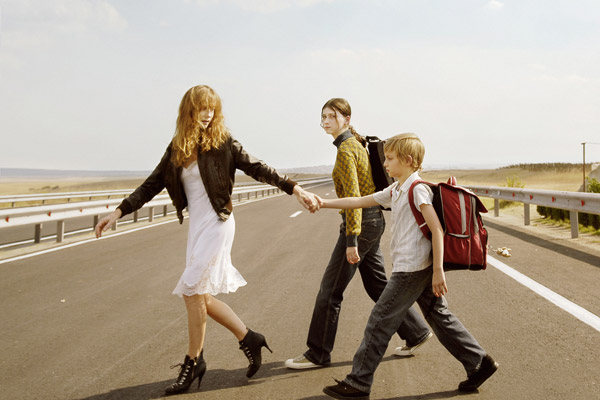
Home is a small, low key film, perhaps best described as a road movie that goes nowhere.  It has just five characters, and centres on a single location. A family - mother (Huppert), father (Gourmet) two teenage daughters (Leroux, Budd) and an eight-year-old son (Klein) - have spent ten years living at the side of an incomplete motorway.  Their lives are disrupted when, suddenly, the road is finished and opened to traffic.

That’s it, and that’s not much to hang 98 minutes on.  The story, such as it is, is hardly the most eventful but the film remains engaging because the five central performances are all outstanding.  Isabelle Huppert is a low-key actress, and in that respect Home suits her perfectly.  She doesn’t, on the face of it, have a lot to do here as a normal housewife and mother, but what’s impressive is how little she has to do to convince us of her role as matriarch.  There’s no sense of acting in Huppert’s work, if it weren’t for the fact that she looked so much like Isabelle Huppert it would be easy to believe that this is simply a middle aged woman whose work is as a stay at home parent.  Even as we learn more about Marthe, and that she may be less stable than she seems, Huppert still keeps everything small, subtle and completely real.  It’s a masterclass in being real on screen.

That’s not to say that the rest of the cast fail to match Huppert, indeed this is a true ensemble piece, because we have to believe in the dynamics of this slightly fractious family.  That ends up being one of the strongest suits of Home.  Ursula Meir has managed to find some remarkable young actors to play the children, none of them with much experience.  The dynamic between the three kids is utterly convincing, the way they shout over each other, fight, but ultimately seem to love one another is much more redolent of what family life actually feels like than what you usually see in movies.  There is also a strong chemistry between Huppert and Olivier Gourmet; the sort of affection between them that speaks of two people who have been together and in love for a very long time.  The way that the actors all gel holds what could easily have been a rather dull film together.

A lot of audiences won’t like Home, because they won’t be able to get past its uneventful nature.  Those people will miss out, because there is much to enjoy in the performances and in the beautiful imagery put together by Meir and DP Agnes Godard.  It’s surprising how attractive the film looks, given that it is set entirely on the verge next to a motorway.  It begins to lose steam in the last twenty minutes, when the tone changes quite sharply, but otherwise Home is a low key treat, if you’ve the patience for it.

Saturday, August 8, 2009

Review Post 38: Crossing Over / Coco Before Chanel

CROSSING OVER
DIR: Wayne Kramer
CAST: Harrison Ford, Ray Liotta, Alice Eve, Cliff Curtis,
Summer Bishil, Jim Sturgess, Justin Chon, Ashley Judd


Many fine films have been made over the years that are also political statements, but if you are going to make a political statement with a film you have to remember to make a film first and a political statement second.  With Crossing Over, Wayne Kramer fails comprehensively in this respect.

Kramer’s multi-stranded narrative is most clearly influenced by Paul Haggis’ comprehensively overrated Best Picture winner Crash.  Like that film Crossing Over's social and political comment - this time on the theme of immigration rather than race relations - lands with sledgehammer subtlety.  Some of that may be down to the fact that Kramer was apparently forced to heavily cut the film before its release, notably losing an entire strand featuring Sean Penn, and has apparently largely disowned this available cut.  However, it is hard to see how reintegrating yet another storyline into what is already an overstuffed and unfocused film would help.  Crossing Over suffers from having a multiplicity of targets, which reduces the subtlety that each story is able to employ and the impact each story is able to have.

Kramer isn’t a subtle director at the best of times, even his much lauded 2003 film The Cooler had passages that were almost operatically over the top, and his 2006 effort Running Scared started out at a fever pitch of action loaded insanity, and only got madder as it ran on.  The key difference between those films and this one is simple; they were engaging, and entertaining to watch.  The endearing lunacy of Running Scared is gone, replaced by a declamatory tone more suited to a lecture hall than it is a cinema.

Perhaps the most heavy-handed story involves Summer Bishil, who gives an exceptional performance given the limitations of the screenplay.  She plays a Muslim immigrant who writes an essay that seems to support the 9/11 hijackers and reads it out in her high school class; a decision that ends up tearing her family apart.  It’s not so much the story itself as it is the way that Kramer paints the opposing sides; immigrant family and immigration control, in broad black and white brush strokes.  This is a problem with the entire movie, there are few shades of grey.  Everyone is either good; mistreated and misunderstood (Bishil’s essay doesn’t actually support the hijackers, rather it suggests we should try and understand why the hijackers did what they did) or they are corrupt and disgusting (see Ray Liotta as an immigration official who extracts sexual favours from Alice Eve, in return for fast-tracking her a green card).

While this, and an extremely irritating recurring image of intertwining motorways (I GET IT, WAYNE), make the films and, by extension, Kramer’s politics easy to see it is not good storytelling.  Because the stories aren’t really being told for the sake of telling the stories as much as they are for the sake of making a point there is no room for nuance, or for any real imagination.  Each story advances almost entirely as you would expect it to - try and tell me what happens to the Korean youth (Chon) who gets involved, against his will, in a robbery the night before his naturalisation.  Tell me what happens to the immigration attorney who has forged a connection with a young African orphan.  Tell me what happens to the tearaway daughter (Melody Khazae) of a family of Iranian immigrants.  Tell me what happens to the young Mexican immigrant (Alice Braga) who an INS agent (Ford) tries to help.  You’re almost certainly right in every case.   This makes Crossing Over, as well as a preachy and ham-handed film, a very boring film.

The only real compensating factor in Crossing Over is the handful of strong performances, with several actors turning in work far better than the script deserves.  Liotta is appropriately slimy and objectionable, and Melody Khazae, despite very limited screentime, injects a little genuine light and life into what is a dour and downbeat film.  It is the aforementioned Summer Bishil who walks off with the honours here though.  She takes a character who is little more than a political mouthpiece and gives her layers, personality and emotion which almost certainly wasn’t there on the page.  Kramer over indulges - to an almost pornographic degree - in the wrenching emotion of the final act of that story, but Bishil’s conviction makes it play.

Sadly to go along with the poor screenplay and the over earnest direction, there are a lot of poor performances to endure as well.  Most notable is Harrison Ford, who has seldom sounded more completely bored, he delivers his dialogue as if he’s reading it from cards and on the verge of slipping into a coma.  Alice Eve, whose role is totally exploitative, and whose breasts receive almost as much screentime as her face is also notably bad, with an Australian accent which sounds cockney in her first scene, and goes through several other permutations during the film.

Someone called Crossing Over ‘liberal guilt, the movie’. That implies that, as a staunch liberal, I probably should have felt more sympathy towards it, but I didn’t go to the movies to be lectured, and that’s what Wayne Kramer delivers here.  It’s a shame, because he’s a talented and interesting filmmaker.  Hopefully his next film, Evilseek, will allow Kramer to return to making batshit insane and highly entertaining movies.


COCO AVANT CHANEL
[COCO BEFORE CHANEL]
DIR: Anne Fontaine
CAST: Audrey Tautou, Benoit Poelvoorde, Alessandro Nivola,
Emmanuelle Devos, Marie Gillain


My Mum and my step-dad will like this film, it’s very nice.

I, as anyone who has ever met me can attest, have less than no interest in fashion, and so I went into Anne Fontaine’s biopic knowing nothing at all about Coco Chanel.  Certainly this film gives you a decent overview of Chanel’s early life, but it feels so much a cookie cutter biopic that you have to question exactly how many liberties have been taken with the truth.  In particular one event, which comes near the end of the film, seems so much out of screenwriting 101 that, even if it is in fact true, it rings false in the context of a movie, and that is a problem that I felt in small doses throughout the film.

I like Audrey Tautou.  She’s too often seen as simply the gamine, but there are more layers, and more talent, there than she is often credited with.  At first it seems like her Gabrielle Chanel (the nickname comes later) might be the sort of simpering pixie that she’s played a few times since Amelie, but then we see the steel behind that façade.  That’s the strongest part of Tautou’s excellent performance.  It seems to be the film’s contention that Chanel was a woman out of step with her times, and Tautou really puts that across, delivering both a personality and a performance that is different in approach to any other in the film, especially those of the women.  The excellent Emmanuelle Devos and Marie Gillain give broader, and more exaggeratedly prim performances, Tautou’s style of acting is more modern and subtler. It’s a fine ensemble, and one that allows Tautou to really shine.

The problem is that the film doesn’t really take full advantage of this fine performance, this could have been a fascinating character study, but instead the film contents itself with surfaces.  As a result it ends up too light and fluffy a concoction to really engage on any deeper level.  The love triangle story falls a little flat because while Benoit Poelvoorde (as Chanel’s rich, older, lover) and Alessandro Nivola (as the handsome English businessman she wants to marry) are both individually fine neither shares much chemistry with Tautou, and there is little charge to even the more romantic, and more sexual, relationship with Nivola.  Since this is the central thread of the film it does mean that many scenes fail to really engage the attention completely.

As befits a film with this subject matter Coco Before Chanel looks quite ravishing.  The pixieish Tautou has never looked better on screen than she does here, especially when clad in Chanel’s famous women’s suits.  The design and the photography are uniformly strong and it would be neither surprise nor injustice to see costume designer Catherine Leterrier among 2010’s Oscar nominees.

Anne Fontaine’s work with her cast is strong, but her screenplay (written with her sister Camille) and storytelling is a little ragged round the edges.  The biggest issue is one of timescale, which is never clear in either writing or visuals.  After a brief sequence set in 1893 we flash forward fifteen years, but the rest of the film could unfold over as little as two years or as many as ten, and it would be nice to have some clarification for that.  I have a feeling that there is a better film, one less interested in chasing a 12A certificate, to be made about Coco Chanel.  This by no means a bad film, and most of its many cracks are papered over by the excellent Audrey Tautou, but while it’s not dull it’s also got an ever present and frustrating air of unfulfilled promise.

Thursday, August 6, 2009

John Hughes: 1950 - 2009


If you were a child of the 70's onwards, you knew, and almost certainly loved, several John Hughes movies. For me it was Home Alone, which came out when I was 9, and which I pretty much wore out a video tape of when I was 11. That was one of the many, many movies that Hughes wrote and produced, but he was perhaps best loved as the writer/directtor of 80's classics like Sixteen Candles, The Breakfast Club, Ferris Bueller's Day Off and Weird Science. If you were a teenager at some time in the last quarter of a century then this is a sad day.

On the morning of August 6th 2009, while out for a morning walk, John Hughes died of a sudden heart attack. He hadn't directed for 18 years, but was wtill active as a writer (under the pseudonym Edmond Dantes). His tragically early death robs cinema of a man whose films spoke to generation after generation of kids and teenagers. The good news is that those films will continue to be seen and enjoyed for years to come. Thanks John.

RIP

Tributes
Friends and colleagues of Hughes have been releasing statements in the wake of his death. Here's what they've had to say.
Matthew Broderick (Ferris Bueller's Day Off)
"I am truly shocked and saddened by the news about my old friend John Hughes. He was a wonderful, very talented guy and my heart goes out to his family."

Macaulay Culkin (Uncle Buck, Home Alone)
"I was a fan of both his work and a fan of him as a person, The world has lost not only a quintessential filmmaker, whose influence will be felt for generations, but a great and decent man."

Molly Ringwald (Sixteen Candles, Pretty in Pink, The Breakfast Club)
"I was stunned and incredibly sad to hear about the death of John Hughes. He was and will always be such an important part of my life. He will be missed – by me and by everyone that he has touched. My heart and all my thoughts are with his family now."


Site News: Facelift

I was hoping to get some reviews up today, along with a new List, but you'll have to wait until the weekend, because I've been busy making a lot of smaller changes to the site.

Youll see that the Cinema Viewings: 2009 sidebar is now much longer than it was, that's because most of the titles are now clickable, and will take you to the Review Post where you can read about that title. If you do that you should also notice that I've now got around to implementing a much more uniform look for the review posts, which should help the site flow just that little bit better. There are more little bits and pieces that I have to do, but I hope you like the results of this cosmetic work as much as I do.

That List (DVD Commentaries you NEED to hear) and five reviews should be coming on Saturday or Sunday. Until then, any comments or queries are welcome, as ever.

Tuesday, August 4, 2009

Review Post 37: The Taking of Pelham 123 / Rumba

THE TAKING OF PELHAM 123
DIR: Tony Scott
CAST: Denzel Washington, John Travolta, John Turturro,
James Gandolfini, Luis Guzman


Another week, another remake.  This is a new version of a 1974 film by Joseph Sargent. The central story is, apparently, much the same, but updated for a credit-crunched 2009.  Ryder (Travolta) and his gang (including Guzman) hijack a New York subway car and demand a $10 million ransom for their 19 hostages.  On contacting the rail control centre Ryder speaks to Walter Garber (Washington) and the two men become engaged in a game of cat and mouse when Ryder insists that Garber deliver the money himself.

The simplest way to review this film would be to find a .gif of someone shrugging, and just leave it at that, because that’s exactly how The Taking of Pelham 123 left me feeling.  I was perfectly entertained for a couple of hours, my attention never wavered and for most of the time I enjoyed watching this movie, but as soon as I stood up it was all but gone from my mind.  It meant absolutely nothing to me, left no lasting impression at all, and floated away on the breeze like so much ephemera.

It isn’t that The Taking of Pelham 123 is badly made.  It is executed with exactly the unfussy competence that you’d expect of a director who has been working and at a high level of success for over 20 years.  Since Enemy of the State Tony Scott has had a very particular aesthetic - cut heavy, full of different kinds of stock, unconventional angle choices and an ever-increasing barrage of imagery.  This style overwhelmed Domino, and he’s pulled back from it a bit here.  That’s not to say that this is some visually sedate chamber piece (which, actually, might suit the material better) just that Scott has reined in his worst excesses, making this feel more like a film rather than Domino’s bad acid trip aesthetic.

Because this is a big, expensive film, it has to be a star vehicle and you couldn’t ask for two more diametrically opposed star performances than those on display here.  Denzel Washington added quite a bit of weight to his usually trim frame to play Garber and he gives a deeply serious, committed performance, giving a real sense of Graber as a man, and as a deeply flawed hero.  Against this subdued, method driven display, there is John Travolta. Travolta plays Ryder as a panto villain. Travolta can do this brilliantly - see John Woo’s much underrated Broken Arrow for a masterclass in camp villainy - but here he seems rather disengaged, despite the enthusiastic bellowing of MOTHERFUCKER that punctuates almost his every utterance.

It is, perhaps, not entirely fair to blame Travolta for the shallowness of Ryder, because Brian Helgeland’s surprisingly shoddy screenplay gives him little to hang on to.  It brings in a backstory for Ryder, but only in the most perfunctory ‘look, we’re tying this movie in to contemporary news events, aren’t we clever’ sort of way. The rest of the characterization is extremely lazy, only John Turturro and James Gandolfini (as, respectively, a hostage negotiator and the Mayor) get more than a couple of lines and, great actors though they both are, they are never asked to play more than one note.  Shamefully the always excellent Luis Guzman has even less to do, his major contribution to the story being as an expositional tool.

The story progresses much as you’d expect it to, but it does so with some skill and a reasonable level of excitement, what’s missing is a real reason to care, or an action sequence high octane enough to really get the blood pumping.  It’s these twin issues that keep The Taking of Pelham 123 from being on the level of a Die Hard, or a Speed, but if you’re not looking to think for a couple of hours then there are definitely worse things out there than this stunningly average actioner.


RUMBA
DIR: Dominque Abel / Fiona Gordon / Bruno Romy
CAST: Dominque Abel, Fiona Gordon


For a little while now I’ve been complaining about comedy; about how I’ve found it to be too reliant on gross out, on cruelty and sometimes on bigotry and offensiveness of various stripes. Here’s the antidote to that.

Rumba is just 77 minutes long, and yet I laughed more, longer and harder during it than I had in the many hours of comedy cinema I’ve seen during 2009 combined.  It couldn’t be simpler; married schoolteachers Dom and Fiona (writer/directors Abel and Gordon) spend their spare time winning Latin dance competitions until, one night, they have car crash in which Dom loses his memory and Fiona loses her leg.  The way the two cope with this new situation is rendered in bold primary colours, which, in combination with the dexterous slapstick on display, make Rumba play like a live action Looney Tunes cartoon.

Rumba’s jokes couldn’t be accused of being groundbreaking or new (Dom and Fiona sit round a campfire singing, guess what happens to Fiona’s wooden leg) but they are executed so beautifully that that doesn’t matter.  Abel and Gordon show off great timing and dexterity in the unusually choreographed dance sequences, and they bring those skills to the almost entirely physical comedy sequences.  The camera is most often still, and far enough back to show us the performers full bodies allowing Abel and Gordon to let their physical performances tell the film’s story as well as providing the jokes.  There is such simplicity to Rumba that jokes that would feel corny in another movie here acquire a childlike charm, a feeling that permeates the movie, especially in Dominique Abel’s wonderfully vacant performance as the amnesiac Dom.

The bold colours and straight on, often static, camera angles give Rumba a very particular visual identity.  Simple, but not because of any ineptitude on the filmmakers parts, Rumba is so straightforward because there is just no need for it to be more complex.  More cutting wouldn’t add to the comedy or the story, so a lot of scenes play in single shots.  Close ups aren’t particularly good for showing action, so most scenes are in medium to long shot.  The only really show off moment is one when Dom and Fiona’s shadows have a dance sequence of their own, while their owners sit despondent about their disabilities and, again, this sequence only uses technology in a way that is necessary to advance the film.

I loved Rumba.  It is a completely innocent film, one that I would recommend for the entire family.  Even if you don’t like subtitles you should see this, because there are so few words in it that it could almost be silent (and would be almost as effective if it were).  The audience I saw Rumba with was small, but I haven’t felt as much warmth from a crowd toward a film in a long time, nor have I laughed so heartily for a while.  Go and see Rumba, don’t make me post it as a Why haven’t you seen…?

Sunday, August 2, 2009

News: 2/8

New Posters


Only / Motherhood / The Informant!
The Cabin in the Woods (x2)

Ridley Scott to direct Alien prequel
A script is currently being written by an, as yet, untested screenwriter named Jon Spaihts. We may not have seen anything from Spaihts yet, but studios sure seem to like him, and like him for sci-fi in particular. This is a prequel, but Variety says that Spaihts “won the job with an "Alien" reboot take that the studio and Scott loved.”
Of course the big news is, after years of discussion, and the recent suggestion that a commercial director named Carl Rinsch might take the helm, with Scott producing, that in the franchise’s 30th anniversary year, Ridley Scott has signed to return to the director’s chair for his first sci-fi film since Blade Runner. We’ll probably see the results of this deal some time in 2012.

Fantastic Mr Fox Trailer
In the same week that Wes Anderson’s Roald Dahl adaptation has been confirmed as the opening film for 2009’s London Film Festival the first trailer has emerged. I’m not entirely won over by it, but you can judge for yourselves here.


Send in the lawyers
Apparently there’s this franchise called The Twilight Saga, and it’s sort of a big deal, at least to teenage girls. It’s become a little more interesting in the last week, what with dueling reports from cast member Rachelle Lefevre and producers Summit Entertainment about Lefevre’s abrupt firing, and Bryce Dallas Howard being called in to play the character of Victoria in next year’s film Eclipse. You can read both statements in full here.
Lefevre says: ”I was stunned by Summit’s decision to recast the role of Victoria for Eclipse. I was fully committed to the Twilight saga, and to the portrayal of Victoria. I turned down several other film opportunities and, in accordance with my contractual rights, accepted only roles that would involve very short shooting schedules… Given the length of filming for Eclipse, never did I fathom I would lose the role over a 10-day overlap. I was happy with my contract with Summit and was fully prepared to continue to honor it. Summit chose simply to recast the part.”
While Summit replied with: ”We at Summit Entertainment are disappointed by Rachelle Lefevre’s recent comments which attempt to make her career choices the fault of the Studio. Her decision to discuss her version of the scheduling challenges publicly has forced the Studio to set the record straight and correct the facts… Ms. Lefevre took a role in the other film that places her in Europe during the required rehearsal time, and at least ten days of The Twilight Saga: Eclipse’s principal photography. This period is essential for both rehearsal time with the cast, and for filming at key locations that are only available during the initial part of production.”
This much more entertaining than Twilight

BBFC Decisions

Inglourious Basterds [strong bloody violence]
Chiko [very strong language, strong bloody violence & hard drug use]


Home [one use of strong language and strong nudity]
Rage [strong language]
Mesrine: Public Enemy No. 1 [infrequent strong bloody violence, strong language and sex]
The Informant! [strong language]


The Time Traveller’s Wife [brief sight of bloody injury and scenes of emotional distress]
The Yes Men Fix the World [one use of strong language]

On DVD Monday

It has been confirmed that the UK DVD release will use the original theatrical subtitles, not the simplified ones prepared for the initial US DVD release.

At Cinemas Friday


Adam / GI JOE: The Rise of Cobra / Mesrine: Killer Instinct
Orphan / The Ugly Truth / The Yes Men Fix the World